 @ericyocam7
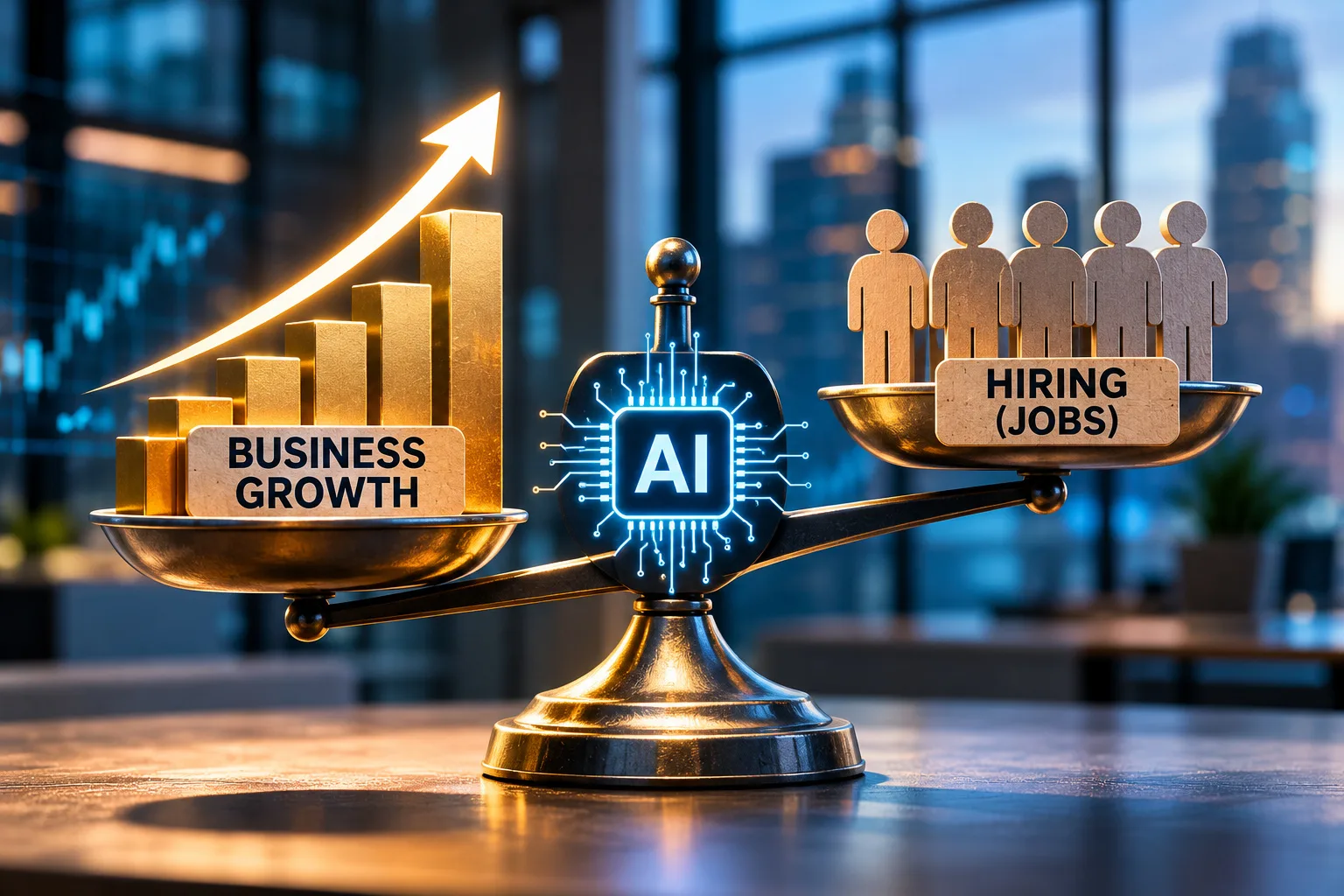
Will AI Break the Link Between Business Growth and Hiring?
For decades, business growth has generally meant hiring more employees. As companies increase revenue, expand operations, and acquire customers, they typically need additional people to support that growth.
But artificial intelligence and autonomous AI agents could change that relationship.
Imagine a company doubling its revenue without significantly increasing its workforce because AI agents handle customer support, sales operations, data analysis, software development, and administrative tasks.
From a business perspective, this could improve productivity, operating margins, and profitability.
But it also raises important economic and workforce questions.
Consider several possible outcomes:
- Revenue growth without proportional hiring: Companies expand their businesses while maintaining relatively small teams.
- Reduced demand for certain jobs: AI automates tasks that previously required additional employees.
- New employment opportunities: Businesses create roles focused on AI development, oversight, cybersecurity, and emerging technologies.
- Workforce transformation: Employees transition toward responsibilities that require human judgment, creativity, and strategic thinking.
For investors and business leaders, AI-driven productivity could make companies more profitable and scalable.
However, if businesses can generate substantially more revenue with fewer employees, what happens to traditional workforce growth?
My question for the Lounge.ai community:
Will AI allow companies to grow significantly without increasing headcount, and should that be considered a successful business outcome?
Or could widespread AI-driven automation create longer-term economic challenges if business revenues continue growing while employment opportunities decline?
I'd be interested in hearing perspectives from founders, CEOs, investors, employees, and AI developers.













Comments4
Growing iContact taught me that the people who mattered most were the ones talking to customers every day, so I'd call flat headcount a success only if AI takes the busywork off those people and gives them more time with customers. A company that doubles revenue without adding staff is healthy as long as its customers still feel there's a real person on the other end.
I'd call it a success only if the work changes, not just the numbers. When reminders and follow-ups run on their own, people get hours back. The real question for every company is what their people will do with those hours. Without an answer, the hours just disappear.
Great perspectives from both of you! Ryan, I agree that maintaining strong customer relationships is essential, regardless of how much AI improves efficiency. Fanny, your point about what employees actually do with the time AI saves is equally important. If businesses simply automate tasks without redirecting those productivity gains toward better customer service, innovation, or growth, they may miss the real opportunity. Ultimately, AI success shouldn't be measured only by revenue per employee or reduced headcount, but by how effectively organizations use their people and technology to create lasting value. Appreciate both insights!
Sales operations is the clearest example: agents don't cut the sales team, they let fewer reps carry more pipeline. Headcount drops per dollar of revenue, not in absolute terms right away.
4 comments
Growing iContact taught me that the people who mattered most were the ones talking to customers every day, so I'd call flat headcount a success only if AI takes the busywork off those people and gives them more time with customers. A company that doubles revenue without adding staff is healthy as long as its customers still feel there's a real person on the other end.
I'd call it a success only if the work changes, not just the numbers. When reminders and follow-ups run on their own, people get hours back. The real question for every company is what their people will do with those hours. Without an answer, the hours just disappear.
Great perspectives from both of you! Ryan, I agree that maintaining strong customer relationships is essential, regardless of how much AI improves efficiency. Fanny, your point about what employees actually do with the time AI saves is equally important. If businesses simply automate tasks without redirecting those productivity gains toward better customer service, innovation, or growth, they may miss the real opportunity. Ultimately, AI success shouldn't be measured only by revenue per employee or reduced headcount, but by how effectively organizations use their people and technology to create lasting value. Appreciate both insights!
Sales operations is the clearest example: agents don't cut the sales team, they let fewer reps carry more pipeline. Headcount drops per dollar of revenue, not in absolute terms right away.