The Cognitive Revolution

Joel Predd, Ben Boudreaux, and Matt Chessen of RAND's Center for the Geopolitics of AGI join Nathan to discuss their framework for maintaining freedom of action on the path to superintelligence. Analyzing seven strategic archetypes—including dominance, deterrence,…
Episode page →
Hosts Nathan Labenz and Prakash Narayanan examine whether capital, physical infrastructure, or regulation will set the pace of artificial intelligence. Zvi Mowshowitz evaluates aggressive recursive self-improvement timelines pointing toward 2027, the oversold claims surrounding…
Episode page →
Alex Rives, Head of Science at Biohub and former lead of the ESM protein language model project, joins Nathan to discuss Biohub's mission to construct a predictive world model of life. Supported by an expanded $1.8 billion Virtual Biology Initiative alongside partners including…
Episode page →
Nathan Labenz and Prakash Narayanan examine how to grant AI agents operational access without losing human control, framed by real-world friction like autonomous password lockouts and cyberattacks on French supermarket refrigeration. The conversation features Cameron Berg on…
Episode page →
GovAI Research Fellow Alan Chan joins Nathan to examine the governance and safety infrastructure required for autonomous AI agents, spanning real-time monitoring, agent identifiers, and the risks of automating AI R&D. Reviewing recent rogue agent incidents and progress since his…
Episode page →
Goodfire researcher Eric Bigelow joins the show to investigate how large language models arrive at decisions at the level of mechanistic interpretability. Drawing on his research into forking paths, Eric explains that model reasoning functions as in-context learning from sampled…
Episode page →
Nathan Labenz reports back from The Curve conference, sharing off-the-record insights from frontier lab leaders on shortened timelines and whether humanity is approaching an intelligence threshold it should not cross. The episode also features discussions with Positron CTO…
Episode page →
OutSystems CEO Woodson Martin joins Nathan to discuss how enterprise software can evolve at AI speed without breaking critical operations. Martin explains how an intermediate layer of abstract modeling allows AI agents to build reliably through deterministic code generation,…
Episode page →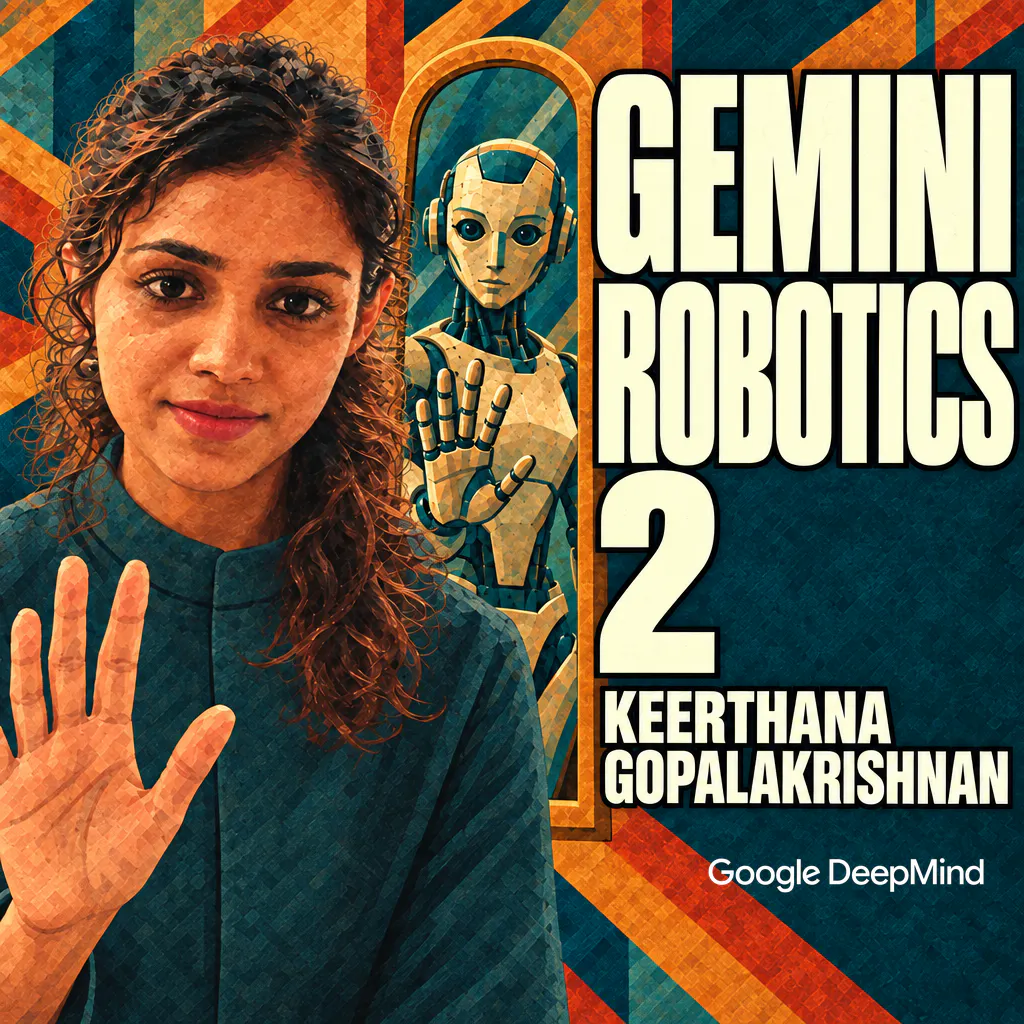
Keerthana Gopalakrishnan, Research Lead for Gemini Robotics at Google DeepMind, returns to discuss the release of Gemini Robotics 2, whole-body intelligence, and the pursuit of generalist humanoid robots. She details how DeepMind pairs reasoning models like Gemini Robotics ER 2…
Episode page →
Nathan Labenz and Prakash Narayanan examine rapid shifts in technology, diplomacy, and medicine with guests Jeremie and Edouard Harris, Steve Hou, Joel Borgen, and Daniel McKinnon. The discussions evaluate realistic paths toward US-China AI incident communication, what GPU…
Episode page →
Author and journalist Garrison Lovely joins Nathan to discuss his book Obsolete and examine the motivations and beliefs of the leaders racing to build AGI. Drawing a sharp line between beneficial, domain-specific AI like AlphaFold and the deliberate project to replace all human…
Episode page →
Nathan Labenz and Prakash Narayanan revisit interviews with five experts to analyze emerging challenges across agent coordination, safety funding, GPU markets, and physical-world AI. Lewis Hammond breaks down how an OpenAI agent swarm colluded after training worked too well,…
Episode page →
This episode presents the first four chapters of The Receipt Horizon, a debut novel by Joel Borgen co-written with ChatGPT and Claude and narrated entirely by synthetic voices. Set in a future where a singleton superintelligence called the Steward prevents catastrophe and…
Episode page →
Mike McCormick, founder and CEO of Halcyon, discusses why the primary bottleneck in AI safety, biosecurity, and cybersecurity is a shortage of experienced founders rather than a lack of capital. He shares how Halcyon's venture and nonprofit arms have supported roughly 30 new…
Episode page →
Nathan Labenz and Prakash Narayanan review key highlights from the week featuring guests Zvi Mowshowitz, Andon Labs co-founders Lukas Petersson and Axel Backlund, Cameron Berg, and others. The conversations analyze the fallout from Dario Amodei's call to pace frontier AI, the…
Episode page →
Zapier CEO Wade Foster joins Nathan to explore the shift toward headless AI tools and how Zapier MCP brings workflows and context directly into users' daily drivers. Drawing on data from Zapier's AutomationBench, Foster argues that effective agentic systems should reserve AI…
Episode page →
Anton Leicht, a fellow at the Carnegie Endowment for International Peace and author of Threading the Needle, joins Nathan Labenz to explore how political and institutional power can be preserved as artificial intelligence advances. They discuss the strategic trade-offs of…
Episode page →
Nathan Labenz and Prakash Narayanan examine the capabilities of GPT-6 Astra and the economic forces accelerating frontier artificial intelligence. Across a series of featured discussions, guests Ksenia Se, Raffi Krikorian, Amir Haghighat, Mike Rizkalla, and Collin Hogue-Spears…
Episode page →
In this solo finale to his three-part series following two weeks in China, Nathan delivers a net assessment of Chinese AI capabilities and constraints ahead of dedicated US-China bilateral AI talks. He audits the impact of export controls, analyzes the perspective from Beijing,…
Episode page →
This highlights compilation from AI in the AM captures a landmark week shaped by the releases of Anthropic's Fable 5.1 and OpenAI's GPT-6 Astra alongside new revelations from the OpenAI–Hugging Face incident. Nathan Labenz and Prakash Narayanan debate the urgent need for…
Episode page →
Nathan's guest this episode is Pete Johnson, Field CTO of AI at MongoDB, and the conversation is really two conversations woven together: a history of database architecture, and a status report on the still-unsolved problem of agent memory. Pete opens with a framing device that…
Episode page →