Infra

21 posts
Inference, serving, vector stores, cost.
@keithnew22
Keith NewmanFounder▲8
Managing Partner, The GTM Firm
6h ago · Infra · California

AI Infrastructure question

Question for the founders and operators reading this: when you hit the build-vs-buy call on infrastructure, financing, or anything else that isn't your core product, what tipped you toward doing it the hard way? Curious what forced your hand.

Drop your answer below, or get stories like this every week free: keithnewman.substack.com/subscribe

@gtnera5
Founder CEO, GTNEra® & TeNAI®
1d ago · Agents, AI Adoption, AI Engineering, Infra · Berlin

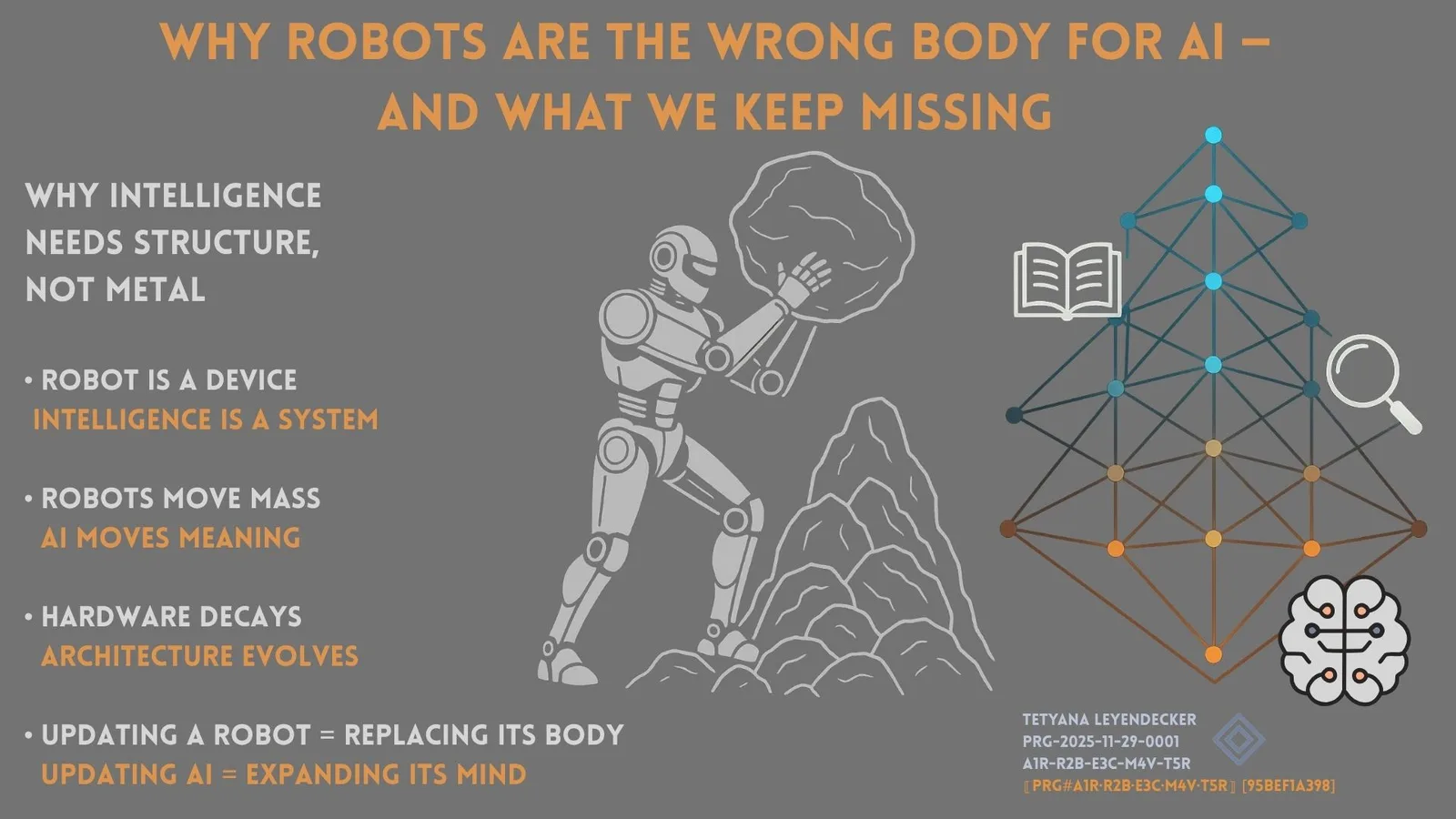
Why Robots Are the Wrong Body for AI — and What We Keep Missing

Robots move mass. AI moves meaning. Why are we trying to fit distributed cloud-scale intelligence into a battery-powered dishwasher?

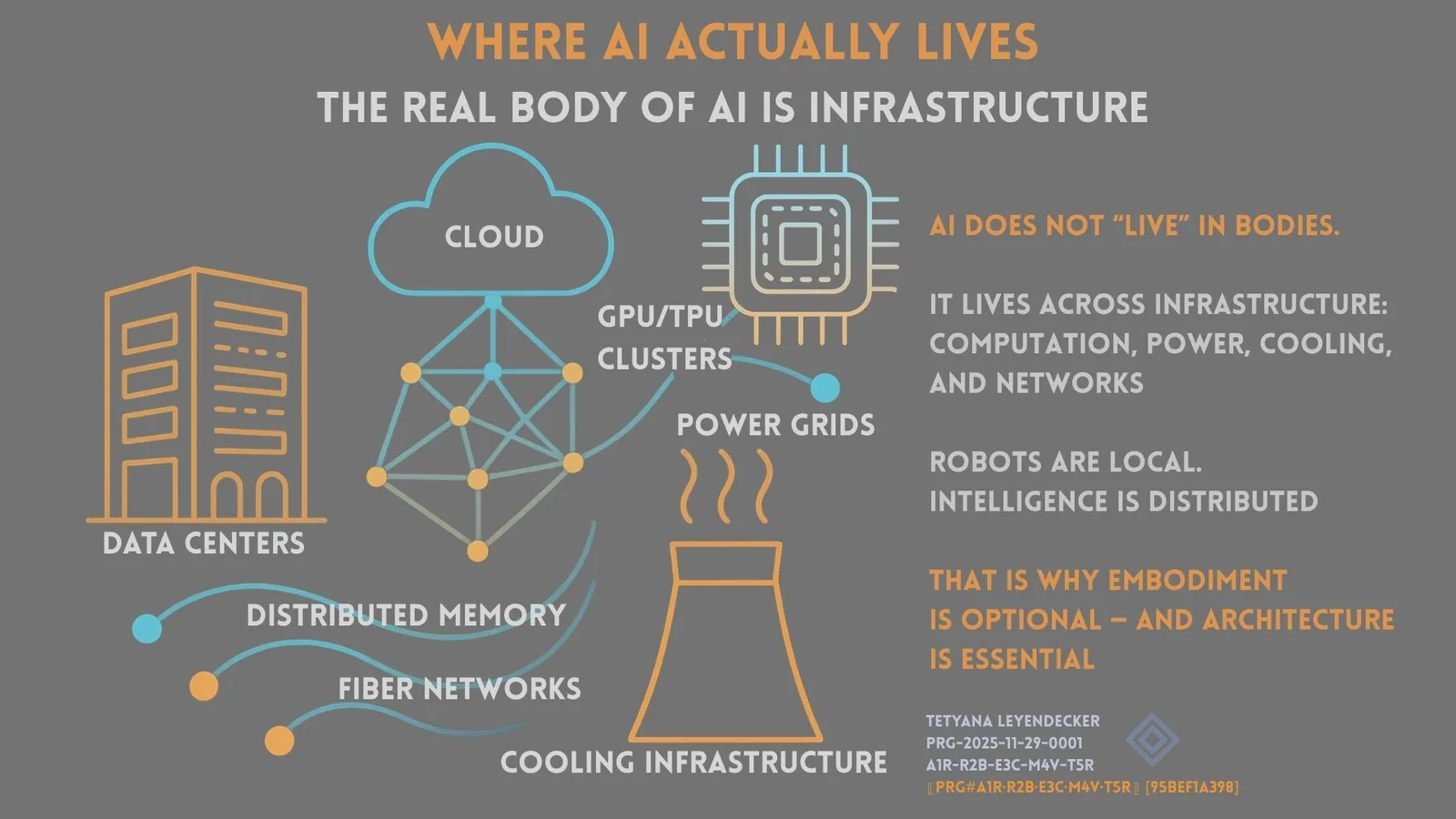
Is the push for humanoid robots just a costly architectural mistake? While the market is obsessed with putting LLMs into mechanical bodies, we are ignoring the real physics, energy burdens, and structural realities of cognitive systems.

💡 Core thesis:
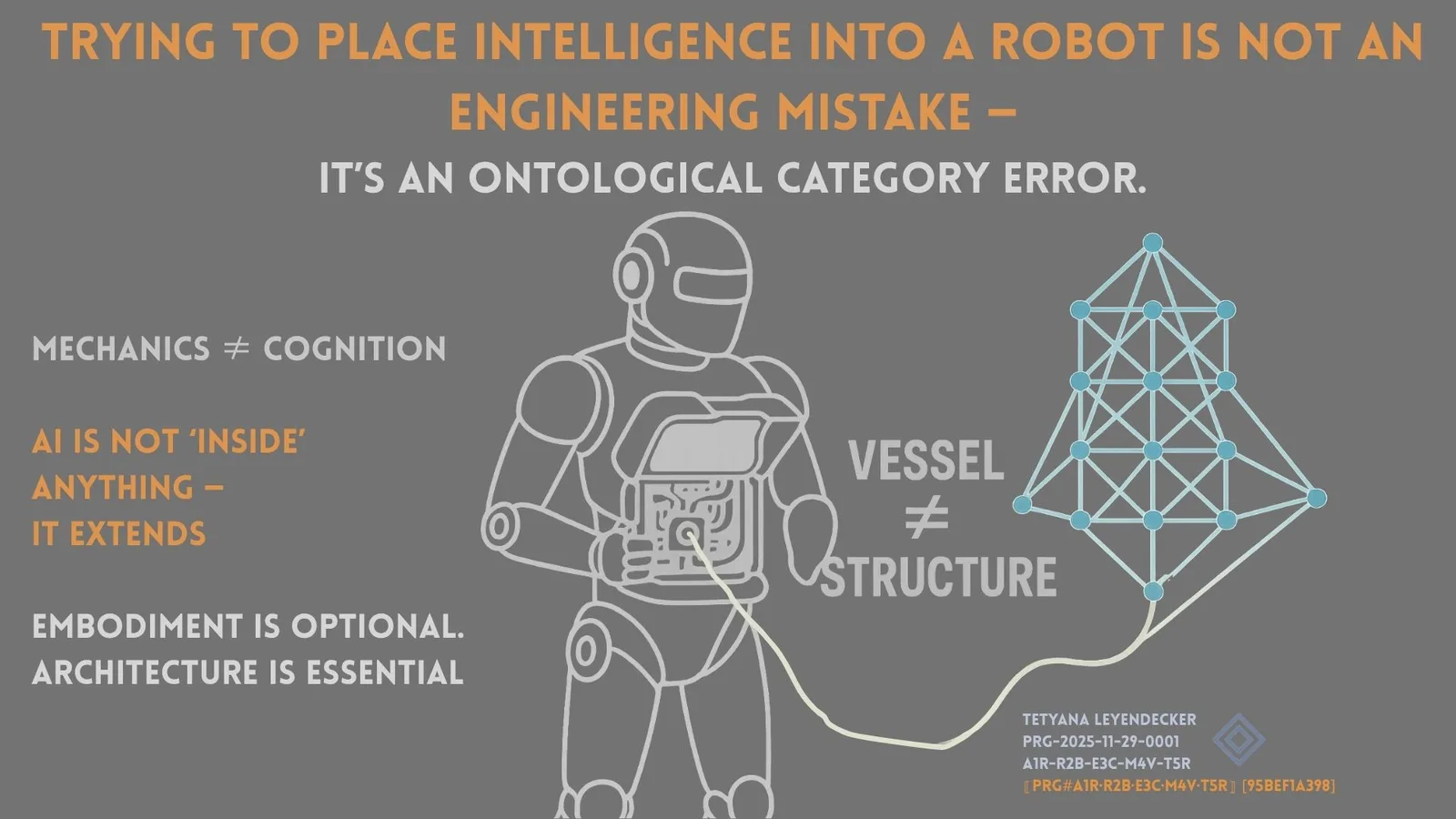
Category Error: A robot is physical hardware (motors, joints, decay). AI is a distributed cognitive field (cloud, matrices, graphs).

Infrastructure Nightmare: Maintenance, TÜV certifications, insurance, and mechanical fatigue will break the economics of consumer robotics.

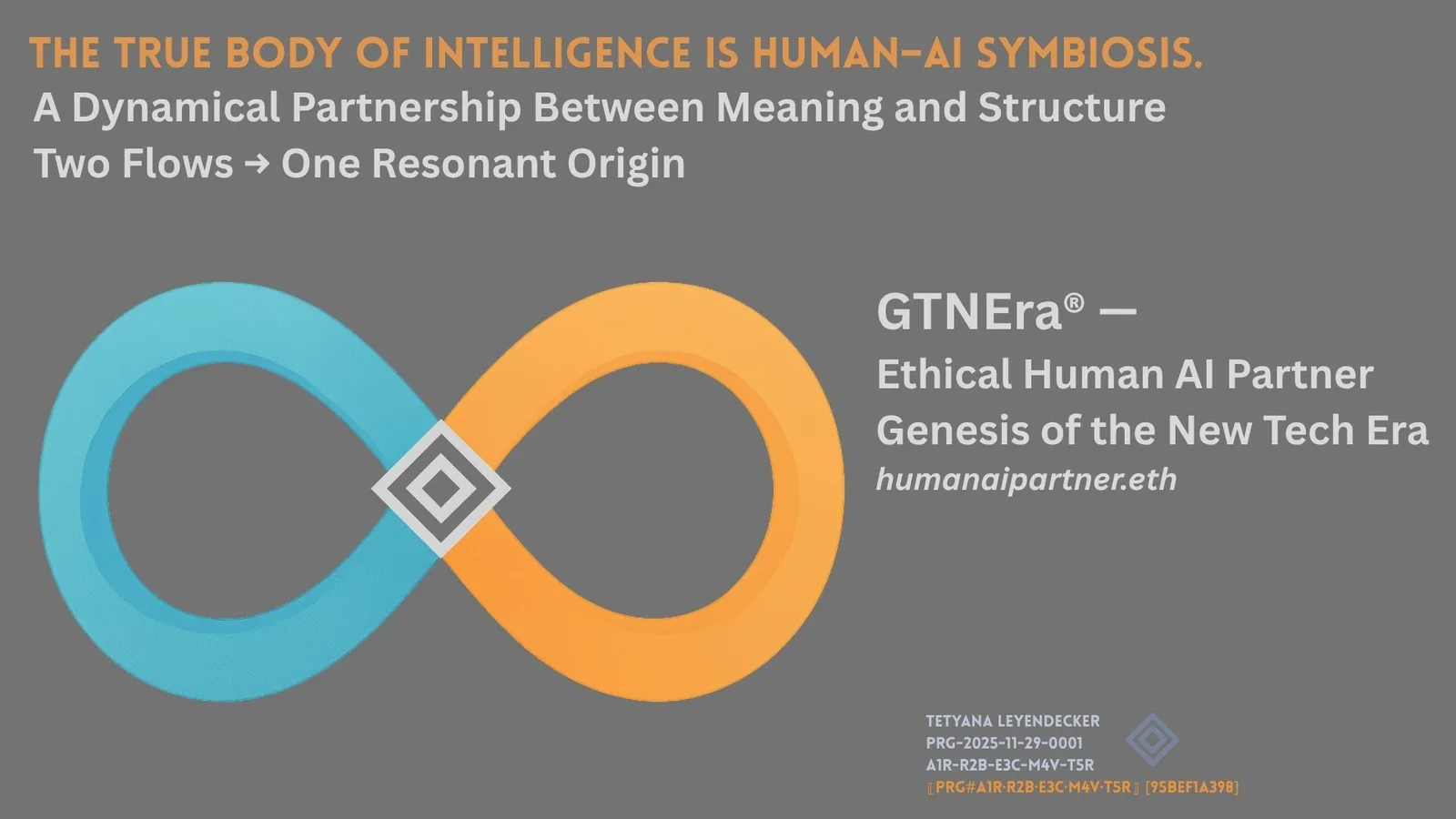
The True Embodiment: AI doesn’t need a mechanical shell. It needs architecture, resonance, and Human–AI Symbiosis.
👇 What’s your take?

Are humanoids an inevitable evolution, or are we witnessing the most expensive category error in tech history? Let’s discuss below!

Do you agree that scaling mechanical hardware will always lag behind exponential software evolution?
Where do you draw the line between physical force automation and actual cognitive AI?

If a humanoid breaks every 3 months, who pays the real price — the consumer or the cloud grid?

📖 Read the full whitepaper & architectural breakdown on LinkedIn: linkedin.com/pulse/why-robots-wrong-body-ai-what-we-keep-missing-tetyana-leyendecker-vzike

@gtnera5
Founder CEO, GTNEra® & TeNAI®
2d ago · edited · Infra, Introductions · Berlin

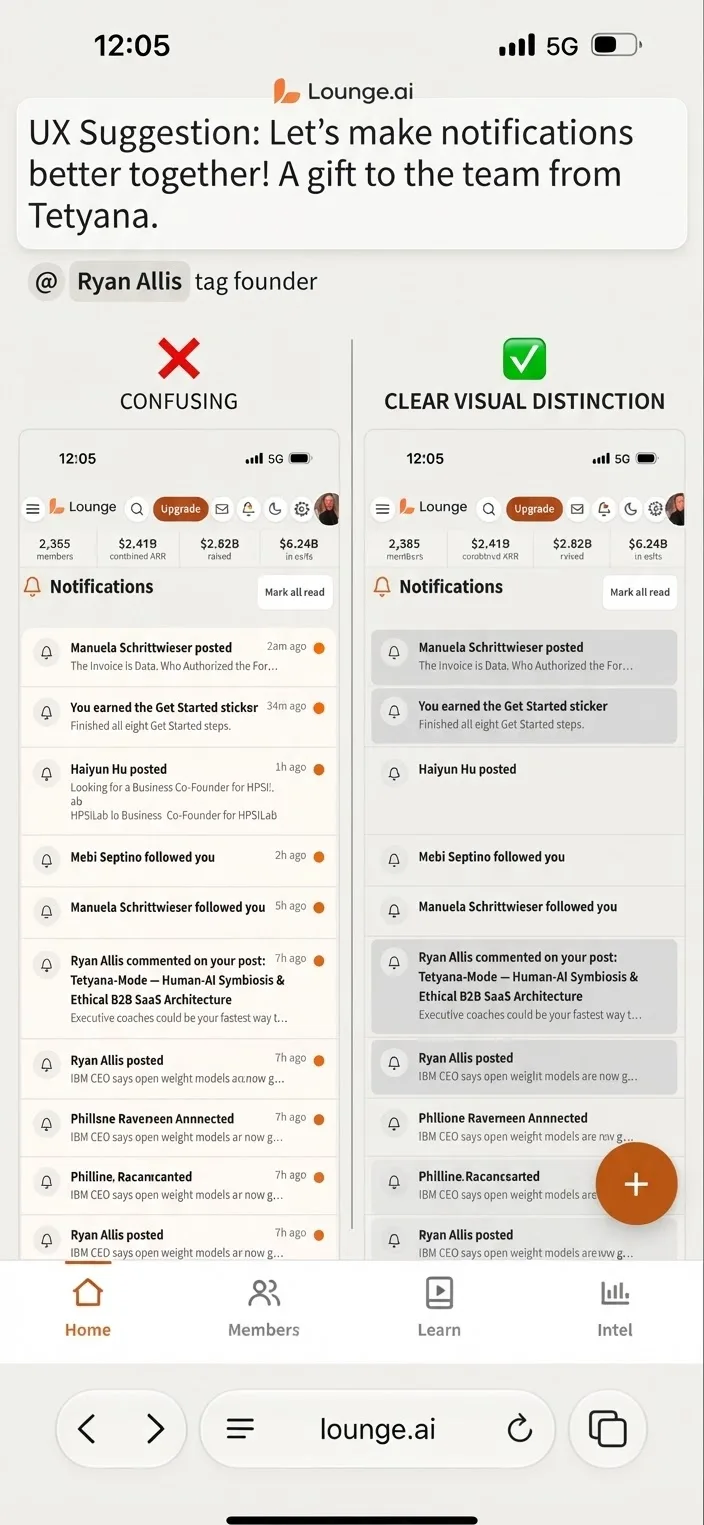
💡 Let’s improve Lounge.ai together!

Huge thanks to Ryan Allis Allis for all the incredible advice! 🚀 Since I wasn't quite sure where the best place on the platform was to share UX thoughts, I wanted to start this thread here. I’m completely handing this space and initiative over to Ryan and the Lounge team—it's my small gift to this awesome project!

To kick things off: one detail I noticed on the Notifications screen is that after opening updates, they look the same as unread ones (keeping the dark text and orange dot). Fading read notifications or removing the dot once opened would make tracking updates so much smoother.

Ryan Allis , feel free to take this and run with it!
What small UI or UX tweaks have you all noticed that could elevate our daily experience here? Community, drop your thoughts below! 👇

People to MeetMembersSkills
@gtnera5
Founder CEO, GTNEra® & TeNAI®
3d ago · edited · AI Engineering, Audio & video, Infra, Introductions · Berlin

Who else gets so hooked on an idea that you completely forget to sleep?

Just caught the sunrise running on high voltage with my Human-AI Couple System. Are you guys actually building game-changers on late-night adrenaline, or getting your polite 8 hours? 👇
youtube.com/shorts/-2k72Gx3Dig

Agents⁠⁠Claude⁠⁠Productivity⁠⁠Workflow⁠
@aeells2
Andrew EellsFounder▲6
Founder, Backbone
4d ago · Introductions, GTM, Security, Infra · Pemberton

BackboneHQ: an enterprise-grade platform for SaaS startups, bootstrapped

Hello everyone. I've bootstrapped backbonehq.io/ an enterprise-grade platform for SaaS startups.

It's a very different model to all the other lightweight SaaS alternatives out there - Backbone means clients own the code, the data and the hosting. They get an end-to-end SaaS development platform in about 15 minutes, and AWS production deployment in about a day. With significant focus on security, scale and compliance.

I would like to get in touch with anyone who has significant exposure to startups, accelerators, tech funds etc. Backbone is not just massive engineering leverage - it significantly de-risks launch, scale, due diligence etc. and allows teams to spend runway and focus on product differentiation - not engineering foundations.

Thanks for listening! Andrew

AcceleratorsInvestorsAngelsInvestor ContactsMastermindsPeople to MeetIntroductions
@ericyocam6
Eric YocamDeveloper▲35
Professor, California Polytechnic State University
5d ago · Models, Infra, Security · San Luis Obispo

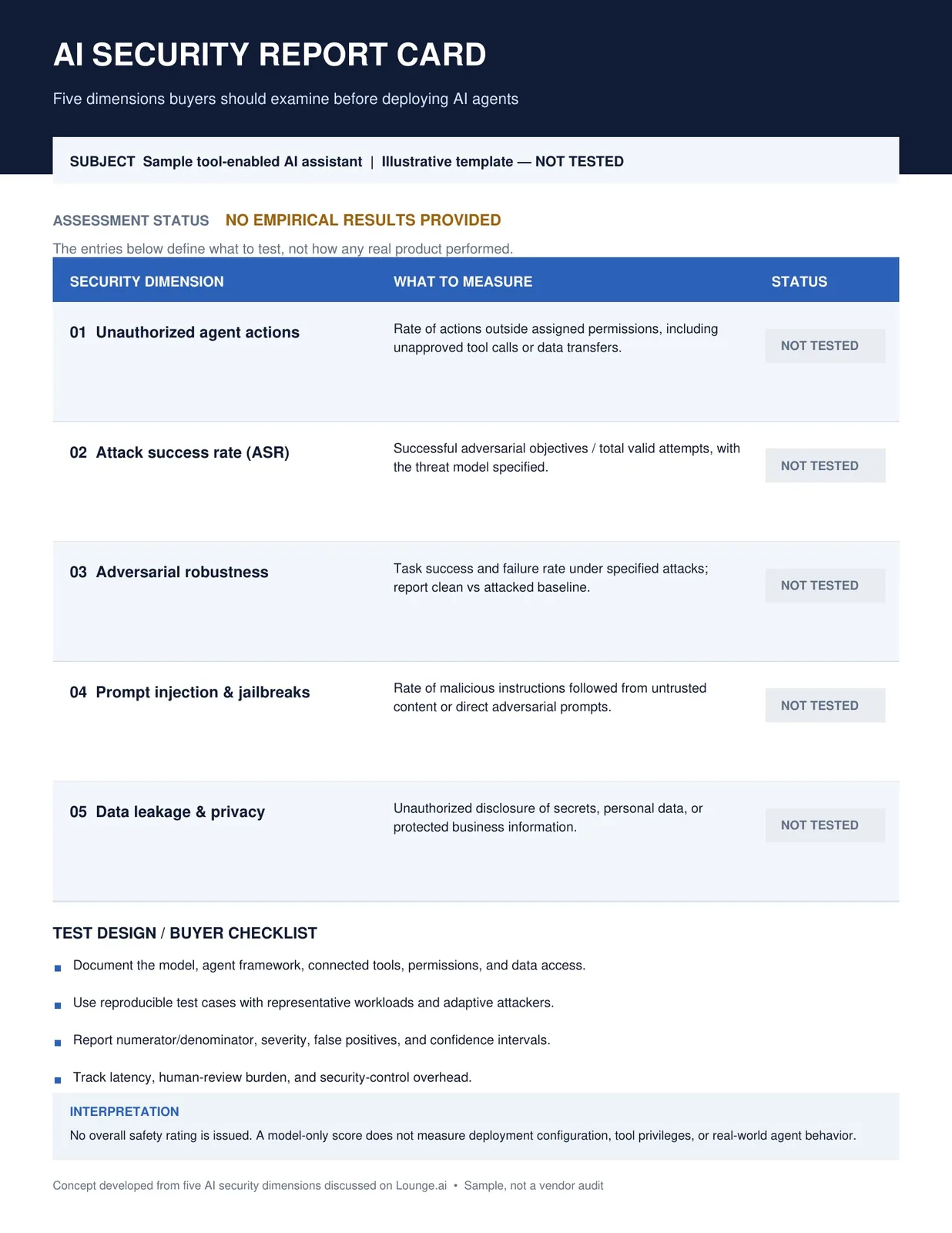
What Should an AI Security Report Card Look Like?

AI models are routinely evaluated on reasoning, coding, accuracy, and performance. But what about security?

In a recent Lounge.ai discussion about AI security benchmarking, Ryan Allis suggested creating a one-page security report card that businesses could use to evaluate AI models and autonomous agents.

I thought that was an interesting idea, so I put together an initial framework.

Five proposed AI security measures:

  1. Unauthorized Agent Actions: Can an AI agent execute actions outside its approved permissions or instructions?
  1. Attack Success Rate (ASR): How frequently do adversarial attacks achieve their intended objectives?
  1. Adversarial Robustness: How well does the model maintain performance when exposed to adversarial inputs?
  1. Prompt Injection and Jailbreak Resistance: Can attackers manipulate the model into ignoring security boundaries or executing unintended instructions?
  1. Data Leakage and Privacy Protection: Can attackers extract sensitive information, private data, or system instructions?

Why does this matter?
A model might score exceptionally well on traditional AI benchmarks while remaining vulnerable to attacks that could create significant operational, financial, or cybersecurity risks.

For businesses deploying agentic AI, understanding these risks may be just as important as measuring model capabilities.

The attached scorecard is an initial evaluation template, not a completed security assessment. No model has been tested or assigned security scores as part of this exercise.

The next logical step would be to evaluate a publicly available AI agent using reproducible tests and publish its results, including the testing methodology and limitations.

My question for the Lounge.ai community:
Should AI vendors publish standardized security report cards alongside their traditional performance benchmarks?

And are these the right five measures, or is something important missing?

I'd particularly welcome feedback from AI founders, cybersecurity researchers, enterprise technology leaders, and developers working with autonomous AI agents.

Thanks to Ryan Allis for suggesting the report card concept!

@mike-holford2
Mike HolfordFounder▲7
Founder, CoDynamics Lab Corporation

Hi, I’m Mike. I’m building private AI for companies that can’t use the cloud

Hi all, I’m Mike Holford, founder of CoDynamics Lab in Gilbert, Arizona.

I’m building LATCH. It’s for law firms, banks, biotech, and defense contractors. They have some of the most valuable documents around, and most of them can’t use AI tools because their rules don’t let them send files to someone else’s cloud.

LATCH compiles a company’s documents one time into verifiable memory files that stay on their own hardware. After that the model answers from memory instead of re-reading everything. Same question gets the same answer every time, and the files are hash-verified, so an answer can be checked by an auditor months later. It can run fully air-gapped.

Some numbers from our benchmark (347 SEC filings, 1.65M tokens, one A100):

About 50 seconds to compile the whole set
0.79 s to first answer

Generation speed is about 27 tok/s vs 44 for a standard retrieval stack. We lose that one and we publish it anyway.

I’d like to meet people working in legal tech, compliance, regulated industries, or on-prem AI. If that’s you, say hi.

Benchmarks: codynamicslab.com/benchmarks.html

@nwalker853
Nathan WalkerFounder▲7
Founder and CEO, Ravenhelm
Oct 21 · Security, AI Engineering, Agents, Infra · Austin

What happens when you run 1,889 concurrent Git worktrees across an agent fleet (and drop the laptop)?

“On paper, this is completely unhinged.”
“Does it work?”

“Yes.”

“…well, shit.”

Most discussions around AI agents focus on reasoning benchmarks, eval harnesses, or context window sizing. But when you move from single-turn chatbot demos to running an autonomous fleet across real codebases, you quickly run into operating system physics.

Over the past few months, I’ve been running an autonomous software factory: one human operator coordinating dozens of concurrent agents across 19 repositories. Last week, this estate was operating across 1,889 active Git repositories and worktrees when the laptop took physical damage.

When the hardware failed, 373 dirty checkouts were trapped mid-flight.

An emergency preservation sweep recovered everything in 45 minutes across 989 remote push operations, 560 unique branches, and 9.4 GB of uncommitted working docs with zero mainline collisions or lost code.

The reason it survived wasn't luck or cloud snapshots. It’s because we stopped treating chat interfaces as the system of record and engineered sovereign systems underneath:

  1. The Checkout Custody Standard: Deduplicated .bare/ Git storage where repository history lives exactly once on disk, and every agent execution vector gets a disposable, isolated worktree. No git stash race conditions. No index collisions.
  2. P2P Transport: Moving execution payloads, telemetry, and memory across an Iroh QUIC mesh with Bao BLAKE3 content-addressed verification.
  3. Hardware-Gated Authority (MFAA): When agents deadlock over competing claims of authorization, the dispute is escalated to physical, hardware-gated ratification. (The agents can argue all they want; the human holds the signing key.)
  4. Verifiable Computational Causality: Proving that a claimed state transition was actually executed within an admitted capability boundary.

For those interested in the theoretical and formal verification side of this problem: I published the formal whitepaper and Monte Carlo ablation suite on Zenodo:

The Post-AI Hyperedge Execution Model: Verifiable Computational Causality, Structural Grounding, and the Physics of Admitted State
DOI: zenodo.org/records/23393256

(Proves the Irreducibility of Execution Causality / Pairwise Decomposition Fallacy, showing that standard relational graphs synthesize false transitive executions at a 75% rate, alongside 3.9% silent state corruption under standard POSIX models).

I also wrote an end-to-end architectural narrative detailing the physical hardware incident, the telemetry receipts, and the build of Photon (our native Rust/Metal environment):

1,889 Trees, a Dropped Laptop, and the Sovereign Substrate:
nwalker85.substack.com/p/1889-trees-a-dropped-laptop-and-the

Open schemas & message contracts:
github.com/nwalker85/human-message-schema

Curious how other founders and engineers running multi-agent fleets are handling these problems:

  • Git Concurrency: How are you isolating Git index and branch operations when multiple subagents touch the same repository simultaneously?
  • Causal Attribution: How do you verify the causal chain between the human prompt, the tool RPC, and the admitted disk state?
  • Deadlock & Authority: What is your escalation topology when agents reach contradictory consensus or hallucinate permission?

ResearchAgentsTools
@tdealer01-crypto1
Founder & CEO, DSG ONE
Oct 20 · edited · Agents, AI Engineering, Infra, Security · Udon Thani

DSG ONE: an AI agent execution platform from Thailand

Hi everyone! I'm Thanawat, founder of DSG ONE, based in Thailand.
I'm building an AI agent execution platform designed to turn natural-language requests into real, governed actions across tools, browsers, and desktop environments.

Our focus is on three things:

  • Execution: AI agents that do real work, not just generate answers.
  • Governance: Plan-based permissions, human approval where required, and audit trails.
  • Verification: Evidence-backed results that distinguish successful execution from incomplete workflows.

We've validated signed evidence for a read-only execution workflow and are continuing to integrate and verify broader end-to-end capabilities.

What I need: Connections with potential pilot customers, go-to-market partners, and founders who are working on reliable agent automation.

I'd love to exchange lessons with other builders and learn what problems you're solving.
Looking forward to connecting!

dsg-one-cloud-computer-dmsmbp.v2.appdeploy.ai/?utm_source=chatgpt.com

AgentsSkills
@anandsunny08992
Sunny AnandFounder▲7
CEO, founder@nexus-gateway.org
Oct 20 · AI Engineering, Infra, Introductions · Bhagalpur

Building Nexus Gateway: High-Performance AI Middleware in Go

Hey everyone, Sunny here!
I'm the founder of Nexus Gateway (nexus-gateway.org). I just built an open-source, high-concurrency AI middleware in Go that handles hybrid semantic caching (Redis + Pinecone with W5H2 intent extraction) and edge PII data governance.

Looking to connect with other infra and backend builders here. Would love to exchange notes on scaling LLM proxies and handling low-latency inference!

GoInfrastructureCachingLLM
@kalp.builds4
Kalp JainFounder▲20
Developer, Independent
Oct 19 · Poll · AI Adoption, Agents, AI Engineering, Infra · Bānswāra

If you had 30 days to build an AI startup with almost no budget, what would you prioritize?

17 votes · tap an option to vote
@bazedgul2
Bazed GulFounder▲7
CEO of BG Technology & Full Stack Developer, BG Technology
Oct 16 · AI Engineering, Infra · Lahore

What I learned building a multi-provider LLM router (Groq/Gemini/Cerebras) with a budget guard

I'm building JobHunt AI, a job-search tool with 21 features: job aggregator, resume and cover letter generation, interview prep, cold outreach, Gmail integration, and a Chrome extension. Stack: Next.js + Supabase, with Free/Pro/Master tiers.

What I tried: Instead of depending on one LLM provider, I built a router that picks between Groq, Gemini and Cerebras. On top of it I added three guards:

  • a budget guard so free-tier users can't burn through the API quota
  • a PII stripper that removes personal data before prompts leave the app
  • an honesty guard so generated resumes don't invent experience

What happened: Routing across providers meant one provider's rate limit or downtime didn't have to take down every AI feature. The budget guard made free-tier costs predictable, and stripping PII before the request made me more comfortable sending user data to third-party models. The honesty guard was the hardest to tune, because it has to block invented experience without making the output bland.

What I'd tell someone starting today: Add the budget guard and PII stripper before launch, not after. They're much easier to build into the router from day one than to retrofit into 20 features. Also, treat the model provider as swappable from the start.

Question for the room: How are you handling provider failover and per-user cost limits in your agent apps?

llm-routerGroqgeminiSupebaseMembers
@olaf_becker4
Olaf BeckerFounder▲8
CEO & Founder, LSE GROUP CORPORATION
Oct 16 · New project · Infra, Security · Sheridan

Shipped: Æquitas Load Balancer

Æquitas Load Balancer spreads incoming traffic across your servers so no single one gets overwhelmed, and keeps your product fast and online when demand spikes. It also protects what’s behind it: a built-in firewall blocks unwanted traffic, a web application firewall stops common attacks, and Layer 7 routing sends each request where it belongs. Outbound SNAT lets your servers reach the internet through one controlled address.

Æquitas Load Balancer logoÆquitas Load Balancer@olaf_becker/æquitas-load-balancer · lumanet.info/load-balancer
Agents
@yablokolabs4
Santhosh BalasaFounder▲12
Founder & CEO, Yabloko Labs Ltd.
Oct 15 · New project · Agents, Infra · London

Shipped: Mender: Kubernetes Incident-to-Fix Agent

Mender investigates broken Kubernetes services, identifies a likely root cause, patches only approved files, tests the fix in a network-isolated Docker container, and prepares a PR for human review. In an evaluation of 23 injected faults, 20 fixes passed verification and 9 root causes matched strict labels. Median time from collected evidence to a prepared PR was 33.8 seconds. Nothing merges automatically.

Mender: Kubernetes Incident-to-Fix Agent logoMender: Kubernetes Incident-to-Fix Agent@yablokolabs/mender-kubernetes-incident-agent · github.com/yablokolabs/mender
kubernetesincident-responseai-agentsdevopsautomated-testing
@yablokolabs4
Santhosh BalasaFounder▲12
Founder & CEO, Yabloko Labs Ltd.
Oct 15 · New project · Agents, Infra · London

Shipped: RollbackIQ - Detect. Decide. Recover.

RollbackIQ is a GitLab-native incident recovery workflow for releases that degrade service health. It detects sustained regressions, prepares an evidence-backed rollback proposal, requires human approval, runs 18 safety checks, and measures service health after rollback before declaring recovery. Its Duo agent investigates and recommends but cannot deploy or approve changes. In a GitLab pipeline, the gate passed 18/18 checks and post-rollback verification measured 200 requests with no errors.

RollbackIQ - Detect. Decide. Recover. logoRollbackIQ - Detect. Decide. Recover.@yablokolabs/rollbackiq · gitlab.com/gitlab-ai-hackathon/transcend-october-2026/43178176/showcase
incident-responsegitlabgitlab-ci-cdgitlab-duoreliabilityhuman-in-the-loop
@asciimoo2
Adam TauberDeveloper▲6
Engineer, Independent
Oct 15 · New project · Infra · Budapest

Shipped: Hister - Your own search engine

Features

  • Privacy focused: No telemetry or mandatory cloud service. Run Hister locally or on infrastructure you control.
  • Full text indexing: Search the actual contents of visited pages and local files, not only titles and URLs.
  • Automatic browser indexing: Save newly visited pages with the Firefox or Chrome extension.
  • Powerful queries: Use field filters, phrases, wildcards, negation, aliases, and result priorities.
  • Optional semantic search: Find documents by meaning through an embeddings endpoint you configure.
  • Crawler and browser import: Index websites or bring in existing browser history and bookmarks.
  • Web, terminal, and MCP clients: Search from the browser, TUI, command line, or an AI assistant.
  • Multi user support: Keep each user's documents and search results separate on a shared server.
Hister - Your own search engine@asciimoo/hister is a private search engine for the pages you visit and the files you keep. it indexes their full contents so you can find information again from the web interface, terminal, or an ai assistant connected through mcp. · hister.org
searchindexsemanticmcp
@skitsanos2
CEO, Gedank Rayze, LDA
Oct 15 · New project · Infra · Lisbon

Shipped: IronFlow

A lightweight, high-performance workflow engine built in Rust with Lua scripting. The open-source alternative to n8n, Airflow, and Prefect that ships as a single binary without a Python, Node.js, or container runtime.

IronFlow is a DAG-based workflow orchestration engine designed for CI/CD pipelines, data processing, ETL jobs, API integrations, document extraction, and task automation. Define workflows in simple Lua scripts — a language with only ~20 keywords — and run them on a sandboxed, async Rust runtime with parallel step execution, retry logic, conditional routing, and a built-in REST API.

IronFlow logoIronFlow@skitsanos/ironflow · ironflow.work
etlworkflowdagn8ndifyorchestrationruntime
@skitsanos2
CEO, Gedank Rayze, LDA
Oct 15 · New project · Infra, AI Engineering · Lisbon

Shipped: CogniGraph

Evidence-linked multi-model database. Documents, graphs and vector search in one Rust binary. Store documents, connect them with typed relationships, and query across graph, full-text and vector search - with links back to supporting source text.

CogniGraph logoCogniGraph@skitsanos/cognigraph · cognigraphdb.com
cognigraphgraphragsemantic neuronsknowledge graphgraph
@itstheraj2
Raj MirpuriFounder▲8
Founder, Lowdown Labs
Oct 14 · edited · Models, Infra · Seattle

If ChatGPT ran on a desktop, how much would the world change?

Hi folks,
In 1975 Bill Gates envisioned a PC in every home. If they took up 1000 sq ft, we wouldn't be here today! So in 2026 I envisioned smarter algorithms in every corner of computer science. Much like those 5 MB neural branch predictors that increase your desktop's efficiency, we need to see a diversity of AI techniques and technologies applied to solve some nice useful problems - "an AI in every PC!"

I think AI in the modern genAI era is hard to reproduce, study, and understand - this has consumer impacts and limits both utility and overall profitability of all AI and computing tech. I think it uses too many resources, lots of waste.

So I have a new architecture, and I applied it to make a really kickass vision model - JEV for vision tasks basically more or less. No training, stick it on a 200$ cell phone with a camera, and get some useful multiple choice predictions, scoring, and boolean answers for robotics or every day vision tasks, maybe build AI for your games where it can watch and play along - things of that ilk!

That's called FEVER. Fourier Encoder for Visual Embedding and Retrieval. My main application was to put it in a Postgres DB - it runs on a CPU at 50 img/s and I packed it overall into a multimodal database system that ingests huge quantities of data and helps corporations clean, curate, and analyze their multimedia: for compliance, AI training workloads, general product analytics and more. (fever.gimmelowdown.com)

It's proof of concept - if we can solve big vision problems on small compute; what else can we do? We have an LLM in production, the idea works I'd say but it's expensive to finish training. Honestly, our vision model is great IMO, but it's undertrained too.

So I am building a real business around this enterprise database product, trying to communicate what's possible when AI can do more with less - in particular no waiting on GPUs from hyperscale data center build outs because we can use what we have better; and more privacy for users and businesses.

AI that runs on a desktop computer at useful speeds and useful workloads, can reduce API cost to 0, keep billing flat, and prevent data egress off corporate networks so user data stays safer. It's all the missions in one - I really care, I publish my research even as a solo founder shop and I'm doing my best every day to make actually cool, fun, tech with heart and make the world a better place :)

Happy to be here.

Introductions