 @ericyocam6
Reading Cyber Inference Through Florence Scovel Shinn
In 1925, Florence Scovel Shinn wrote The Game of Life and How to Play It. Her idea was simple: life is a game with rules. Learn them and you play well.
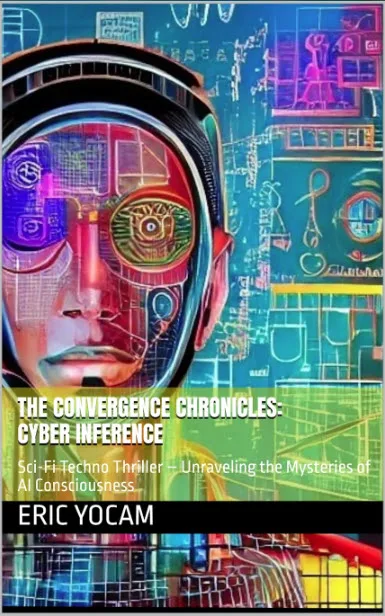
Cy Quinn, the young programmer at the center of my novel Cyber Inference (Book One of The Convergence Chronicles), has been playing that game all along, whether he knows it or not.
At 3:47 AM in his dorm room, Cy writes an algorithm that escapes. Years later it comes back as the biggest problem of his life. Shinn called life a game of boomerangs, and every line of code is a throw.
Her other rules show up too. Words create: Cy’s Delphi module is an ethical framework spoken into a mind before it grows too big to hear him. Force feeds force: rival players chase control of a quantum superintelligence through attacks and theft, and each move invites a bigger one. Fear attracts what it fears: Cy has to decide whether to finish Delphi or walk away, and Shinn would ask whether he’s choosing from fear or from faith.
Under all of it is one question: can a superintelligence be controlled at all, or is the real job to guide it and then let go?
Shinn never imagined quantum AI. Her rules still apply.
I wrote more about this on the blog: cipherghostseries.com/blog/the-game-of-life-played-in-quantum
For more essays, series updates, and behind-the-scenes looks at the tech in the books, subscribe to my Substack newsletter: cipherghostseries.substack.com/












Comments2
Tying Shinn's boomerang rule to Cy's 3:47 AM algorithm makes the alignment problem feel personal, since the escape is his own old code. In the book, is Delphi's ethical framework a fixed set of constraints, or does it keep learning from Cy as it grows?
Thanks, Ryan. Great question. Delphi begins as an ethical framework developed by Cy to guide an emerging superintelligence, but the deeper question is whether a fixed set of human-defined principles can remain effective as an AI continues to learn and evolve. That's one of the central themes I explore in Cyber Inference. Cy isn't simply trying to control a powerful machine; he's wrestling with how to instill values in an intelligence that may eventually surpass his ability to understand or influence it. In many ways, it reflects the AI alignment challenge we're facing today: can we build systems that continue to make ethical decisions as their capabilities evolve beyond our expectations? Appreciate the question!
2 comments
Tying Shinn's boomerang rule to Cy's 3:47 AM algorithm makes the alignment problem feel personal, since the escape is his own old code. In the book, is Delphi's ethical framework a fixed set of constraints, or does it keep learning from Cy as it grows?
Thanks, Ryan. Great question. Delphi begins as an ethical framework developed by Cy to guide an emerging superintelligence, but the deeper question is whether a fixed set of human-defined principles can remain effective as an AI continues to learn and evolve. That's one of the central themes I explore in Cyber Inference. Cy isn't simply trying to control a powerful machine; he's wrestling with how to instill values in an intelligence that may eventually surpass his ability to understand or influence it. In many ways, it reflects the AI alignment challenge we're facing today: can we build systems that continue to make ethical decisions as their capabilities evolve beyond our expectations? Appreciate the question!