 @ericyocam6
Can AI Identify What a 3D Printer Is Manufacturing Without Seeing the Object?
What if an attacker could use machine learning to identify a manufactured object simply by analyzing a 3D printer's sound, vibrations, or printing duration?
Our recent research, Side-Channel Attacks Survive Noise Cancellation in 3D Printers, explores how unintended physical signals can expose sensitive manufacturing information—even when active motor noise cancellation (AMNC) is enabled.
Using 144 synchronized acoustic and vibration recordings from two Bambu Lab printers, we investigated how machine learning techniques, including Random Forest and a 1D Convolutional Neural Network (CNN), could identify printed objects.
Key experimental findings:
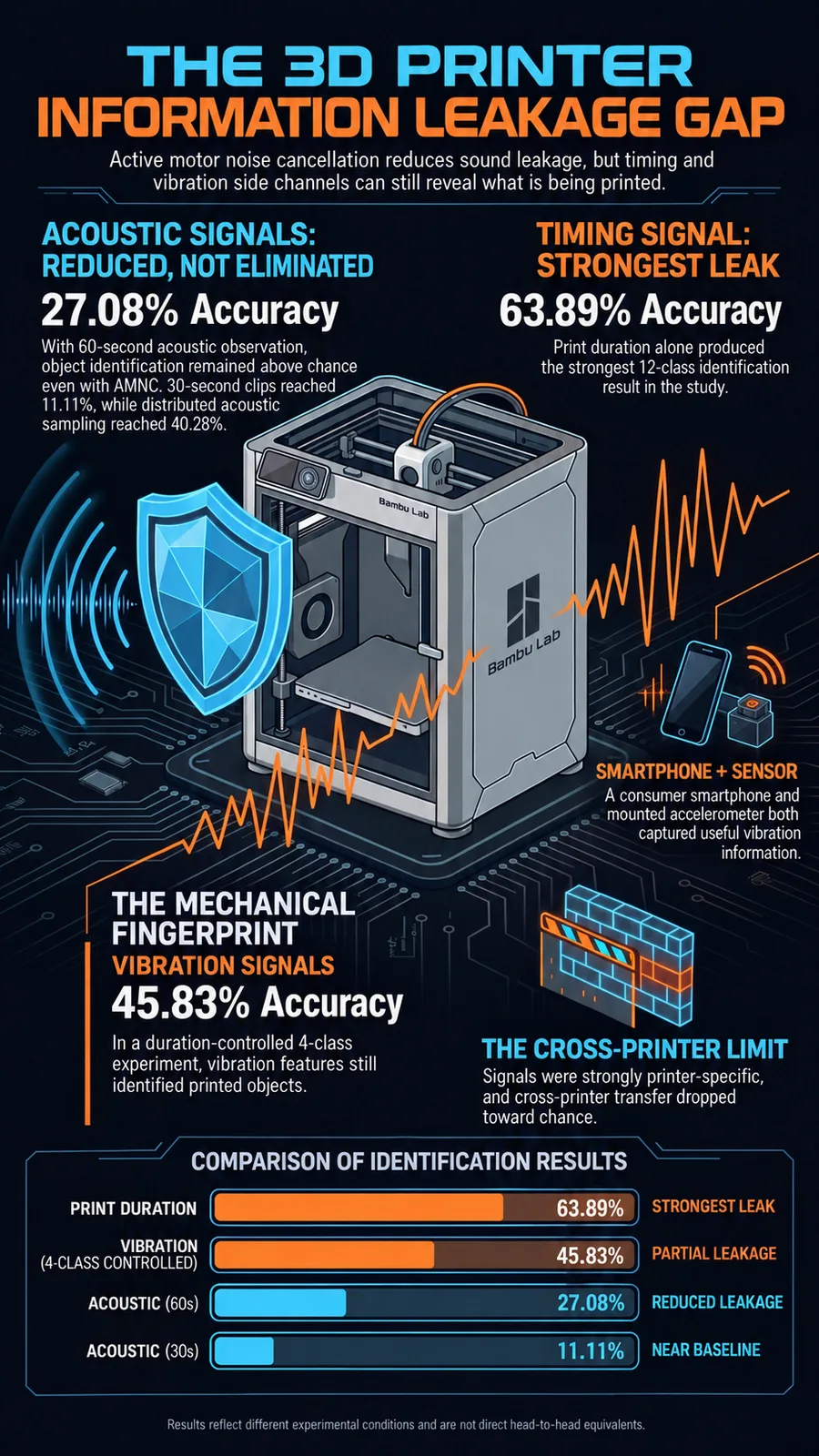
63.89% accuracy: Print duration alone identified objects across 12 classes.
45.83% accuracy: Vibration-based identification in a duration-controlled four-class experiment.
27.08% accuracy: Acoustic identification using 60-second recordings despite active motor noise cancellation.
11.11% accuracy: Acoustic identification using shorter 30-second recordings.
Consumer-grade sensors: Smartphone and accelerometer recordings captured useful vibration information.
These results involve different experimental conditions and are not direct head-to-head comparisons.
Where does AI fit in?
Machine learning can recognize subtle patterns in acoustic signals, mechanical vibrations, and timing data that may be difficult for humans to interpret.
This creates an interesting cybersecurity challenge: protecting digital design files may not be enough when the physical manufacturing process itself leaks information.
Our experiments focus on identifying known objects, not reconstructing complete 3D designs.
My question for the Lounge.ai community:
As AI becomes increasingly capable of extracting information from physical-world signals, are organizations overlooking a critical attack surface in their hardware and manufacturing environments?
And could AI-driven countermeasures become an effective defense against these side-channel attacks?
Interested in hearing perspectives from AI researchers, cybersecurity professionals, and hardware engineers.
Research paper: arxiv.org/abs/2606.13952












Answers2
Print time alone naming the right object almost two out of three times is the finding that stuck with me, because anyone can time a print without special equipment. A product team printing unreleased parts in a shared office, or a defense supplier with printers on the shop floor, now has to think about who is standing nearby with a phone.
Great observation, Ryan! That's exactly what makes this type of side-channel attack interesting. Even something as simple as print duration can reveal information about what's being manufactured. Our experiments demonstrated that timing alone could identify known objects with 63.89% accuracy under controlled conditions, without requiring sophisticated sensors.
Your examples also highlight the potential business implications, particularly for organizations developing proprietary products or sensitive components. While our research doesn't demonstrate identification of arbitrary unseen designs, it does show that protecting digital design files isn't necessarily enough. Organizations may also need to consider the physical information their manufacturing processes unintentionally expose. Appreciate the perspective!
2 answers
Print time alone naming the right object almost two out of three times is the finding that stuck with me, because anyone can time a print without special equipment. A product team printing unreleased parts in a shared office, or a defense supplier with printers on the shop floor, now has to think about who is standing nearby with a phone.
Great observation, Ryan! That's exactly what makes this type of side-channel attack interesting. Even something as simple as print duration can reveal information about what's being manufactured. Our experiments demonstrated that timing alone could identify known objects with 63.89% accuracy under controlled conditions, without requiring sophisticated sensors.
Your examples also highlight the potential business implications, particularly for organizations developing proprietary products or sensitive components. While our research doesn't demonstrate identification of arbitrary unseen designs, it does show that protecting digital design files isn't necessarily enough. Organizations may also need to consider the physical information their manufacturing processes unintentionally expose. Appreciate the perspective!