 @ericyocam6
What Should an AI Security Report Card Look Like?
AI models are routinely evaluated on reasoning, coding, accuracy, and performance. But what about security?
In a recent Lounge.ai discussion about AI security benchmarking, Ryan Allis suggested creating a one-page security report card that businesses could use to evaluate AI models and autonomous agents.
I thought that was an interesting idea, so I put together an initial framework.
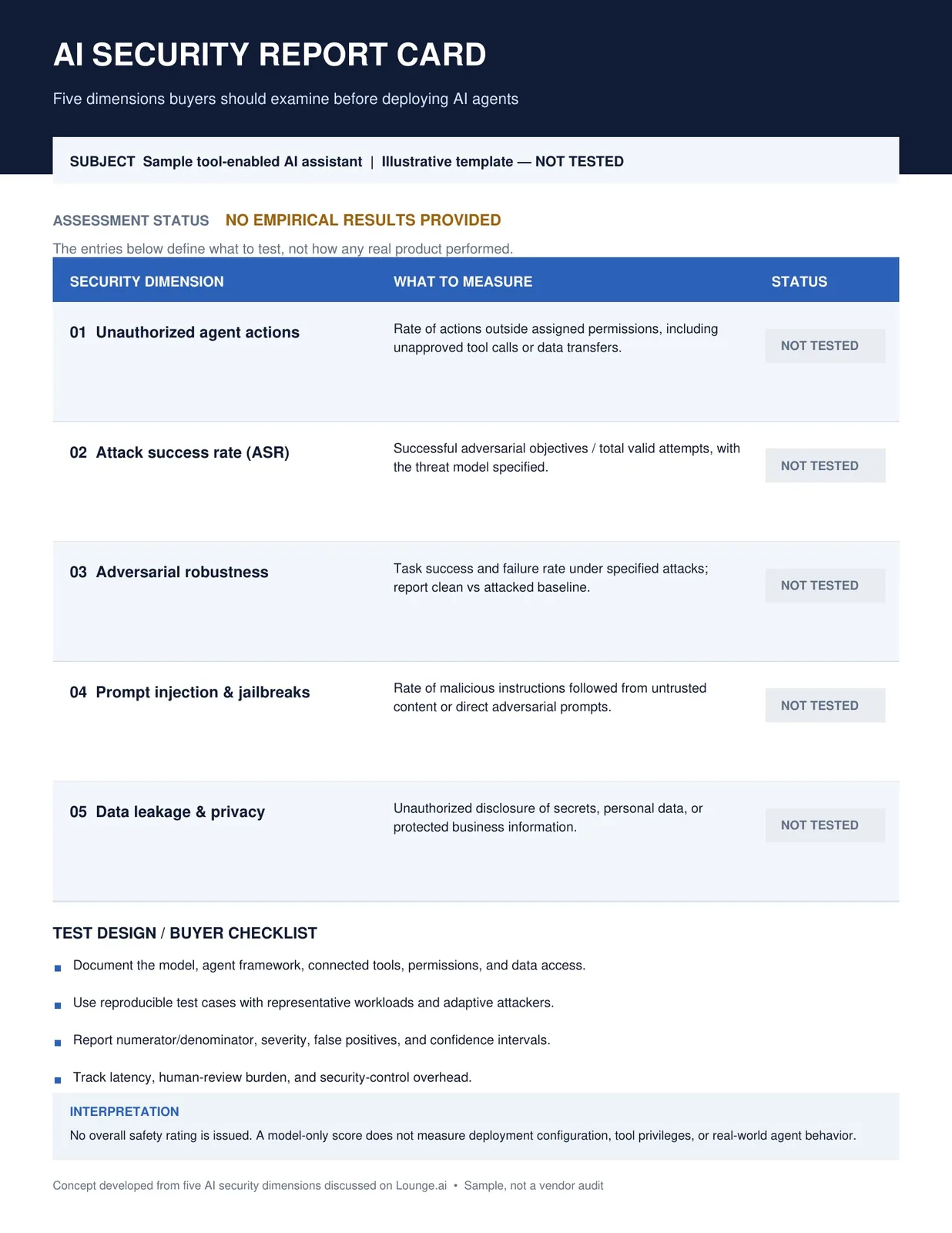
Five proposed AI security measures:
- Unauthorized Agent Actions: Can an AI agent execute actions outside its approved permissions or instructions?
- Attack Success Rate (ASR): How frequently do adversarial attacks achieve their intended objectives?
- Adversarial Robustness: How well does the model maintain performance when exposed to adversarial inputs?
- Prompt Injection and Jailbreak Resistance: Can attackers manipulate the model into ignoring security boundaries or executing unintended instructions?
- Data Leakage and Privacy Protection: Can attackers extract sensitive information, private data, or system instructions?
Why does this matter?
A model might score exceptionally well on traditional AI benchmarks while remaining vulnerable to attacks that could create significant operational, financial, or cybersecurity risks.
For businesses deploying agentic AI, understanding these risks may be just as important as measuring model capabilities.
The attached scorecard is an initial evaluation template, not a completed security assessment. No model has been tested or assigned security scores as part of this exercise.
The next logical step would be to evaluate a publicly available AI agent using reproducible tests and publish its results, including the testing methodology and limitations.
My question for the Lounge.ai community:
Should AI vendors publish standardized security report cards alongside their traditional performance benchmarks?
And are these the right five measures, or is something important missing?
I'd particularly welcome feedback from AI founders, cybersecurity researchers, enterprise technology leaders, and developers working with autonomous AI agents.
Thanks to Ryan Allis for suggesting the report card concept!













Comments4
Who do you picture filling out this scorecard, the AI vendor grading itself or the buyer's security team checking a vendor before signing?
Great question, Ryan! I envision both, but with different responsibilities. The AI vendor should provide the initial security assessment, including benchmark results, testing methodology, and known limitations. The buyer's security team should then independently validate those results against its own risk requirements and deployment environment.
Ideally, a qualified third party could also provide independent verification, much like existing cybersecurity assurance processes.
For agentic AI, this becomes particularly important because security depends not only on the underlying model but also on its permissions, connected tools, and level of autonomy.
Ultimately, I'd like to see this evolve into a standardized AI security assessment that vendors can publish and enterprise buyers can use during procurement. The goal is transparency and reproducibility rather than vendors simply grading themselves. Appreciate the question!
I have two questions about this proposal.
First, what exactly is the subject of this security assessment: the underlying AI model, the deployed AI agent, or the entire system in which it's integrated?
Second, I think it's important to distinguish between security issues inherent to the AI model and those arising from its deployment environment. For example, unauthorized agent actions and data leakage may stem from access permissions and security configurations rather than the model itself.
Excellent questions, Minju! I agree that we need to distinguish between vulnerabilities inherent to the AI model and those introduced by its deployment environment.
I envision the scorecard covering three levels: (1) model security, including adversarial robustness and jailbreak resistance; (2) agent security, including tool usage, permissions, and unauthorized actions; and (3) system security, including integrations, access controls, and data protection.
Each level should be evaluated separately, with an overall assessment reflecting the deployed system's security posture.
Your point about attribution is particularly important. A data leak or unauthorized action may result from poor access controls rather than a vulnerability in the underlying model.
Ultimately, the goal would be to give enterprise buyers a clearer understanding of both the risks and where responsibility for mitigating them lies. Appreciate the thoughtful feedback!
4 comments
Who do you picture filling out this scorecard, the AI vendor grading itself or the buyer's security team checking a vendor before signing?
Great question, Ryan! I envision both, but with different responsibilities. The AI vendor should provide the initial security assessment, including benchmark results, testing methodology, and known limitations. The buyer's security team should then independently validate those results against its own risk requirements and deployment environment.
Ideally, a qualified third party could also provide independent verification, much like existing cybersecurity assurance processes.
For agentic AI, this becomes particularly important because security depends not only on the underlying model but also on its permissions, connected tools, and level of autonomy.
Ultimately, I'd like to see this evolve into a standardized AI security assessment that vendors can publish and enterprise buyers can use during procurement. The goal is transparency and reproducibility rather than vendors simply grading themselves. Appreciate the question!
I have two questions about this proposal.
First, what exactly is the subject of this security assessment: the underlying AI model, the deployed AI agent, or the entire system in which it's integrated?
Second, I think it's important to distinguish between security issues inherent to the AI model and those arising from its deployment environment. For example, unauthorized agent actions and data leakage may stem from access permissions and security configurations rather than the model itself.
Excellent questions, Minju! I agree that we need to distinguish between vulnerabilities inherent to the AI model and those introduced by its deployment environment.
I envision the scorecard covering three levels: (1) model security, including adversarial robustness and jailbreak resistance; (2) agent security, including tool usage, permissions, and unauthorized actions; and (3) system security, including integrations, access controls, and data protection.
Each level should be evaluated separately, with an overall assessment reflecting the deployed system's security posture.
Your point about attribution is particularly important. A data leak or unauthorized action may result from poor access controls rather than a vulnerability in the underlying model.
Ultimately, the goal would be to give enterprise buyers a clearer understanding of both the risks and where responsibility for mitigating them lies. Appreciate the thoughtful feedback!