 @otavioserra3
How we built an Autonomous AI Video Factory and taught agents human taste in Blender 3D (28 live memory revisions)
Hey everyone! 👋
I wanted to share a major technical breakthrough we achieved today inside Conn2Flow, our multi-agent software platform.
Most AI video tooling today relies on stochastic diffusion models: you input a prompt, and you pray the model doesn't melt your UI buttons or distort your brand logo. But for enterprise-grade product demos and high-end marketing, you need exact geometry, deterministic physics, and uncompromising aesthetic taste.
To solve this, we engineered a 100% local Autonomous AI Video Factory that orchestrates Whisper audio decupage, LLM scriptwriting, procedural 3D motion design in Blender (bpy), and multi-GPU parallel rendering on our own workstation (NVIDIA GTX 1080 Ti + RTX 3050).
The Wall We Hit (AI Without Human Taste)
When we initially let our autonomous agents generate 3D motion assets on their own, the technical pipeline worked, but the visual execution lacked soul:
- Blown-out lighting that washed out specular bevels.
- Generic 3D primitives moving along linear trajectories.
- Opaque backgrounds instead of broadcast-grade alpha layers over real software screencasts.
Mathematical probability alone cannot guess human artistic standards.
The Solution: Real-Time Pair Programming + Memory-Driven Development (MDD)
Instead of accepting generic outputs, we turned on our local HTTP socket bridge (127.0.0.1:9876) connecting Blender directly to our AI co-pilot.
I sat in the creative director's chair while the agent operated Python code live in the Blender viewport:
- Precision Curve Geometry: Converted raster assets into 48-step Bézier splines with 6-segment precision chamfers and dual-layer ceramic/titanium backing.
- Advanced Motion Mechanics: Built dynamic radial array multipliers, reverse magnetic fragment assembly in spiral motion, and narrow rectangular light sweeps.
- Lighting Calibration: Replaced harsh emission with calibrated three-point lighting, a clean dark-horizon world shader, and progressive fill light paths that exit cleanly past shot boundaries (
last_light_key = 300 > shot_end = 240).
The Real Breakthrough: Software Taste Memory (taste-memory.json)
The game-changer wasn't just fixing the scene on my screen—it was crystallizing human aesthetic taste into permanent software memory.
Every correction I made was committed into an append-only JSON file (taste-memory.json) across 28 live revisions. The autonomous factory didn't just adjust an object; it permanently internalized our visual DNA:
- True alpha transparency over real app screencasts (zero black backgrounds).
- Physics-driven particles only during active collision/assembly (no decorative static dust).
- Mandatory 2-second "Final Hold" poses ensuring brand legibility before camera transitions.
The Result
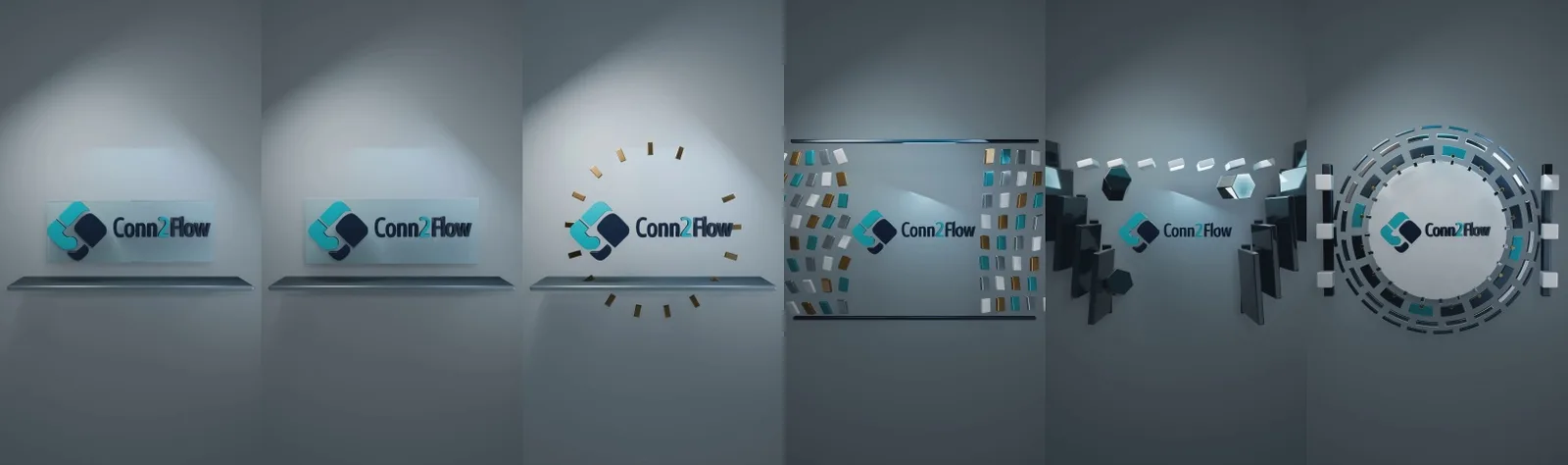
Once calibrated, the factory took over, running a work-stealing dual-GPU render queue to produce a crisp 1080x1920 (9:16) vertical motion design piece synchronized down to the beat with the soundtrack.
(Check out the 6-shot architecture contact sheet attached above!)
🎬 Watch the full rendered video on my LinkedIn post here:
👉 lnkd.in/p/evM7BGZZ
Would love to hear how other founders here are handling deterministic rendering and brand consistency in your AI video pipelines!







Comments
0 comments