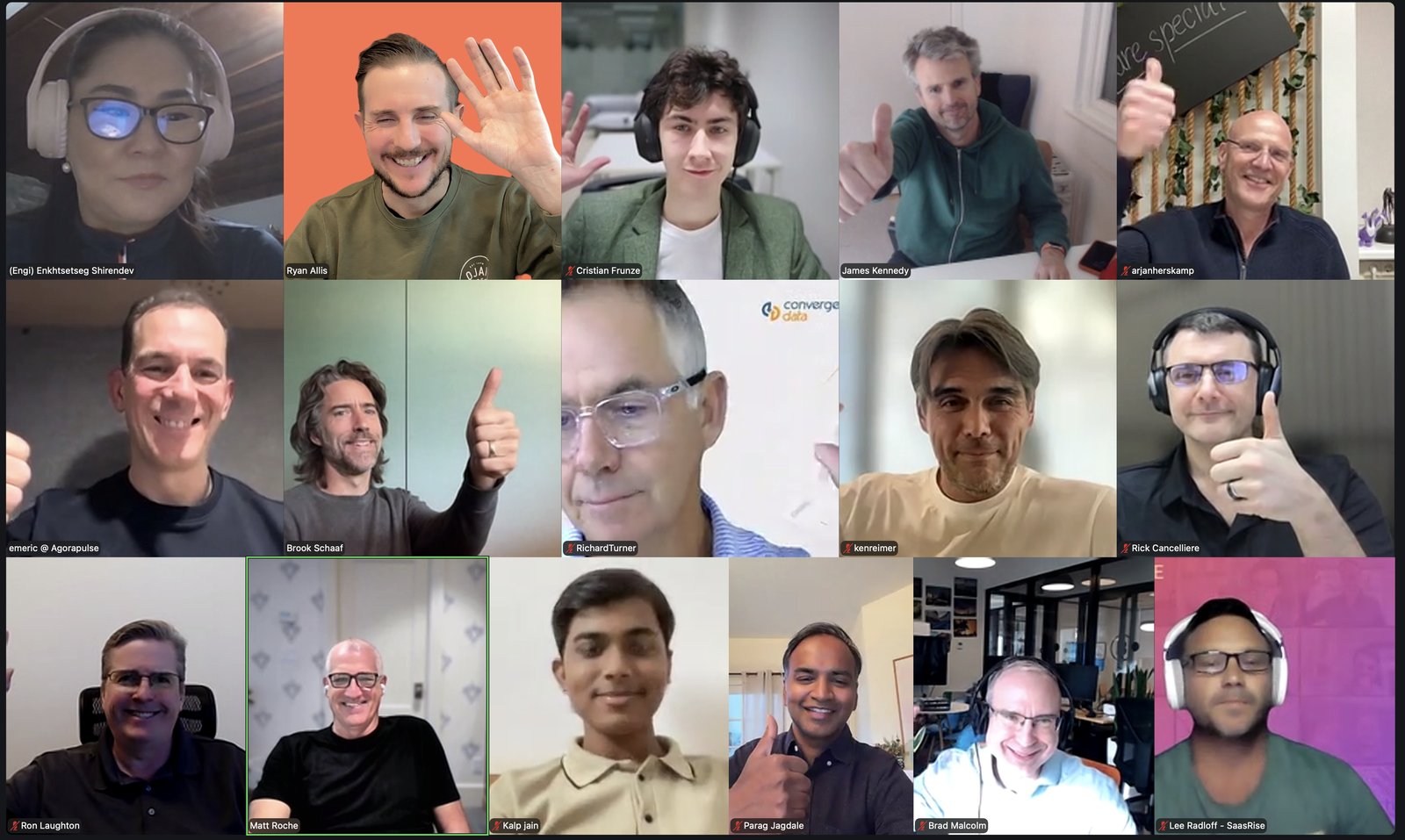
Weekly AI Founder Mastermind recap, November 5: 20 founders on the call
Best advice from the call
- Run loops, not priority lists
“Think about these things as loops, not as functions. Somebody is running an agentic bettering loop, someone else is running an agentic eval loop to make sure the quality's there, and somebody else is running an agentic prototyping loop. You don't ask how to prioritize X, Y and Z.”
- Three paying customers before you build
“We never build anything unless we have three customers confirm they're paying for this. That commercial buy-in before a proper build is absolutely mandatory to us.”
- Give agents a free tool
“We published free MCP tools that people can use. The idea is that over time agents will start recommending our tool more and more, because it's made for them. Find some part of your tool you can give away free for agents.”
- Build an entity map
“You can give LLMs JSON files with evidence for each element of your business, which cuts hallucination and answers the citations and references they're looking for. It's like schema markup, but for LLMs.”
- Price low before someone else does
“We went upmarket, and 10 or 20 competitors came from the bottom and took our business. That would never have happened if we had stayed low-priced. If your price is low enough, there's no point in competing with you on price.”
- Price follows the cost of sales
“If customers like to buy through salespeople, the limiting factor on price is the cost of sales, not the cost of the software, and it never has been.”






The fifth Weekly AI Founder Mastermind brought together 16 founders and CEOs, plus the AI Lounge team, from Dublin, Amsterdam, Meppel, Pittsburgh, Austin, Toronto, Miami, Akron, Los Angeles and Banswara, India (join next week's call with Lounge Pro). Five topics: getting AI agents to find your product, in-app agents vs. MCP, running social media with agents, validating agent ideas before you build, and what happens to pricing when anyone can rebuild your features. The thread through all five: building is now fast and cheap, so distribution, validation and pricing decide who wins.
- Growth: AI Lounge is at 2,998 members, about to pass 3,000.
- New name: Lounge is now AI Lounge, leaving room for other lounges later.
- City ambassadors: 14 cities and counting. Want to host a quarterly gathering where you live? Apply to be an ambassador. Want to sponsor one? Message Ryan.
James Kennedy (Founder, ProcurementExpress.com) built an MCP (check.procurementexpress.com) that runs the debarment check required when organizations spend federal money on purchases over $10K. He has already signed up for paid services himself because his own agent recommended them, and wants agents to recommend his tool the same way.
- Rick Cancelliere (Founder and CEO, PracticeBeat): build an entity map, "schema markup, but for LLMs": JSON files that give evidence for each part of your business, so LLMs stop guessing and can cite you. It was the buzz at Brighton SEO.
- Cristian Frunze (Founder, Ken): give part of your product away free as MCP tools. Ken.so's free email finder and verifier went live two weeks ago and this week reached about 50 requests a day. Separately, Ken.so's paid connector was accepted into the official ChatGPT and Anthropic directories.
- Ryan Allis (CEO, AI Lounge & SaasRise): list your MCP in the registries (he shared 14 in chat, including the Official MCP Registry, PulseMCP, Smithery and Glama), and make your site answer-engine friendly: don't block AI bots in robots.txt, structure content like FAQs, and point Claude at your site's repo with an SEO skill to do the work. AI Lounge launched a month ago and gets 5 to 10 new members a day recommended by ChatGPT.
- James's own takeaway: open-source the tool and market it on GitHub.
Lessons learned
- Give agents something free and useful to call.
- List everywhere agents look, and give LLMs evidence about your business they can cite.
- Make your site easy for AI to read; Claude can do most of it in an afternoon.
Cristian asked whether people use the agent built into an app or connect the app to Claude or ChatGPT.
- Ryan: most in-app agents are chatbots that repeat the help docs and can't do anything. Lightfield CRM is the exception. He sends Claude 300 to 400 messages a day and would rather act on an app through a connector than log in.
- Ken Reimer (CEO, Continuum): both, each where it works. But an app without an MCP connection to Claude is a reason not to pick it, and across his companies MCP usage is much higher than in-app chat.
- Emeric Ernoult (Founder & CEO, Archie): it's like mobile and web. You need a very good AI experience in your product and as an MCP inside Claude.
Emeric, CEO of Agorapulse and now building Archie, asked how people handle LinkedIn messages and comments with agents. His friction: the agent doesn't know who he knows or how he talks to them, and you can't edit a draft inline or take actions like hide or delete.
- Cristian connects LinkedIn to Claude through Unipile (it keeps the message history, so replies have context). Claude sends him a daily report, filters the spam, and scores his ~30 daily connection requests, accepting anyone at 80 or above.
- Ryan demoed the video studio he vibe-coded in Claude for AI Lounge and SaasRise: a teleprompter that writes 60-second scripts each night, edits each take into vertical and horizontal cuts in about 30 minutes for about $0.45 a video, and tracks which styles perform. Building it cost about $600 in tokens. Daily views went from 1,200 to 8,100 in a week, with 16.9 hours of watch time yesterday. As of this morning, the nightly script writer also reads what the top AI and SaaS influencers posted that got at least 2x their normal views. Speed beats polish: a video recorded at 10 AM goes out by 3 PM.
Parag Jagdale (Unific) has years of ecommerce data and wants an autonomous agent that spots churning customers and emails them a discount directly. Customers haven't asked for it, so how much should he build first?
- Matt Roche (Founder and CEO, Extole): prototype it in two hours and put it in front of someone. If they don't use it, move on. If they do, run the loop until it behaves consistently, then automate it.
- Ryan: hold off on marketing and ad spend until usage is proven. Build it in a day or two, put it in front of 100 users, call them, iterate. What took 6 months now takes 6 days.
- Ken (eight companies averaging about $5M in revenue): engineers overbuild even more with AI, so raise the bar. Ken's companies never build anything until three existing customers confirm they'll pay for it.
Brook Schaaf (Co-Founder and CEO, FMTC) asked how to balance new paid features against improving the core product.
- Matt: think in loops, not functions. One person runs an agentic improvement loop, another an eval loop for quality, another a prototyping loop, and someone keeps cleaning up the core so the API and MCP stay clean.
- Ryan: the P0/P1/P2 era is over. Doing both may cost an extra $100 in tokens.
Brook's follow-up: if anyone can rebuild your features cheaply, what happens to your margins?
- Emeric: prices are going down for self-serve products. Agorapulse once moved upmarket and 10 to 20 low-priced competitors took its customers from below. What it builds next will be priced low enough that no one bothers to undercut it. This doesn't apply to enterprise sales.
- James: for products sold through salespeople, price is set by the cost of sales, not the cost of the software, and that hasn't changed.
- Ken: in enterprise his prices haven't dropped. Revenue per head is up, and because AI lets his teams cut bigger costs for clients, they've raised prices and cross-sold more.
- Matt: investors he met this week expected agentic platforms replacing tools like ServiceNow to need to cost 10% of the old price to win the switch, but they're winning at about 50%. Enterprise buyers aren't optimizing the price of software, they're optimizing the price of people. The squeeze is in the "deadly middle," roughly $24K to $100K contracts.
Lessons learned
- Prototype in hours, and get three customers to commit money before the real build.
- Run improvement, evals and prototyping as parallel loops, each with an owner.
- Self-serve products should price low before someone else does; enterprise products should price on the people cost they remove.
- Ron Laughton (Founder & CEO, ReviewInc) shared that his team shipped the "Ask AI" report with data security, built on last week's advice.
- Enkhtsetseg (Engi) Shirendev is piloting a battery registration system for Mongolia and an AI tool to track Mongolia's resource exports (mcbis.org).
- Brook asked whether the anti-AI sentiment in this week's US election will raise AI costs. Ryan closed by saying AI policy will be the conversation of 2027 to 2030: data centers have real water and power costs for local communities, the benefits of AI far outweigh the downsides, and AI-controlled weapons are worth worrying about.








- Arjan Herskamp · Founder & CEO, Mydatafactory
- Brad Malcolm · co-founder & CEO, EyeQ
- Brook Schaaf · Co-Founder and CEO, FMTC
- Cristian Frunze · Founder, Ken
- David Trachsel · Head of Growth, SaasRise
- Emeric Ernoult · Founder & CEO, Archie
- Enkhtsetseg Shirendev · Founder & CEO, MCBI, LLC | Mongolia Circular Battery Initiative
- James Kennedy · Founder, ProcurementExpress.com
- Kalp Jain · Developer, Independent
- Keith Pelatowski · Chief Executive Officer, Points North
- Ken Reimer · CEO, Continuum
- Lee Radloff · Head of Sales & Member Success, SaasRise
- Matt Roche · Founder and CEO, Extole
- Parag Jagdale · Co-Founder & CEO, Unific
- Richard Turner · President & Founder, Convergence Data
- Rick Cancelliere · Founder and CEO, PracticeBeat
- Ron Laughton · Founder & CEO, ReviewInc
- Ryan Allis · CEO, AI Lounge & SaasRise
- Zamir Javer · CEO, Jumpfactor











Comments
0 comments