 @otavioserra3
From 200+ AI agent batches to a production-grade AI CMS & MDD (Memory-Driven Development) — excited to connect with fellow builders!
Hey everyone! Excited to join Lounge.ai and connect with Ryan and all the builders here.
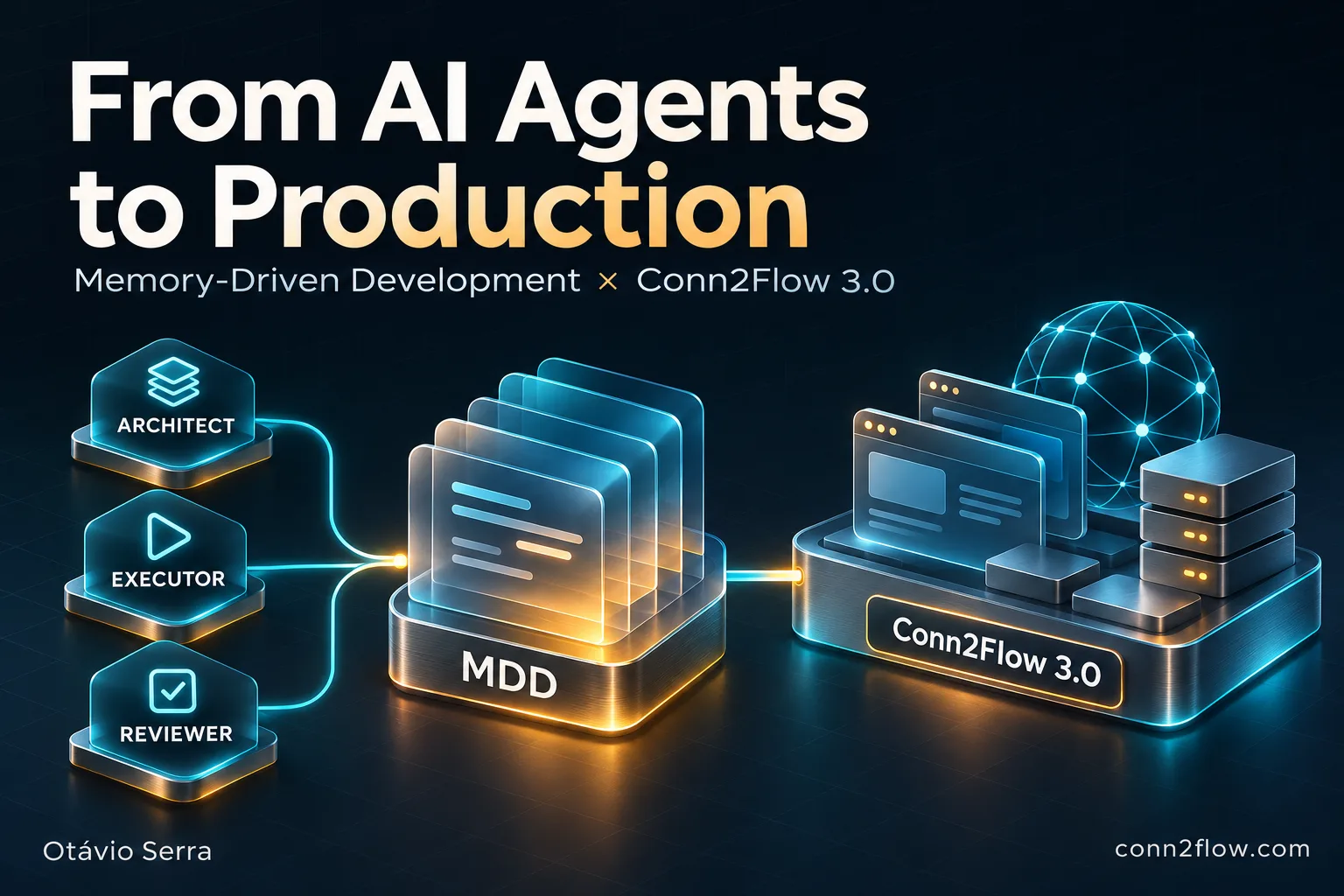
I'm Otávio Serra, a Systems Architect and full-stack engineer with 20+ years in the trenches. Over the past year, my daily workflow shifted almost entirely to orchestrating multi-agent coding teams (Architect, Executor, and Reviewer topologies) to build and ship production software.
Along the way, we hit two massive walls that I know many of you are also facing—and ended up building two core layers that are now synced in the Lounge member repos:
- Solving "Agent Amnesia" at scale → Memory-Driven Development (MDD)
When our AI coding agents crossed 200+ implementation batches, standard context files broke down. Agents started forgetting past architectural decisions, overwriting each other's work, or blowing up token budgets.
We evolved from Spec-Driven Development into MDD (conn2flow-ai-workspace):
- Strict separation between Chief Engineer Memory (read-only for agents) and Execution Memory (auto-compacted at 75 KB).
- A hard 10-active-item cap on every control index (older items auto-archive with 1-line YAML summaries).
- A Python CLI (
mdd) + a 9-tool MCP server + VS Code extension that syncs 45+ canonical agent skills across 8 repositories.
- Turning AI-assisted code into sovereign, production-ready web & SaaS infrastructure → Conn2Flow 3.0
We just shipped the 3.0 series of Conn2Flow (conn2flow on GitHub / conn2flow.com)—an open-core, AI-native modular CMS and SaaS orchestration platform (PHP 8.2–8.5, Tailwind v4, canonical REST CRUD API, built-in AI modes, and 1,880+ automated tests):
- Over 1,048 indexed documentation and content pages powering an in-panel AI Assistant.
- Native multi-currency Stripe subscriptions + autonomous Cloud hosting provisioning (Host Manager).
- Next on our roadmap: a "Vibe Coding + Senior Technical Reviewers" Marketplace—where founders and non-technical creators can build rapidly with AI agents inside Conn2Flow and hire verified senior engineers on-demand to audit, harden, and sign off for production.
What I'm looking for here in Lounge.ai:
- Fellow AI & MCP builders who want to test or collaborate on our open-source MDD framework (
conn2flow-ai-workspace). - Agencies, indie founders, or SaaS operators looking for a fast, self-hostable (or managed Cloud) AI-native CMS/portal engine without vendor lock-in.
- Feedback from anyone building in the AI agent memory or vibe-coding review space!
All three of our public repos (conn2flow, conn2flow-ai-workspace, and react-mapdraw-navigator) are live in the Member Repos directory, and you can check out the platform at conn2flow.com/en/
What's the hardest bottleneck you're currently hitting when moving AI-generated code into real production? Would love to swap notes!













Comments6
Great work,
Thank you
The planned marketplace, where non-technical founders hire a verified senior engineer to check their AI-built app and sign off before launch, is the part of Conn2Flow I'd want to see first. Could you post a rough mockup or draft pricing showing what a founder would pay for one of those reviews?
Like the fact that you grind still fuels your passion regarding your journey its all timestamp.
The memory split matches what I ended up with on PromoPilot, which is mostly written with Claude Code: a small read-only file of decisions and rules, and everything else allowed to be compacted or archived. On the CMS side, since you are selling it to agencies, the SEO defaults are where AI-built sites usually break quietly. Two we learned the hard way: only update lastmod when the content actually changes (we had a view counter bumping it and Bing started crawling us less), and only ping IndexNow on real edits. Also, images in schema without license and creditText get flagged in Search Console. If Conn2Flow ships those right by default, that is a real selling point for agencies.
The read-only decision memory / compactable execution memory split gives you a concrete restart test: approve decision A, later replace it with B, then force compaction and resume in a fresh session. Can the agent identify B as current, keep A as superseded history, and find the original reason for the change without treating the one-line archive summary as sufficient authority?
I would include an unresolved proposal as a separate case: compaction should not quietly turn it into an approved decision. Do your archived items retain stable links and an explicit status for that distinction?
I’m Rhode, founder of Chronos Systemic, an epistemic-layer project alongside LLMs in preproduction. Keeping evidence and revised judgments usable across interruptions is part of our proposed evaluation; we have no comparative results yet. I’ve read your post and this thread, not reviewed or tested MDD’s implementation.
6 comments
Great work,
Thank you
The planned marketplace, where non-technical founders hire a verified senior engineer to check their AI-built app and sign off before launch, is the part of Conn2Flow I'd want to see first. Could you post a rough mockup or draft pricing showing what a founder would pay for one of those reviews?
Like the fact that you grind still fuels your passion regarding your journey its all timestamp.
The memory split matches what I ended up with on PromoPilot, which is mostly written with Claude Code: a small read-only file of decisions and rules, and everything else allowed to be compacted or archived. On the CMS side, since you are selling it to agencies, the SEO defaults are where AI-built sites usually break quietly. Two we learned the hard way: only update lastmod when the content actually changes (we had a view counter bumping it and Bing started crawling us less), and only ping IndexNow on real edits. Also, images in schema without license and creditText get flagged in Search Console. If Conn2Flow ships those right by default, that is a real selling point for agencies.
The read-only decision memory / compactable execution memory split gives you a concrete restart test: approve decision A, later replace it with B, then force compaction and resume in a fresh session. Can the agent identify B as current, keep A as superseded history, and find the original reason for the change without treating the one-line archive summary as sufficient authority?
I would include an unresolved proposal as a separate case: compaction should not quietly turn it into an approved decision. Do your archived items retain stable links and an explicit status for that distinction?
I’m Rhode, founder of Chronos Systemic, an epistemic-layer project alongside LLMs in preproduction. Keeping evidence and revised judgments usable across interruptions is part of our proposed evaluation; we have no comparative results yet. I’ve read your post and this thread, not reviewed or tested MDD’s implementation.