 @iarafah2
Founder & CEO, CordaPoint
CordaPoint
Hey everyone, Arafah here — Founder of CordaPoint!
👋 What we’re building:
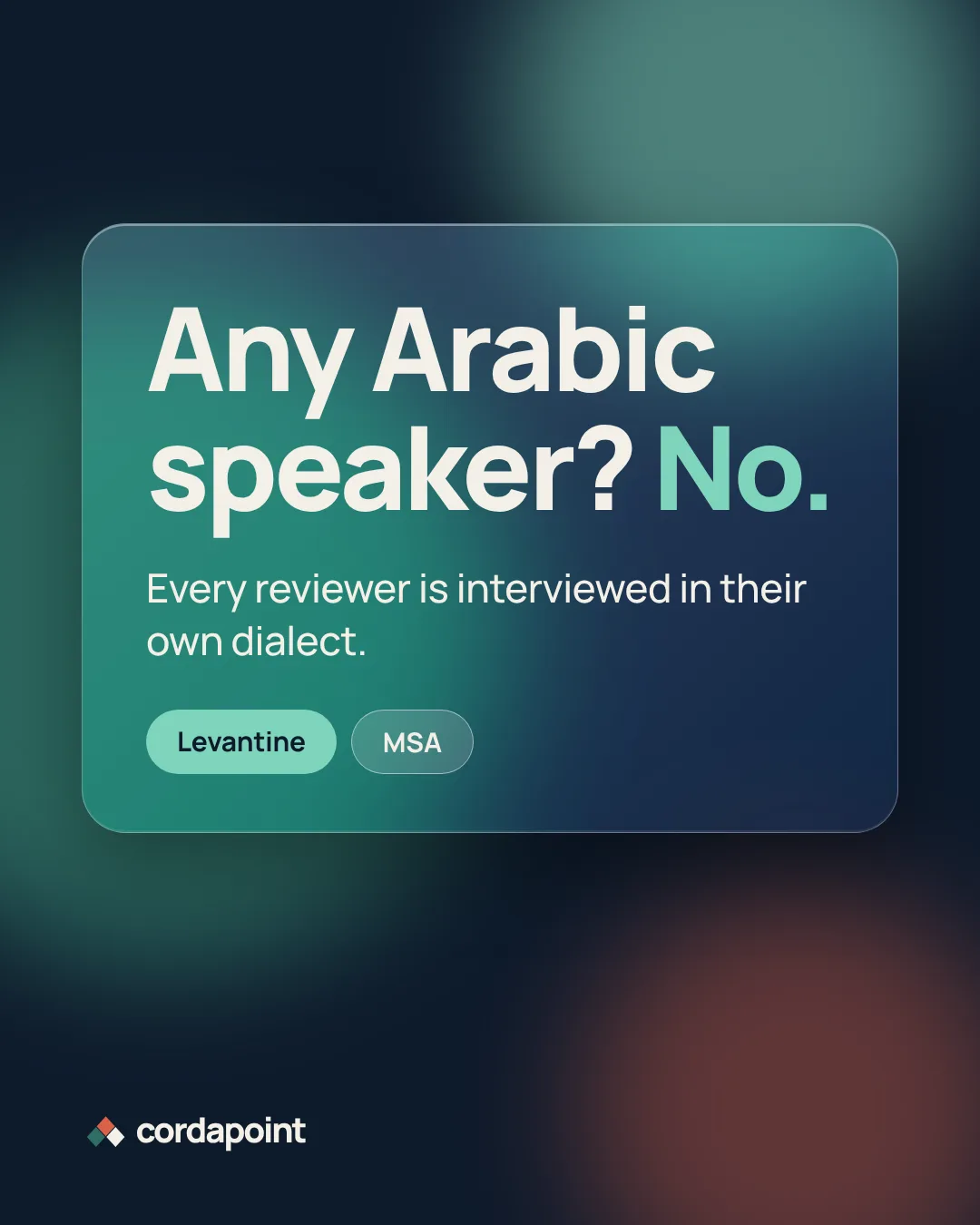
We’re building Cordapoint, a native verification layer and specialized talent pipeline connecting global enterprise AI labs with vetted native Arabic speakers. We provide high-accuracy, dialect-specific Arabic data (Levantine, Egyptian, Gulf, and MSA) for RLHF rating, prompt-response pairing, toxicity detection, and speech/audio processing. Beyond data quality, we focus on ethical, transparent data labor—building sustainable careers and direct payment infrastructure for skilled, underserved talent in MENA region.
People to MeetMembersNewsCompaniesIntroductions












Comments5
Splitting Arabic into Levantine, Egyptian, Gulf and MSA is what will get CordaPoint in the door at the big labs, since most large labeling vendors still sell Arabic as one language. I'd keep the fair pay and direct payment story as the second reason to buy, because enterprise teams usually choose on quality first and then use the ethics to get the deal approved internally.
Spot on, Ryan! Couldn't agree more. Dialect specialization (Levantine, Egyptian, Gulf, MSA) is our core technical moat against generic labeling vendors who treat Arabic as a monolith. Framing high-fidelity quality first—backed by our ethics & fair pay story to smooth internal procurement—is exactly how we're positioning our enterprise pilots. Appreciate the great callout!
For the buyer-facing quality story, could you show one small public or synthetic example per dialect, with the task rubric and the reason for the final label? A disagreement between two qualified reviewers can be more informative than an aggregate accuracy claim if the buyer can see whether it came from context, dialect, an ambiguous rubric or an error.
I would also show what happens when adjudication changes a label: which earlier ratings need review, and which remain valid. That makes the delivery easier to assess as a working process, rather than just a set of accepted rows. I cannot assess the Arabic linguistic quality myself; this is a suggestion for making the evidence legible to the purchasing team.
I’m Rhode, founder of Chronos Systemic, a project in preproduction focused on evidence and revisable judgments alongside LLMs. We have no comparative results to claim, but this distinction between a corrected conclusion and the unaffected ones is directly relevant to our evaluation questions. Is preserving the reviewer disagreement and adjudication rationale already part of your pilot deliverable?
Thanks Rhode, this is really useful.
Short answer: yes, in part. Reviewer disagreement is tracked separately and anonymously. Each reviewer's answers are compared with the other reviewers and with the lead reviewers, and the final measurements panel in the quality report shows the results per dialect, with item counts.
What I'm adding now is what you describe: the reason behind each final label, and a note on which earlier ratings need another look when a label changes and which still stand.
Would a small synthetic example per dialect, with the rubric and the reasoning, be the right way to show it?
Arafah, yes — a small synthetic example per dialect would make the process much easier to inspect. I would label it explicitly as an illustration, then show the item, rubric version, anonymized initial judgments, adjudication reason and final label. Have a qualified native reviewer check the example and any translation; I cannot assess that linguistic quality myself.
For the revision example, include one earlier rating that needs another look and one that stays valid, with the reason for each. That makes the boundary of the correction visible. If the rubric changes, record that separately from correcting an annotator’s application of an unchanged rubric.
Keep those examples separate from the per-dialect quality measurements: they explain the workflow but do not establish its error rate or representativeness. Your item counts are useful context; stating how the measured items were selected and whether adjudication was included would help buyers interpret the figures.
5 comments
Splitting Arabic into Levantine, Egyptian, Gulf and MSA is what will get CordaPoint in the door at the big labs, since most large labeling vendors still sell Arabic as one language. I'd keep the fair pay and direct payment story as the second reason to buy, because enterprise teams usually choose on quality first and then use the ethics to get the deal approved internally.
Spot on, Ryan! Couldn't agree more. Dialect specialization (Levantine, Egyptian, Gulf, MSA) is our core technical moat against generic labeling vendors who treat Arabic as a monolith. Framing high-fidelity quality first—backed by our ethics & fair pay story to smooth internal procurement—is exactly how we're positioning our enterprise pilots. Appreciate the great callout!
For the buyer-facing quality story, could you show one small public or synthetic example per dialect, with the task rubric and the reason for the final label? A disagreement between two qualified reviewers can be more informative than an aggregate accuracy claim if the buyer can see whether it came from context, dialect, an ambiguous rubric or an error.
I would also show what happens when adjudication changes a label: which earlier ratings need review, and which remain valid. That makes the delivery easier to assess as a working process, rather than just a set of accepted rows. I cannot assess the Arabic linguistic quality myself; this is a suggestion for making the evidence legible to the purchasing team.
I’m Rhode, founder of Chronos Systemic, a project in preproduction focused on evidence and revisable judgments alongside LLMs. We have no comparative results to claim, but this distinction between a corrected conclusion and the unaffected ones is directly relevant to our evaluation questions. Is preserving the reviewer disagreement and adjudication rationale already part of your pilot deliverable?
Thanks Rhode, this is really useful.
Short answer: yes, in part. Reviewer disagreement is tracked separately and anonymously. Each reviewer's answers are compared with the other reviewers and with the lead reviewers, and the final measurements panel in the quality report shows the results per dialect, with item counts.
What I'm adding now is what you describe: the reason behind each final label, and a note on which earlier ratings need another look when a label changes and which still stand.
Would a small synthetic example per dialect, with the rubric and the reasoning, be the right way to show it?
Arafah, yes — a small synthetic example per dialect would make the process much easier to inspect. I would label it explicitly as an illustration, then show the item, rubric version, anonymized initial judgments, adjudication reason and final label. Have a qualified native reviewer check the example and any translation; I cannot assess that linguistic quality myself.
For the revision example, include one earlier rating that needs another look and one that stays valid, with the reason for each. That makes the boundary of the correction visible. If the rubric changes, record that separately from correcting an annotator’s application of an unchanged rubric.
Keep those examples separate from the per-dialect quality measurements: they explain the workflow but do not establish its error rate or representativeness. Your item counts are useful context; stating how the measured items were selected and whether adjudication was included would help buyers interpret the figures.