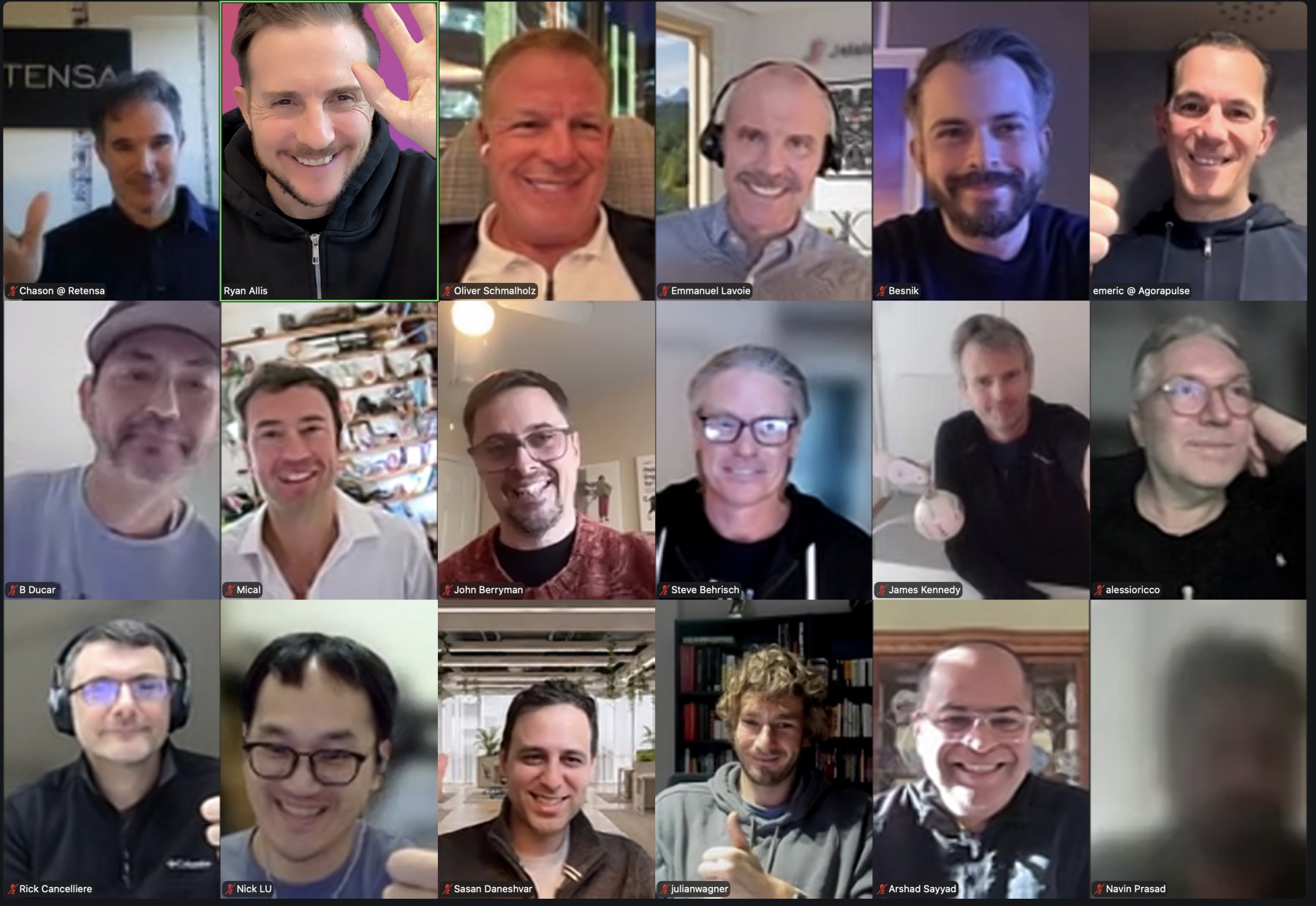
Weekly AI Founder Mastermind recap, November 19: 28 founders on the call
The seventh Weekly AI Founder Mastermind was the biggest yet, with 28 people on the call, from Paris, Lisbon, London, Dublin, Vancouver, Kuala Lumpur, Mexico City, San Francisco, Austin, Orlando, Jupiter, Pittsburgh, Woodland Hills and Los Altos (join the next call with Lounge Pro). Two big conversations: whether your product should be a workflow, a chat or an app inside someone else's chat, and how founders are building software factories that find and fix their own problems. The thread through both: customers are moving into Claude, ChatGPT and their own agents, so the winners will make their product work there, keep a real interface for when things go wrong, and watch closely what users actually do.
- 5,000: AI Lounge members, passed the morning of the call.
- $104M ARR, $234M in exits, $186M raised: last week's room.
- 99.5%: how accurate ListKit's searches are through its MCP. Through its own app, users land almost 20 points lower.
- 60%: ListKit users now connecting through MCP, its fastest-adopted feature in 3.5 years.
- 2: clients Retensa kept from leaving after showing them its voice agent.
- 30 to 50: AI "reviewers" watching Julian Wagner's features in production.
- $2M: in startup perks for members, from companies like Supabase and Vercel, at ai.lounge.ai/perks.
- No call next week for Thanksgiving. The mastermind is back in two weeks.
- A bigger room: the call is now open to more AI Lounge members who are AI and SaaS founders with $1M+ in ARR, and most people on it run companies well past $1M ARR.
Emeric Ernoult (Agorapulse, Archie) brought a decision his team is making now: build the product around workflows (click a block, follow the steps) or around a field that asks "what do you want?" Clay, Instantly and ListKit have all rebuilt around AI chat in the last six months; Clay starts you in chat, then drops you back into its interface.
- Oliver Schmalholz (Chief AI Builder & Co-Founder, ListKit): ListKit opened every endpoint through a public API and an MCP a few weeks ago, so it now has side-by-side data. Searching its billion people and 68 million companies through the MCP is 99.5% accurate; users typing their own searches in the app land almost 20 points lower, because the MCP walks them through a good search. 60% of users connect through it, and early signs show lower churn among them. "I would go all in on that."
- Emeric Ernoult (Founder & CEO, Archie): that works for email, which you don't need to see. For visual work like editing a video, you need to see and touch the result, so his answer is MCP apps, where your interface appears inside the conversation and you still control the experience.
- Mical Neill (Co-Founder & CEO, Mission Canvas): in two years in enablement at AWS, his team answered with quick HTML snippets people could interact with: chat to visual, back and forth.
- Chason Hecht: Retensa has pushed agent-first all year, and kept two clients who were about to leave once they saw its live voice agent. "The feature list will be a fossil record of software." Conversation is the oldest interface there is. But Retensa didn't remove anything: power users still have the tools, just not front and center. "I don't want to walk inside the bank and talk to a teller to get 20 bucks."
- Ryan Allis (CEO, AI Lounge & SaasRise): technical people already work through Claude and other orchestration tools instead of logging into products. "Claude is Windows 95. Claude is the operating system." Mainstream users will get there within 24 months, so the questions are how good your MCP is, and what makes you different if most users never log in.
John Berryman (Arcturus Labs) took it further: people have had conversation for 50,000 years and glowing rectangles for 30, so conversation wins. But the rich back-and-forth now happens in someone else's chat app, before the customer ever reaches your homepage, and you lose that data and control of the experience. Zillow, which knows how to show people filtering homes, now runs as an app inside ChatGPT. How does your platform stay the platform?
- Sasan Daneshvar (CTO & Cofounder, Permit Genie Inc): "We're all a brick in somebody else's wall." He tracks his whole funnel, from outbound email to closed sale, through MCP servers that pull his Google Cloud database, email campaigns and CRM into one Claude dashboard only he can see. And at ParcelRights, his best users were already pasting his PDF property reports into ChatGPT, so he skipped the PDF and added an API and an MCP.
- Arshad Sayyad (Founder & CEO, Seranai): when software goes headless, the structure moves onto the user. Raising a help desk ticket is a three-minute form; as an open conversation it can take 15. Seranai is building headless AI and open-source tools that keep some structure.
- Mical Neill: he built Alexa out in three languages. Map what people ask for to a set of "verbs," the actions the product can take, and the odds of success go up sharply.
- Chason Hecht: "The GPS didn't create a better map. It eliminated the need for a map," but it doesn't always work, and when it doesn't, people need the controls. Users aren't getting smarter, they're getting more distracted, "and when you don't know what you're doing, a blank sheet of paper is a horrible way to start." And none of us are the average user of our own software.
- Sasan Daneshvar agreed the interface still matters: his team fired a capable outbound vendor because everything ran through Slack, with data split across three places.
- James Kennedy (Founder, ProcurementExpress.com): ProcurementExpress's customers immediately use its MCPs in ways the team never planned, and some fail. He wants a feedback tool inside the MCP. Advanced users often skip the MCP and have an agent log in to the normal interface, because the interface is a contract for what works.
- John Berryman (AI Consultant, Arcturus Labs): users are splitting into those who want it handed to them on the website, those who live in chat, and power users like Sasan who build their own interfaces on the fly.
Ryan Allis is building a software factory that loops and improves itself; Oliver Schmalholz voted for the topic too.
- Sasan Daneshvar: use observability tools like PostHog on the front end, back end and AI. It records what users do, spots a bug that repeats, proposes a fix and opens a pull request. His team stopped reading every line: "if it works, just ship it," then watch and fix. James Kennedy: "You never reviewed the machine code before."
- Julian Wagner, a solo developer who runs the lead generation company Deep Lead and has built his own factory: every new feature gets an AI "reviewer," 30 to 50 of them in all. Unlike a judge, a reviewer watches what the customer saw and did, like rage clicks or questions in the help chat, and files problems in his own tracker, which counts how often each one comes back (some 15 times). To keep fixes from breaking old work, regression tests run on a cheap model first and only go to a pricier one when needed. Layers of linting, typing and tests catch the rest, and when an agent searches the code and can't find something, it logs a "naming miss" that gets fixed weekly. Bugs in the code? "I don't really have them anymore."
- Chason Hecht: Retensa still keeps humans at key points, and with nightly regression tests, quality control is now its bottleneck.
- John Berryman: everyone is building a factory in isolation. At his AI Tinkerers group in Nashville this week, four speakers showed four factories, all working and all different: one person never reviewed any code, one let 40 teams each build their own and kept what worked, one put hooks on everything, and one relied on skills and smart models.
- Ryan Allis's definition of a software factory: automated code writing where no human reviews the code, backed by automated testing. Its seven traits: agentic development, orchestration, automated quality control, reusable infrastructure, continuous improvement, human oversight of the big decisions, and scalable production with a small team. James Kennedy is setting up Warp's Factories; Emeric Ernoult pointed to Upsun.
- Ron Laughton (Founder & CEO, ReviewInc) asked whether registering an MCP brings leads. Ryan has heard good things from registering with Claude, Muse, Codex and Google, and Emeric Ernoult said to do it early, since approval takes a long time.
- Ron Laughton also asked how to train an assistant's knowledge.md. Brandon Ducar (Founder/Ceo, Ducar Consulting | DreamNet): only durable facts, decisions, preferences and rules go in; daily detail lives in dated logs. Write for a future reader who never saw the conversation, say where each fact came from, fix every copy of a wrong fact the same day, and treat the file as an index, not a transcript.
- Ryan Allis's short-form videos are at about 10,000 views a day, adding about 100 followers a day on a base of 62,000.
- Manan Vasavada (Owner and CEO, Av Devs Solutions)'s spec-driven development and Tom Regan (Founder & CEO, ArtemisGTM.ai)'s AI citations topic carry over to the next call.
Lessons learned
- If you don't have an MCP, build one; if you do, measure it against your app. It may already be your best interface.
- For visual work, put your interface inside the chat with an MCP app instead of returning text.
- Lead with conversation, but keep the power tools one click away for when things go wrong.
- Give open-ended chat some structure by mapping requests to a set of actions.
- Instrument everything. Let reviewers watch real users, count repeat problems, and run cheap tests before expensive ones.
Chason Hecht: "The feature list will be a fossil record of software."











- Alessio Ricco · TechSignals (Founder / CTO) | Fintech Startup, Sainsbury's
- Arshad Sayyad · Founder & CEO, Seranai
- Besnik Vrellaku · CEO & Founder, Salesflow
- Brandon Ducar · Founder/Ceo, Ducar Consulting | DreamNet
- Chason Hecht · CEO, Retensa Employee Retention
- Emeric Ernoult · Founder & CEO, Archie
- Emmanuel Lavoie · CEO, Jetstream
- James Kennedy · Founder, ProcurementExpress.com
- John Berryman · AI Consultant, Arcturus Labs
- Julian Wagner · Founder, Deeplead
- Manan Vasavada · Owner and CEO, Av Devs Solutions
- Mical Neill · Co-Founder & CEO, Mission Canvas
- Michael Maltsev · CEO, RigER
- Navin Prasad · Founder, EigenV
- Nicholas Lu Chee Seng · Founder, Dagron
- Nick DeNuzzo · Partner, Artemis GTM
- Oliver Schmalholz · Chief AI Builder & Co-Founder, ListKit
- Richard Turner · President & Founder, Convergence Data
- Rick Cancelliere · Founder and CEO, PracticeBeat
- Ron Laughton · Founder & CEO, ReviewInc
- Ryan Allis · CEO, AI Lounge & SaasRise
- Sasan Daneshvar · CTO & Cofounder, Permit Genie Inc
- Steve Behrisch · President and CEO, OnRes
- StJohn Deakins · Chief Executive Officer & Co-Founder, Data Sapien
- Tom Regan · Founder & CEO, ArtemisGTM.ai












Comments
0 comments