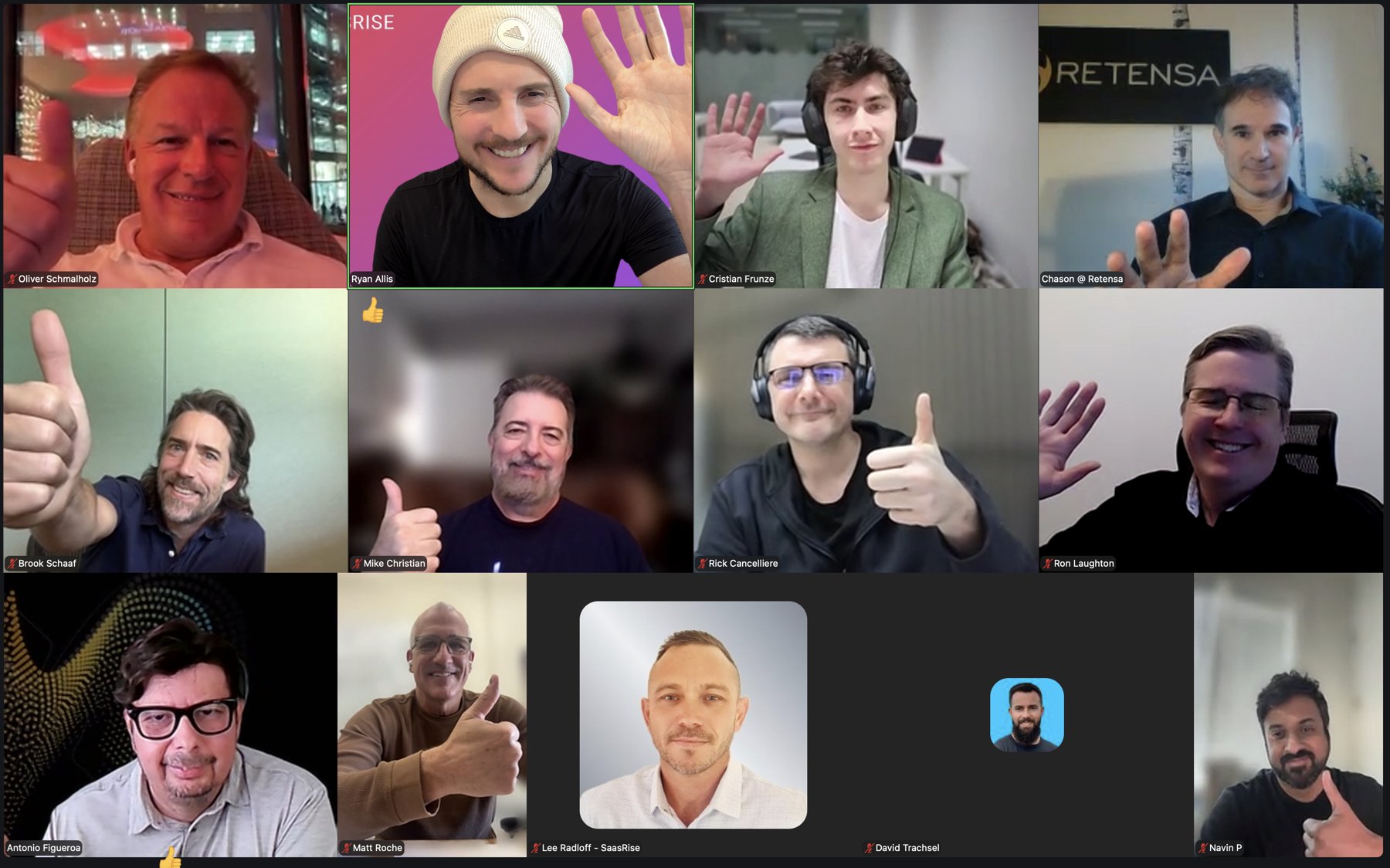
Weekly AI Founder Mastermind recap, November 12: 14 founders on the call
The sixth Weekly AI Founder Mastermind brought together 11 founders and CEOs, plus the AI Lounge team, from Amsterdam, Lisbon, Dublin, New York, Dripping Springs, Pittsburgh, Dallas, San Francisco, Los Altos, Woodland Hills and Fort Lauderdale (join next week's call with Lounge Pro). Seven topics: building a company brain, keeping sensitive data out of it, how agent loops hand work to each other and to people, redesigning a UI with a council of AI models, pricing when tokens are a real cost, whether to self-host models, and whether product management is still its own job. The thread through all seven: AI now does most of the work between the conversations, so the questions that matter are what it can see, what it costs, and who owns the result.
- $30 vs. $30,000: what one runaway user in a loop cost before he was cut off, and what it could have cost.
- 80 to 90%: the share of customers who should stay under your usage cap.
- $4M to $1M: AT&T's token spend after going hybrid.
- 40% to 70%: one member's gross margin in six months, delivering at about 25% of the old cost.
- 10 to 12: design rounds per screen in one member's AI design council.
- New member: Mike Christian (Founder & CEO, From the Future) joined for the first time. His company, From the Future, came out of gaming and defense simulation, recently sold part of its VR business, and is rebuilding itself AI-first. His biggest problem right now: keeping track of everything.
- AI GTM webinar, Wed Nov 18: Tom Regan (Founder & CEO, ArtemisGTM.ai), Apollo's founding SDR leader and now CEO of Artemis GTM, on building a signal-based AI outbound system, programmatic ICP scoring and email infrastructure for deliverability. Free for AI Lounge and SaasRise members, and your team is welcome. Register here.
- A bigger group next week: the call is now open to more AI Lounge members who are AI and SaaS founders with $1M+ in ARR.
Brook Schaaf (Co-Founder and CEO, FMTC) wants every meeting, email and Slack message in one place, so that after a call the AI does nine tenths of the follow-up work. He's using Balda, a freemium Obsidian alternative that's easier to permission and sync, with folders for collected material, prompts, operating rules, intelligence and outputs, and pages for key companies and people. It runs overnight: if a salesperson promises a follow-up and it slips, it's caught that night, not two days later. A friend of his goes further, dumping all his email into a bucket and having AI draft every reply for him to edit.
- Ryan Allis (CEO, AI Lounge & SaasRise): Emmanuel Lavois of Jetstream, who got Brook using Balda, says the key is permissions by folder, topic and person. AI Lounge's CRM, Lightfield, has a similar company brain but can't yet redact or permission by department.
- Matt Roche (Founder and CEO, Extole) asked what Balda adds over the Confluence his company already has. Brook: the harness reads local, synced files more easily, and moving things over forces you to decide what's worth keeping. He still uses GitHub for technical work and Jira for product discovery, with the harness writing to both.
- Cristian Frunze (Founder, Ken): start with skills files (claude.md and project instructions) holding a map of each project and when to use what. When the context outgrows them, add a memory database with permissions. His team's runs on a bare metal server.
Chason Hecht's company, Retensa, works on employee experience and knows "the skeletons in all the closets" of its clients, so it moves slowly with AI.
- Brook: Balda sets permissions per vault. His team ran every Fireflies and Zoom transcript through a redaction pass with Codex, then with Claude. Claude caught more but was overcautious, even removing subscriber names an internal call needs.
- Brook: Gmail exports let you set rules to skip certain topics and people. And if a conversation is that sensitive, you probably shouldn't record it at all.
- Brook's idea: public redaction standards for recorded calls, so every participant can see which one is in use.
Matt runs one loop that builds programs customers ask for, like a loyalty or referral program. When one fails, a person asks Claude why, and the answer (say, an unclear API) becomes work for another agent on the architecture. How should loops pass work, and who decides what comes first?
- Cristian: his team added Claude to ClickUp as a user with its own email, so agents working at the same time left each other comments. They moved to Linear, which is "way better for agents," and now run their own communication layer: a database with an internal front end only the team can sign in to. It sets priorities, limits what each agent can pass to whom, and lets a teammate approve before taking a task on.
- Cristian's tip: put your skills in an internal plugin in your GitHub organization. Everyone installs it in Claude Code or Codex, and when you push an update, every teammate's agent gets it at once.
James Kennedy (Founder, ProcurementExpress.com), inspired by a Theo video, set up three AI models as a design council to revamp ProcurementExpress.com's legacy app in T3 Code. A master thread picks the screens with the most traffic and the most room to improve; the council works through spacing, balance and typography, 10 to 12 rounds a screen.
- The breakthrough this week: when it's done, it makes a voiced explainer video of what it changed and why, with before and after screenshots. That cuts through AI "code vomit," and anyone from customer success to engineering can review it in a Slack channel.
- Ryan: a year and a half ago few would have believed that by the end of 2026 we'd have self-improving software factories whose commits no human reviews. Most code will never be reviewed by a person.
Ron Laughton (Founder & CEO, ReviewInc) now has a social media builder, an image generator and an "Ask AI" report in his app, and the tokens are adding up. Absorb them, or pass them on? (His update on AI code: Claude Code works, but keeps duplicating instead of reusing what exists, so his team has to keep reminding it.)
- Matt: first, cap runaways. At ADP, a client of his, one user got stuck in a loop; it was $30 when they cut it off, and could have been $30,000. Then, per the pricing specialist he hired: don't price per token, because you're stuck marking up tokens and can't capture the extra value you create. Price on outcomes (Sierra or Serval charge something like $2 to $5 per policy or offboarding processed), set caps that 80 to 90% of customers stay under, and price the overages. And remember procurement will only buy in a few ways.
- Brook pushed back: FMTC's creator discovery product gives a monthly token allowance that covers hard costs like pulling Apollo records. Isn't a cap just a way to slice the same thing? Matt: tokens protect the downside but cap the upside.
- Cristian: free daily and monthly tokens, then credits at cost. At the limit, Ken compacts the conversation and offers a prompt to continue in Claude or ChatGPT through its MCP, where Anthropic and OpenAI subsidize the tokens.
- Chason: eat the cost now, with guardrails. "This is our generational land grab." If clients don't adopt agentic tools from you, they will from someone else, and someone can vibe-code a lookalike in a week.
- Ron is starting with a daily limit of 10 requests, and a new white-label feature that posts reviews to social media as graphics is capped at one a week.
Ryan has seen companies spending hundreds of thousands to millions a month on Anthropic, OpenAI or Google buy GPUs, run an open-weight model like Kimi, and cut token costs 80 to 90% for most of the results.
- Oliver Schmalholz (Chief AI Builder & Co-Founder, ListKit): ListKit tested it, but Anthropic's and OpenAI's price cuts (Haiku included) wiped out the savings; their bill for personalization and routing is down 90%. Cheaper hosted models filter at 95 to 97% accuracy, but their tighter rate limits slow the whole pipeline. And customers of a premium product expect the brand name.
- Antonio Figueroa (Founder and CEO, Raken AI Labs): a Mexican steel company built its own LLM stack to save on tokens. Its data science team doubled from 20 to 40, it never used the models with customers, and when the chief data officer who built it left, nobody could maintain it. "It's not your core business."
- Antonio: AT&T went hybrid: on-prem models for internal work and simple customer tasks like billing review, and models like Sonnet wherever a mistake with a customer is a liability. Token spend fell from $4M to $1M.
At Matt's company anyone can now code the platform through an agent, and a fast-growing B2B AI company he met has no product team at all, just forward deployed engineers, strategy people and engineering, coordinated by AI. So is product a role anymore?
- Ryan: product manager, designer and developer are collapsing into one. "I was a 10 out of 10 product owner and a 1 out of 10 engineer. Now I'm a 10 and a 5, and it keeps getting better."
- Antonio: his company merged its data scientists and former McKinsey consultants into "business scientists." Four or five people now run two or three projects at once, at about 25% of the cost for the same price as three years ago, and gross margin went from 40% to 70% in six months. The time saved goes into helping customers adopt.
- Brook asked whether clients will push the price down. Antonio: they already say "we can build it with Claude in two weeks." His answer: go try. They come back needing help to scale it with the right guardrails and security. Price your expertise and the business result, not the product.
Lessons learned
- Give your company brain permissions from day one, redact before you ingest, and don't record what's too sensitive to store.
- Start agent memory with plain project files, and push shared skills to the whole team through one plugin.
- Cap runaway usage before you set a price; then price outcomes, not tokens.
- Self-host only where the volume and the team justify it; never let it depend on one person.
- The roles are merging: organize around people who can own a problem end to end, and sell the result, not the build.
Brook: "It's probably best to price with tokens." Matt: "I'm just gonna call that making a token effort."











- Antonio Figueroa · Founder and CEO, Raken AI Labs
- Brook Schaaf · Co-Founder and CEO, FMTC
- Chason Hecht · CEO, Retensa Employee Retention
- Cristian Frunze · Founder, Ken
- David Trachsel · Head of Growth, SaasRise
- James Kennedy · Founder, ProcurementExpress.com
- Lee Radloff · Head of Sales & Member Success, SaasRise
- Matt Roche · Founder and CEO, Extole
- Mike Christian · Founder & CEO, From the Future
- Navin Prasad · Founder, EigenV
- Oliver Schmalholz · Chief AI Builder & Co-Founder, ListKit
- Rick Cancelliere · Founder and CEO, PracticeBeat
- Ron Laughton · Founder & CEO, ReviewInc
- Ryan Allis · CEO, AI Lounge & SaasRise












Comments2
I love these roundups on here. Gives me insight into what others are doing as well as thinking about the AI world.
Great recap. Ryan's line — most code will never be reviewed by a person — is probably true. But this week I had an app pass every Google check, and the tester link still didn't open for anyone outside. The code was fine; the gap was something only an outsider could see. So my rule now: one external person tries it first, then the invites go out.
2 comments
I love these roundups on here. Gives me insight into what others are doing as well as thinking about the AI world.
Great recap. Ryan's line — most code will never be reviewed by a person — is probably true. But this week I had an app pass every Google check, and the tester link still didn't open for anyone outside. The code was fine; the gap was something only an outsider could see. So my rule now: one external person tries it first, then the invites go out.