 @victor2
Looking at who gets the money in the EU
Let's start with the meetings. Since January 2025, Commission managers down to Heads of Unit have had to publish their meetings with lobbyists, with some exceptions. That gives nearly two years of records. We took the organisations in the EU lobby register (the public list of those who try to influence EU policy) and counted one seat at the table for each of them at each meeting.
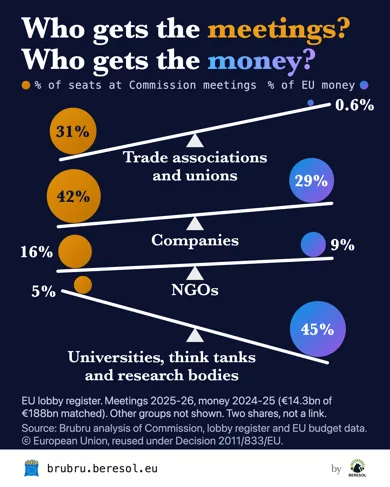
Trade associations and unions hold 31% of those seats. Companies 42%. NGOs 16%. Universities, think tanks and research bodies just 5%.
Now the money. In the #EUbudget's own transparency files for 2024 and 2025, we could match €14.3bn of the €188bn committed to organisations in that register. Trade associations and unions get 0.6% of it. Companies 29%. NGOs 9%. Universities, think tanks and research bodies 45% (between 34% and 67%, depending on how you count).
Is this a scandal? No. It is a map. Associations exist to speak for their members, and EU research programmes exist to fund researchers.
It also says nothing about cause. Two shares side by side do not show that a meeting leads to money, or the reverse. When we tested the order, money then meetings and meetings then money looked about the same.
One small thing we did find: at the same size, organisations that receive EU money are about 6 points more likely to have met the Commission. That gap is much the same for NGOs and for companies.
These files live on different EU websites. Brubru holds them side by side, which is what made this possible.
So, for those who know #Brussels: is this a healthy split between those who speak and those who are funded, or does it tell us something else about who gets heard?











Comments
0 comments