What's the future for pure math research in the age of AI?
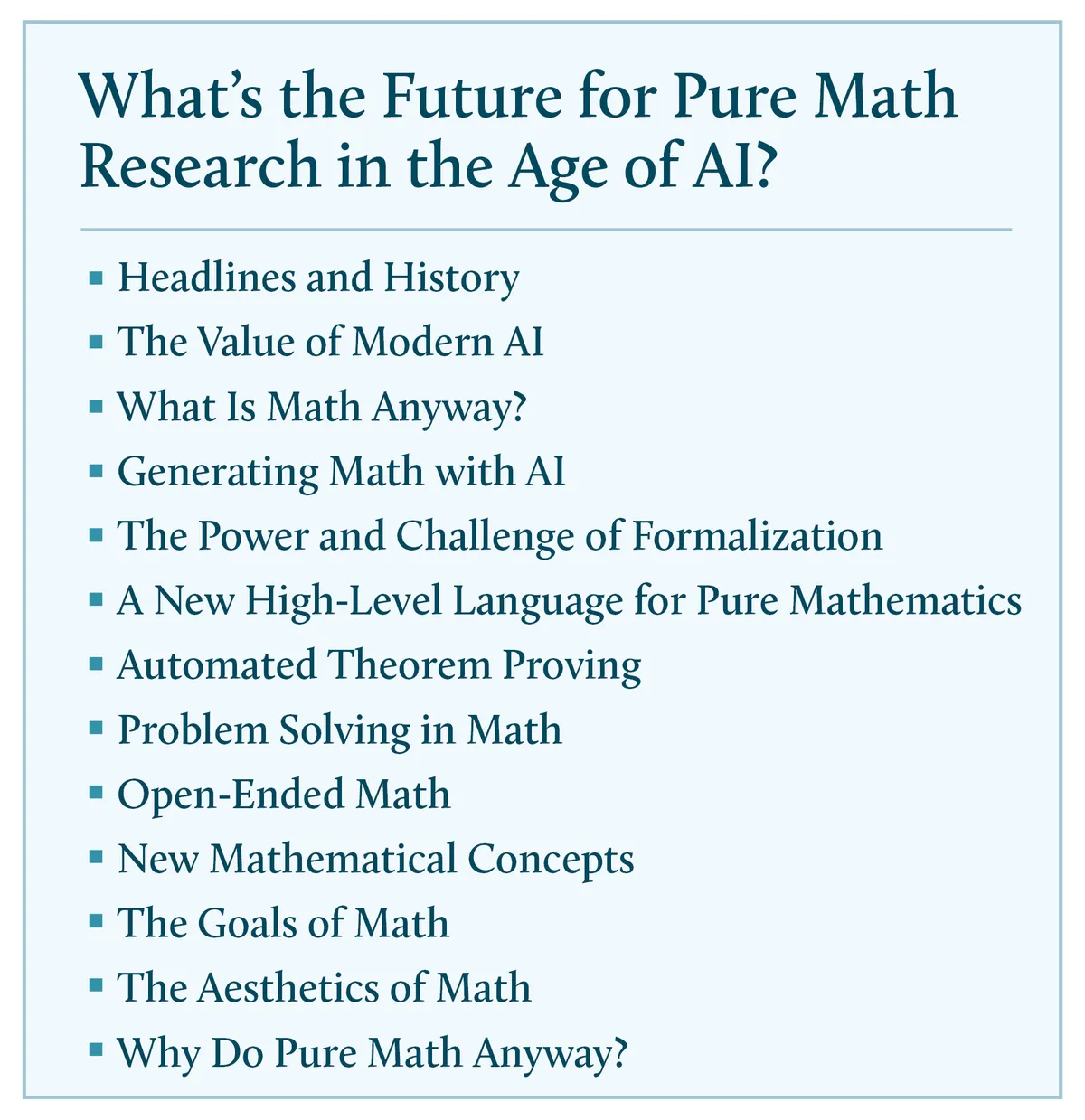
The essay, posted in late September 2026, says AI is most useful for mining the knowledgebase of human mathematics thematically. Wolfram argues that LLMs weaken on long proofs, because their statistical nature makes success less likely as things get more complicated. Math also differs from prose in that a written piece of mathematics can be wrong. Giving the model Wolfram Language to compute with is his proposed fix. His team is extending Wolfram Language to cover pure math constructs such as sheaves, Lie groups and Clifford algebras. The aim is a computational layer connecting human mathematics, AI and formal verification. He also holds that pure math will never be finished, because of computational irreducibility. In his view, deciding which questions matter is a human aesthetic and social process that AI cannot replace. The piece answers a growing claim that math research could be handed to AI, prompted by repeated headlines about systems solving named problems. It is also a product argument from a vendor with an interest: Wolfram sells the tooling he says models need. For AI founders, the takeaway is that tool-grounded reasoning and verification are where Wolfram expects durable value in technical domains. Teams building math or science agents should expect pressure to pair LLMs with exact symbolic engines and formal checkers, not to rely on model output alone.