 @victor2
The #AI revolution is artificial. The drama surrounding it is profoundly #human.
The Jensen Huang and **NVIDIA** saga of the past two weeks would make a rather entertaining **#culebrón** TV series: we all know, by now, what happened. Eventually, there was a spectacular comeback.
All of this happening while the AI industry is facing growing questions about its valuations, its sustainability and its enormous infrastructure investments. But I think there is something much more interesting happening here than corporate gossip.
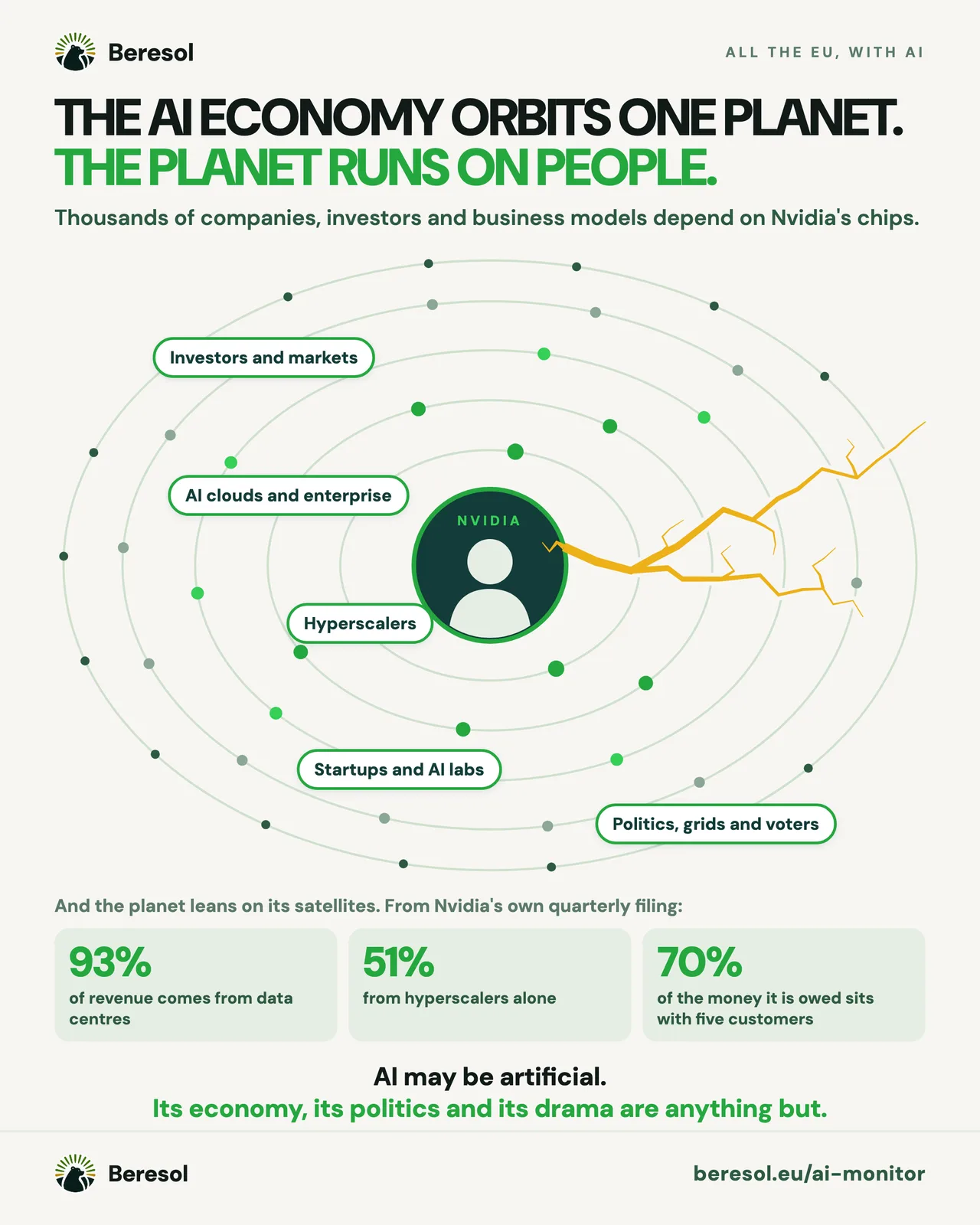
Consider the ecosystem: Nvidia is not just another technology company. It is one of the central pillars of the AI **#economy**. Thousands of companies, investors and business models depend, directly or indirectly, on its **#chips**. Think of Nvidia as a planet with an enormous constellation of satellites orbiting around it. If something happens to that planet, the consequences can travel throughout the entire constellation.
And yet, what happens to this supposedly sophisticated technological ecosystem can depend on something as fundamentally human as the private life, personal relationships, ambitions and decisions of one individual.
Then there is the political dimension: the president of the **#UnitedStates** intervenes publicly in support of a particular **#CEO**. Meanwhile, voters are increasingly questioning the construction of data centres, the infrastructure on which this entire technological revolution depends. **#WallStreet** is nervous, **#SiliconValley** is under scrutiny, and **#MainStreet** is increasingly sceptical (wonder why!).
And somewhere in the middle of all this, social media is producing thousands of **#memes** (read "mémés", not meemms) about the whole affair, many of them generated by AI itself, running on the very chips manufactured by Nvidia. It is almost too good to be true.
I cannot help thinking about **#Keynes** and his concept of animal spirits: the human emotions, instincts, confidence and fears that influence economic decisions, sometimes far more than rational calculations would suggest.
We like to imagine that financial markets are rational, that technological ecosystems follow predictable economic principles, and that artificial intelligence represents something fundamentally different from everything that came before. And perhaps we should remember something: There is nothing particularly artificial about the forces driving the AI revolution.
Artificial intelligence is a human creation: its infrastructure is built by humans; its companies are managed by humans; its investments are driven by human expectations, ambitions and fears. And its markets are influenced by human relationships, political interests and personal rivalries. Even the most sophisticated technological ecosystem remains vulnerable to the oldest forces in human history.
Perhaps that is the biggest irony of the AI revolution: we are building increasingly intelligent machines while discovering, once again, how irrational the human systems surrounding them can be. AI may be artificial. Yet its economy, its politics and its drama are anything but.










Comments
0 comments