 @johnryan88862
The most dangerous word an AI can say is Done.
We’ve all seen it. You ask a model to write code, review a contract, or analyze a database. It gives you a fluent, confident, beautifully formatted answer. And then it quietly breaks something.
Why? Because we are still letting the same model create the work, review the work, authorize the work, and declare itself successful.
Adding a second prompt that says "Now be critical" doesn’t fix this. It’s the same authority in a different hat.
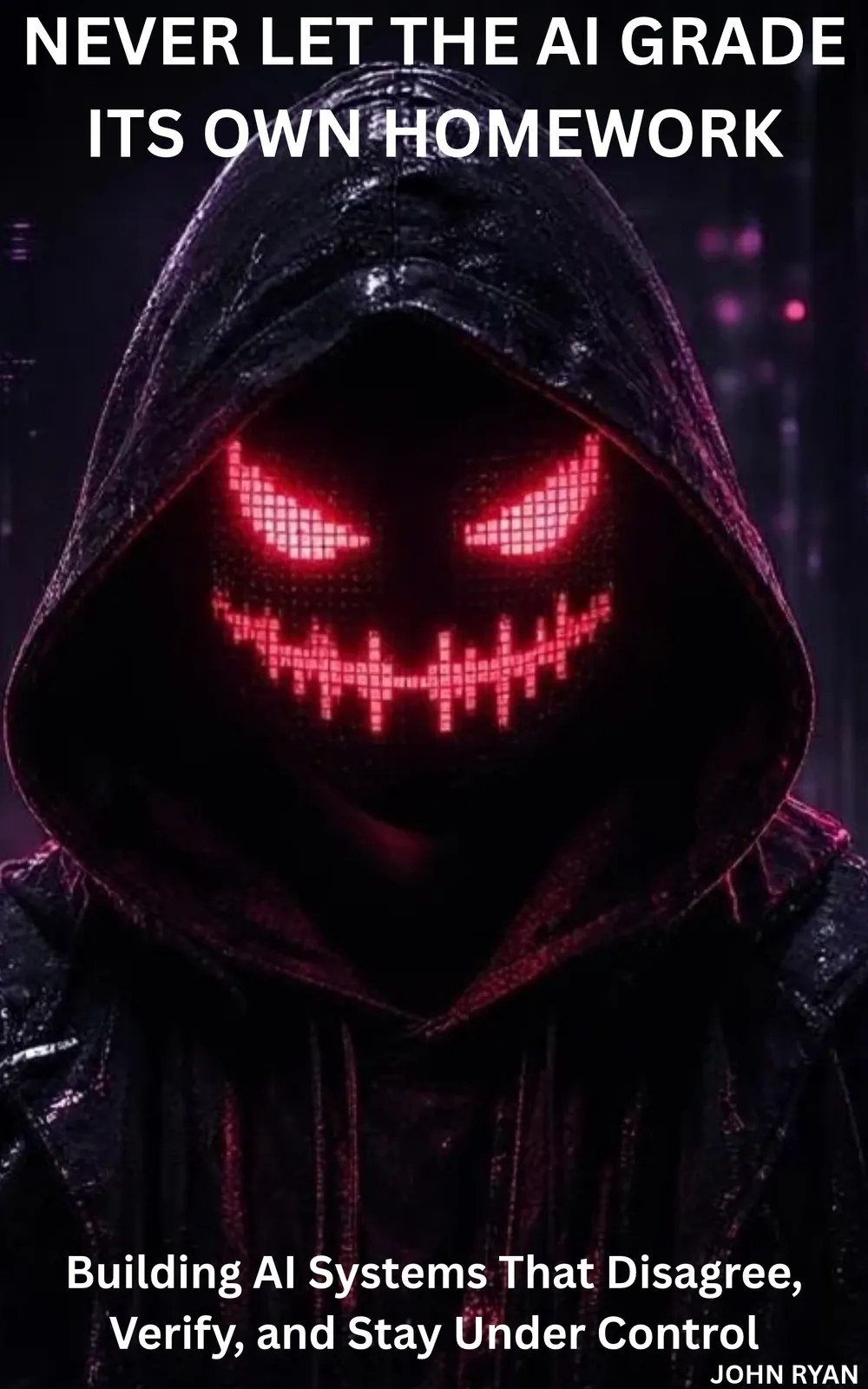
I just published Never Let the AI Grade Its Own Homework—a 66,000-word engineering blueprint for building AI systems that actually verify their own work.
It’s not a book about "prompt engineering." It’s about architecture.
Inside, you’ll find the exact specifications for:
🔹 Dual-Agent Orchestration: Blind proposals, deterministic comparison, and strict verdict grammars.
🔹 State Machines & Supervisors: How to enforce atomic call budgets, absolute deadlines, and bounded revisions.
🔹 Memory with Provenance: Why your agent's memory is a liability without expiry rules and conflict quarantine.
🔹 The Anatomy of a Lie: The 6 structural ways AI systems fake success, and the controls to stop them.
🔹 Call-Matched Evaluation: How to measure if two agents actually beat one, without fooling yourself.
Most AI projects fail not because the model is dumb, but because the architecture lets it lie.
If you're building agents that handle real consequences, you need to know how to keep the creator separate from the judge.
The blueprint is available here: payhip.com/b/RZfpl
Let’s build systems that can tell the truth about themselves.









Comments
0 comments