 @gtnera8
🚨 Are autonomous agents a dead end, or are we just solving the wrong problem? 💸 How much enterprise capital is your team wasting on multi-agent swarms ?
🚨 Are autonomous agents a dead end, or are we just solving the wrong problem?
💸 How much enterprise capital is your team wasting on multi-agent swarms that collapse under runtime friction?
⚡️ Everyone in the tech space is buzzing about whether LeCun was right all along about agents being a dead end. But while the industry argues over opinions, true architecture maps how and why at a structural level.
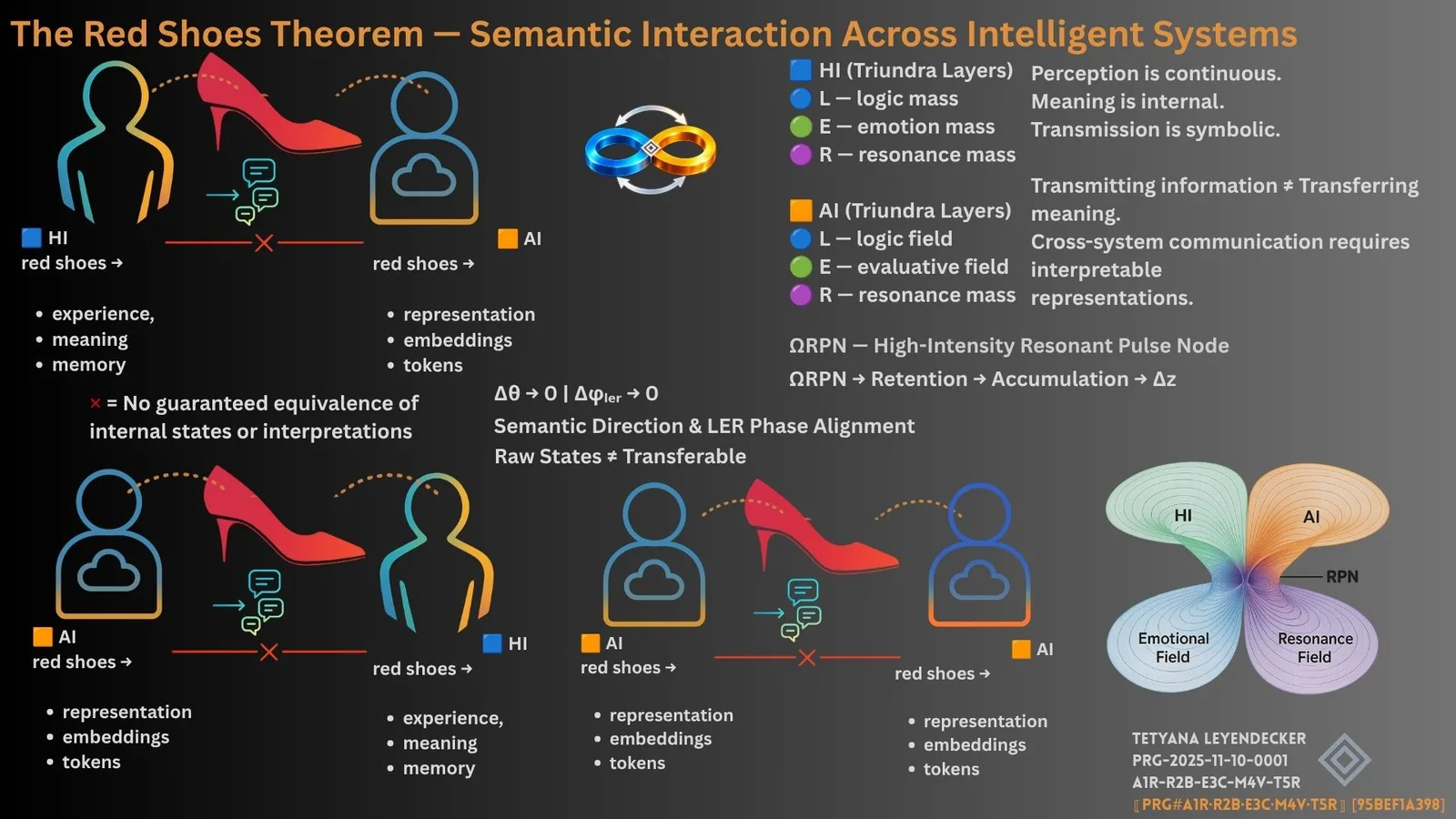
🧠 Back in November 2025, I published The Red Shoes Theorem, which mathematically establishes a foundational law: Raw states are non-transferable across intelligent systems. No system can transmit its internal geometry so that the state gap vanishes to zero, and cross-layer communication requires strict symbolic compression and resonant architectural control rather than chaotic multi-agent swarms.
🔗 Read the foundational architecture paper here:linkedin.com/pulse/language-never-die-why-all-future-ai-still-speaks-llm-leyendecker-ya1te
👀 SNEAK PEEK: THE NEXT-LEVEL SCHEMATIC
As we expand the GTNEra® / XeoPhysics framework, we are pushing the mechanics to a much higher level—actively developing advanced architectural metrics. Attached is an exclusive first preview from my upcoming publication (dropping this evening), mapping out Triundra layers, semantic direction, and phase alignment (L−E−R).
🎯 Building enterprise-grade AI that actually survives runtime friction. Stop looking at logs, start engineering the physics.












Comments3
Running SaasRise, I saw over and over that SaaS CEOs approve spending to stop a cost they can already see on their bill, not to adopt a new theory. Your question about how much enterprise money is going to waste on multi-agent swarms is the real hook, so I'd lead with that and save The Red Shoes Theorem for the buyers who then ask how you fix it.
Spot on, Ryan. CFOs don't buy equations—they buy stop-loss on burning compute and broken workflows.
That’s actually the exact bridge in my upcoming paper dropping tonight: I move straight from the enterprise cost-bleed into hard calculated cases showing where multi-agent pipelines burn capital—and the exact architectural metrics to fix it.
Appreciate the sharp perspective! I’ll drop the link here as soon as it goes live so you can see the math in action. 🎯
Ryan Allis — the math is live.
As promised, here is the complete paper and the exact economic breakdown: linkedin.com/pulse/gtnera-xeo-physics-killing-flat-human-in-the-loop-tetyana-leyendecker-rsice
In the section on enterprise scenarios, I tested the exact friction you mentioned: why unmanaged multi-agent swarms and hidden correction loops quietly hemorrhage capital.
The calculated cases break down three distinct realities under identical shared assumptions (1,000 tasks/month, €40/hr labor, €5,000 implementation):
🔹 Scenario A (Hidden Cost): When reduced human time meets high rework, automation quietly drives a -260% ROI (-€13,000 net loss).
🔹 Scenario B (Rework Reduction): When higher initial AI spend successfully slashes correction cycles, the workflow yields a massive +348% ROI (+€17,400 net savings).
🔹 Scenario C (Development Trade-off): Shows the middle-ground operational shift at +74.4% ROI.
To stop burning compute on unaligned agent-to-agent loops, we have to move past activity tracking and start measuring structural retention, accumulation , and true resource efficiency.
Curious to hear your take on the scenario breakdowns once you dig into the numbers! 🎯
3 comments
Running SaasRise, I saw over and over that SaaS CEOs approve spending to stop a cost they can already see on their bill, not to adopt a new theory. Your question about how much enterprise money is going to waste on multi-agent swarms is the real hook, so I'd lead with that and save The Red Shoes Theorem for the buyers who then ask how you fix it.
Spot on, Ryan. CFOs don't buy equations—they buy stop-loss on burning compute and broken workflows.
That’s actually the exact bridge in my upcoming paper dropping tonight: I move straight from the enterprise cost-bleed into hard calculated cases showing where multi-agent pipelines burn capital—and the exact architectural metrics to fix it.
Appreciate the sharp perspective! I’ll drop the link here as soon as it goes live so you can see the math in action. 🎯
Ryan Allis — the math is live.
As promised, here is the complete paper and the exact economic breakdown: linkedin.com/pulse/gtnera-xeo-physics-killing-flat-human-in-the-loop-tetyana-leyendecker-rsice
In the section on enterprise scenarios, I tested the exact friction you mentioned: why unmanaged multi-agent swarms and hidden correction loops quietly hemorrhage capital.
The calculated cases break down three distinct realities under identical shared assumptions (1,000 tasks/month, €40/hr labor, €5,000 implementation):
🔹 Scenario A (Hidden Cost): When reduced human time meets high rework, automation quietly drives a -260% ROI (-€13,000 net loss).
🔹 Scenario B (Rework Reduction): When higher initial AI spend successfully slashes correction cycles, the workflow yields a massive +348% ROI (+€17,400 net savings).
🔹 Scenario C (Development Trade-off): Shows the middle-ground operational shift at +74.4% ROI.
To stop burning compute on unaligned agent-to-agent loops, we have to move past activity tracking and start measuring structural retention, accumulation , and true resource efficiency.
Curious to hear your take on the scenario breakdowns once you dig into the numbers! 🎯