 @jmcentire3
Entirely Correct
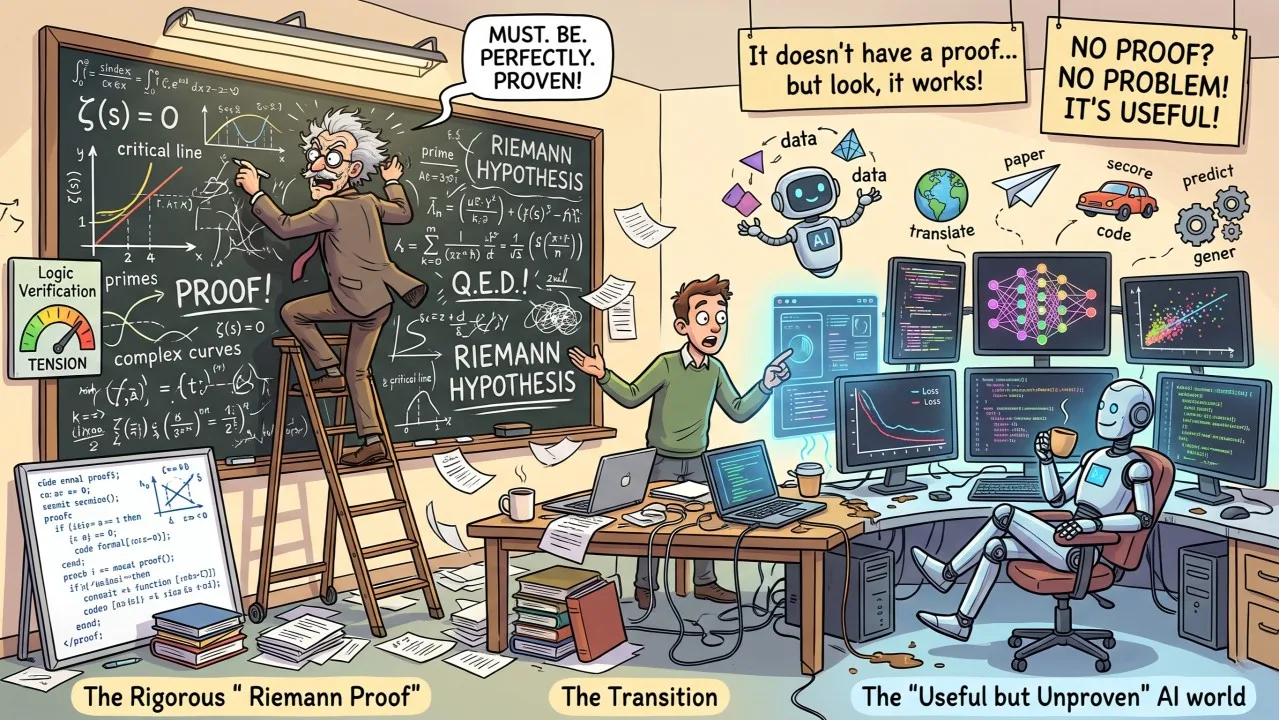
Gary Marcus has written about the Riemann Hypothesis proof, and he is entirely correct.
He is correct that the AI did not do it alone. Levent Alpöge, a mathematician of the first rank, chose the direction and guided the work for months. He is correct that the proof leans on Lean and mathlib, two million lines of formalized mathematics built by hundreds of people over years, an infrastructure most fields do not have and cannot quickly get. He is correct that this is not AGI, that a proof whose explanation runs past 250,000 pages has taught nobody a new technique yet, and that solving the Riemann Hypothesis does not negotiate a contract or widen anyone's operating margin. Every fact the essay stands on checks out.
Yet he is wrong.
Not in anything he asserts. He is careful there: he says only that it is "not at all obvious" the result reaches beyond mathematics, and he never says it cannot. The error is in the reason he gives for the doubt. Mathematics can be checked true or false by a machine, most fields cannot, and so, he reasons, what worked here probably stays here.
Look at what that check is. Mathematics has a grammar strict enough that a program can read a proof and rule on it. The ruling comes from a kernel, the purest approver we have that is not a person. Everywhere else, approval is an act performed by a principal. Who approves the marketing campaign? A person. Whoever owns the budget and the outcome, exercising judgment and weighing the contributing factors, exactly as they did when the campaign was made by a human being.
We never had a true/false gate for the marketing campaign. We hired people anyway. We judged the work anyway. The end product was never provably correct; it was acceptable, which is a property conferred by the approver, not a property of the artifact. If an AI's campaign passes through the same judgment and comes out as acceptable as anyone else's, the missing gate disqualifies nothing. Nothing ever rested on it.
Provability is one species of approval, the species where the approver isn't a person. Marcus operates the concept expertly. He predicted in 2024 that verifiable methods would pay off in math first, and he was right. But he has taken the species for the genus, and graded every other field for lacking the one approval mechanism that was never in use there.
Marcus has a stronger objection within reach, and it deserves an answer. The kernel did more than accept the finished proof. It caught every wrong turn on the way, across seventeen million lines of Lean that no person has read. For work that long, an exact check is all that stands between progress and compounding error, and no human approver could have stood in for it. That is true. It is also the oldest problem in delegated work, and it did not arrive with AI.
No field outside mathematics has ever had a kernel, and every one of them has had to rely on work that the person paying for it could not check line by line. So they built gates of their own. Pacioli, a mathematician, wrote down double-entry bookkeeping in 1494: the books balance or they do not. The building inspector, the second signature, the audit, the clinical trial, and the load test on the bridge are the same idea. Software has a whole stack of them: the compiler, the type checker, the linter, static analysis, the acceptance test. None of these is a proof. Each is a narrow true/false check cut into a field that has no general one, and together they are how long chains of unprovable work have always been kept honest. It is why I built Pact: the contract and its tests are written before any code, and the contract, not the agent, decides whether the work passed.
The absence of a kernel, then, is not a new problem that AI must solve before it can leave mathematics. It is the ordinary condition of nearly all work, and we have been building around it since somebody first hired a stranger to raise a wall. The advice to every field without a kernel is short. Use those.
What survives of his argument, once the error is out, is a claim about rates. AI improves fastest where the error signal is exact, because every wrong turn gets caught and the progress compounds. Where the feedback is slow and confounded, the refinement is slower, and the longer a piece of work runs unchecked, the more gates it needs along the way. That is true, and worth saying. It is a claim about how fast and how carefully. It is no reason to doubt whether.
Alpöge watched the whole thing happen. He admits the grief in it: the problem that steered his working life is gone. And then he says that what he saw on the way there convinced him this is "one dawn across science of something far greater." He works for Anthropic, so discount that as you see fit. But notice that he is describing the work, not the gate.
You can get provability, get it completely, every fact about it, and still not understand what provability is. Entirely correct is a real achievement. It just isn't the same as being right.










Comments
0 comments