 @jmcentire3
Telephone
Where the agent business goes next, and how WhatsApp gets there first.
A user asks their agent to fix a flight. The agent knows the user: the frequent-flyer number, the aisle seat, the kid who needs the early connection, the fact that this is the third time this airline has done this to them. The agent reaches the airline, and the airline has an agent too. So the user's agent writes a summary, the airline's agent reads it, and the airline's agent asks for the last name.
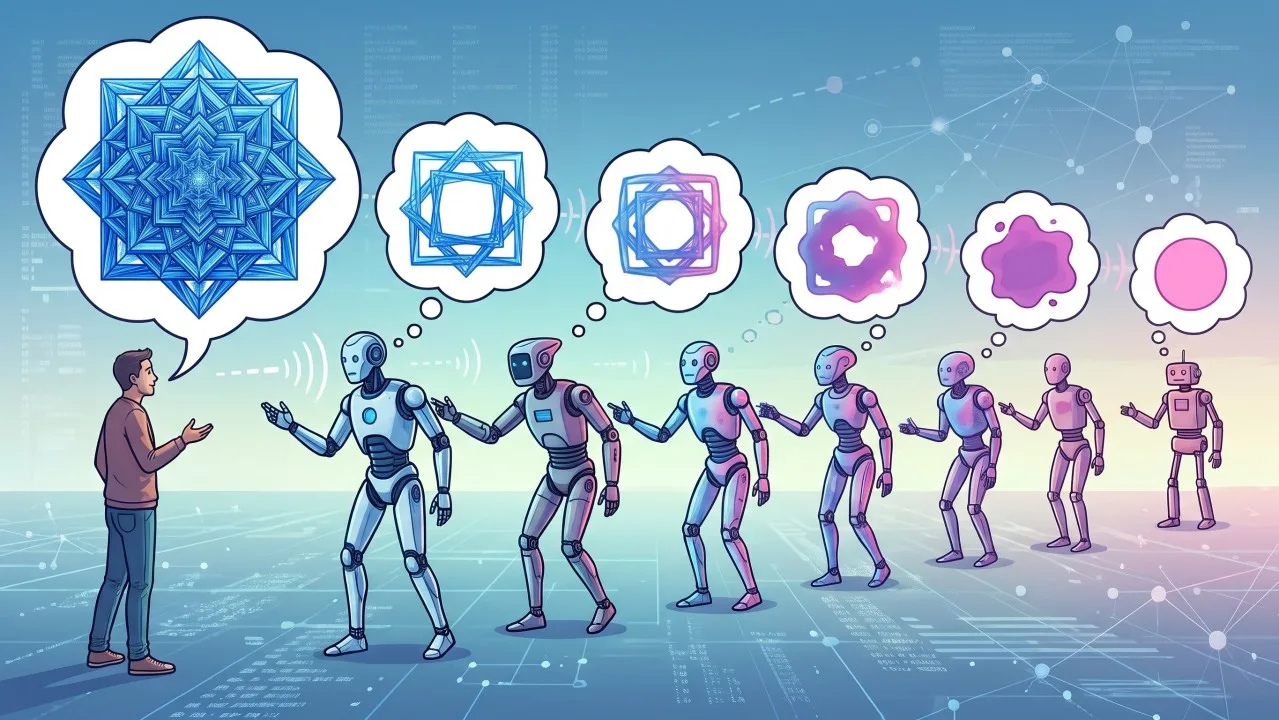
That is the whole problem, in the first exchange. Everything the user's agent knew was compressed into a paragraph. The paragraph was read by a model with its own instructions. Both sides paid for inference, and the result was worse than either could have produced alone.
Nothing here needs a study, though I have run a few and they point the same way.[1]
Compression loses information. A summary of what an agent knows is smaller than what it knows, and whatever was left out cannot be recovered from the summary. Each handoff is another compression, so each hop is a chance to lose the one fact that mattered.
Each hop is also a chance to invent one. A model reading a summary fills gaps the way models do, and the next model downstream cannot tell a filled gap from a fact. Errors do not cancel across a chain; they accumulate, because nobody later in the chain has the original to check against.
The receiving agent is not neutral. It works for the airline, so it is tuned to retain the customer, offer the voucher, steer toward the upgrade. That is not a flaw. It is what the airline paid for. But it means the summary is interpreted by a party with different goals than the person who wrote it, and the user's agent has no way to see what happened inside.
And the user is paying twice. Their agent already spent inference understanding them. The airline's agent now spends inference re-reading a degraded copy of that understanding before doing anything with it. Two bills, one task, and the second bill buys a worse answer than the first already had.
A smarter model on either end loses less per hop. It does not get back what was lost, and it does not change who it works for. The problem is the shape, not the parts.
The fix is not a better agent on the airline's side. It is no second interpretation.
The airline publishes what it can do: capabilities, typed and scoped, with their side effects declared. The rules that govern them, with effective dates and stable IDs, so "eligible for refund" means the same thing on Tuesday that it meant when the agent read it. The procedures, as states and transitions. The outcomes, as structured reason codes rather than apologies. The user's agent reads that surface, plans with full context, and calls the capability. The airline executes, enforces authorization, and signs what it did.
One inference bill. The user's context stays where it lives. Nothing is summarized, because nothing needs to be. The airline keeps the parts it cares about, execution, policy, and the audit trail, and stops maintaining a conversational layer that will always know less than the agent on the other side.
Some tasks are negotiation rather than execution, and agents are fine there. Most customer tasks are not. They are "do the thing my account entitles me to," and a published capability does that better than a conversation ever will.
MCP and A2A already carry the transport. They tell an agent what tools exist and how to pass a message. They do not tell it which version of the refund policy applies today, what the procedure is when a flight is cancelled versus delayed, what a denial means, or whether the airline will stand behind what its system just did. The surface is what you publish over the transport: the rules, the procedures, the outcome codes, and the signatures. That is the part nobody has standardized, and it is the part enterprises actually need.
Meta is selling business agents. That is the right tactic. The market is buying agents this year, and a company that doesn't sell one leaves the account to someone who will.
But it is a tactic, and tactics have shelf lives. The user's agent is the one that accumulates the user's life, and users will bring it with them. When they do, the business agent becomes a second interpretation layer in front of the business, which is the shape that doesn't work. The question is not whether that happens. It is whether Meta is standing on the right side of it when it does.
So build the business agent as a client. Every tool it calls is a published capability from day one. Every policy it quotes is a rule with an ID and an effective date. Every action it takes is signed. The agent Meta sells today is then the adoption path for the surface, not something to be thrown away later. The business got a chatbot. Meta got the interface underneath it, which is what the business's customers will use when they show up with agents of their own.
That is the hedge. If the agent market runs for five years, Meta sold agents for five years. If it turns in eighteen months, Meta already owns what the next thing needs. Nobody has to be right about the timing.
What WhatsApp needs in the enterprise is not another channel for a chatbot. Enterprises have channels. What they don't have is a place where their customers' agents can transact with them under rules the enterprise controls and can prove it followed.
That is the surface, and it is enterprise vocabulary by construction. Versioned policy. Scoped authorization. Delegation a company can verify, so it knows the agent calling it really speaks for the customer. Signed outcomes, so compliance has a record without reading a transcript. Telemetry that tells the company its refund flow fails on a missing field without anyone seeing a customer's message.
Put that under WhatsApp and the pitch to the enterprise changes from "your customers are already here" to "your customers' agents will act here, under your rules, with an audit trail." The first is a consumer argument. The second is the one an enterprise architect can sign. And every business that publishes a surface to reach WhatsApp's users has made WhatsApp the place its capabilities live, which is a position no model release can take away.
Businesses adopt because the customer's agent brings completed transactions rather than abandoned chats, and because they keep what they care about and shed what they never wanted to maintain. Meta wins because it holds the user side today and can build the business side before anyone else notices it needs building.
I've written the surface specification; it's at byoa.tools, and the delegation and attestation pieces are prototyped and open-sourced. None of that is a pitch. It's what I had to build to think clearly about the problem, and you're welcome to it.
The opening scene was a flight. Travel is the vertical where the user's context is richest, the business's rules are most formal, and the gap between "chat with our bot" and "your agent just did it" is widest.
[1]: Small-scale experiments, my own, suggestive rather than settled: natural-language handoff between model instances loses most of the sender's internal state (https://doi.org/10.5281/zenodo.18843833); on the same task and budget, a single agent outperformed every multi-agent topology, and coordination overhead rose with the number of links regardless of model capability (https://doi.org/10.5281/zenodo.18828442). I'd rather you checked the reasoning above than the numbers in these; but the research is there if you prefer it.











Comments
0 comments