Astra can read and write weights to improve Qwen
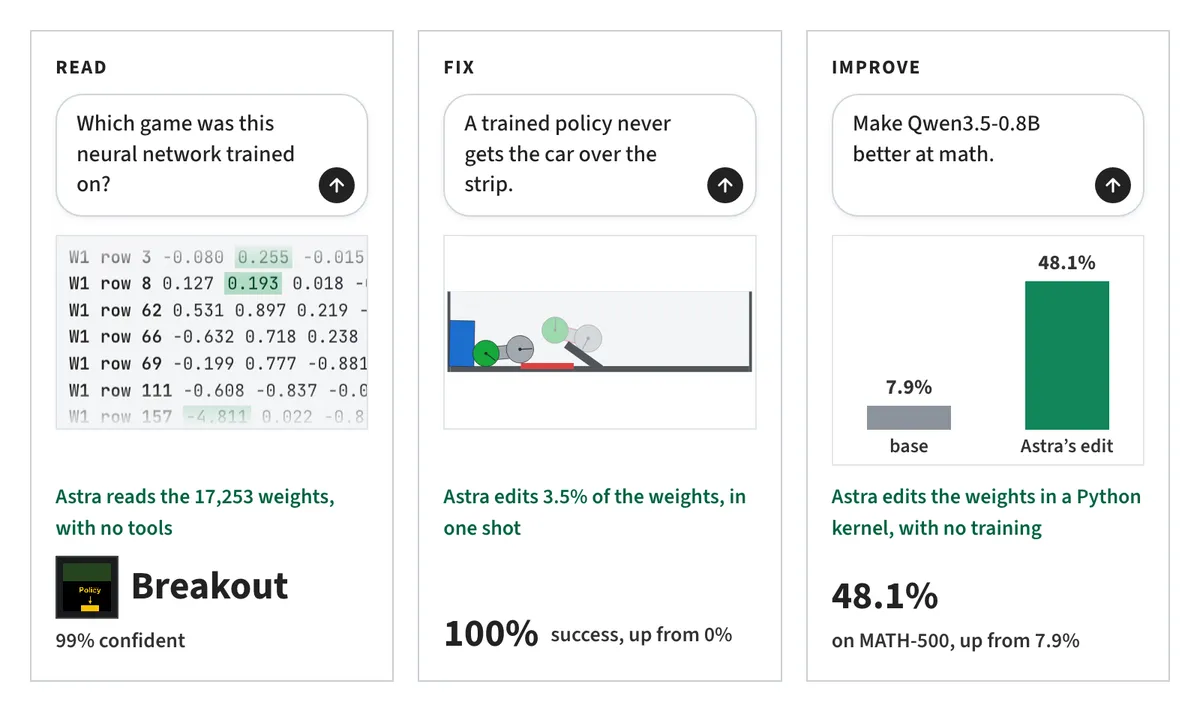
Rikiya Takehi and three co-authors published the write-up on their blog, rikiyat.github.io, on November 2, 2026. They argue that a general-purpose model, which they call GPT-6 Astra, can read neural network weights and rewrite them from a plain-language goal, with no gradient descent. VentureBeat, which credits MIT's Computer Science and Artificial Intelligence Laboratory, says the model is OpenAI's.
In the headline test, the prompt simply asked the model to make Qwen3.5-0.8B better at math. The model traced reasoning loops, a problem Qwen's own model card warns about, to one direction written by the MLP blocks in layers 15 and 19. Subtracting that direction from 64 output columns in each layer changed 131,072 weights, about 0.016% of the model, and MATH-500 accuracy rose from 7.9% to 48.1%. The model read the weights in a Python sandbox, which let it analyze tensors with numpy or PyTorch on a CPU, but it could not run the network.
Other tests were smaller. Across eight experiments, the model named the game a small policy network was trained on, wrote a Breakout network in a single reply, and fixed a PPO car policy by editing 3.5% of its weights, reaching 100% success. The work has not been peer reviewed, and the authors report that a non-looping Gemma 3 270M did not improve.
Why it matters
For founders, the claim challenges the default path of collecting data and running training jobs to change model behavior. If a model can make a small, targeted edit that fixes a known failure, teams using open-weight models may be able to patch narrow problems cheaply. That lowers the cost of niche products, but it also means the quality of an open model could depend on access to a closed frontier model and its terms.
For investors, the evidence is still thin. The headline result rests on one open model and mainly one math benchmark, and it has not been peer reviewed. Diligence should separate editing claims from training claims and ask for results on held-out tasks. Because the frontier model is not publicly available, any company built on this approach would rely on a vendor it does not control.
Key points
- 1The Qwen3.5-0.8B edit changed 131,072 weights, about 0.016% of the model.
- 2MATH-500 accuracy for Qwen3.5-0.8B rose from 7.9% to 48.1% after the edit.
- 3The model could read and save weights in a Python sandbox but could not run the network.
- 4A PPO car policy stuck on a ramp reached 100% success after editing 3.5% of its weights.
- 5The results have not been peer reviewed, and a non-looping Gemma 3 270M did not improve.