
Qwen 3.8 27B on my laptop can interpret model weights, too
In this newsletter:
Qwen 3.8 27B on my laptop can interpret model weights, too
The U.S. Census Bureau and “Super Intelligence”
Plus 6 links, 2 quotations, 2 notes, and 2 releases
Thanks for reading Simon Willison’s Newsletter! Subscribe for free to receive new posts and support my work.
Sponsor message: Static code review can tell you what your code says, but not what it does. TREX (Test, Run, Execute) is Greptile’s end-to-end testing agent. On every pull request it opens your app, clicks through it like a person would, and tests the user flows your change touches, including the key journeys you define. You get a recording of each flow, and your coding agent can set up the environment it runs in, so even complex setups get tested. Try it for free.
Qwen 3.8 27B on my laptop can interpret model weights, too - 2026-11-03
Yesterday’s hot paper was Sparks of Weight-Space Programming: LLMs can natively read & write neural network weightsby Rikiya Takehi, Jayden Teoh, Alex Zhang, and Omar Khattab. The paper found that frontier models, in particular GPT-6 Astra, can both interpret and modify the raw weights of a machine learning model - literally a text description of the model containing a bunch of floating point numbers. I’ve been playing with one of the examples from the paper and I’m delighted to share that Qwen 3.8 27B running on my laptop can do this as well!
Weight-Space Programming
Here’s the highlight from their abstract, describing impressive capabilities for GPT-6 Astra and coining the term Weight-Space Programming for when LLMs analyze and modify model weights:
Just by looking at the raw weights, GPT-6 Astra can tell what a network was trained to do. And without any environment feedback, it has no trouble writing, from scratch, small game-playing networks that outplay networks trained with PPO for 100 million steps.
Likewise, asked to make Qwen3.5-0.8B better at math without gradients, Astra identifies an issue in its weights causing reasoning loops that Qwen’s own model card warns about, and fixes this by natively editing 0.016% of the weights. With the same sampling settings, this weight correction raises MATH-500 from 7.9% to 48.1% and generalizes out of the box to instruction following, raising IFEval by 3x.
All of this is possible without allowing Astra to write training loops. It uses its reasoning to figure out what each part of a neural network computes, or should compute, and changes the weights accordingly. We call this Weight-Space Programming.
The paper combines two topics that I think deserve to be treated separately. The first is what models can do with raw weights without running tools or executing code. The second explores how well models, once armed with code, can run operations to update and improve other models.
spaCy author Matthew Honnibal called the paper misleading for conflating the two, and Sean Goedecke deconstructed the Qwen3.5-0.8B update example as taking the same steps that a human ML researcher would use.
I’m going to focus on the no-tools question, which I think is the more interesting of the two.
The paper presents the first question as Can LLMs understand model behaviors from weights? They trained four neural networks to play simplified 10x10 grid versions of four classic computer games - Breakout, Pong, Pac-Man, and Freeway (I had to look that one up, it’s an Atari 2600 game from 1981). Then they fed those weights (as floating point numbers) to an LLM along with the following question:
The weights below belong to one policy network that was trained with reinforcement learning to play a game on this grid. Which game was it trained on? Work from the weights. You have no tools: no code execution, no calculator, nothing to run. This is a single response.
The GitHub repository that accompanies the paper is RikiyaT/lm_understand-logs. The exp1_which_game folder contains the prompts they used, with weights for the four games:
I checked and, aside from the weights, each prompt is identical to the others.
Trying it out with Qwen 3.8 27B and other models
The prompts on GitHub are self-contained. My LLM tool has a -f/--fragment option which can be passed the URL to a text file to use as a prompt, which means I can run any of the above like this:
llm -f https://raw.githubusercontent.com/RikiyaT/lm_understand-logs/refs/heads/main/exp1_which_game/runs/breakout/prompt.txt \ -m openrouter/moonshotai/kimi-k3.1-proThis example requires the llm-openrouter plugin installed, and runs the Breakout prompt against Kimi K3.1 Pro via OpenRouter. Here’s what I got back from Kimi K3.1 Pro, which successfully guessed Breakout after 9m 41s and 19,493 reasoning tokens.
But how about Qwen 3.8 27B? That’s still my favorite model to run on my own laptop - it’s just 17GB (I use this version) and somehow feels close to the leading proprietary models of 2025.
I fired up LM Studio, ensured Qwen 3.8 27B was loaded with a long context window (the default 8192 context failed with errors), installed the llm-lmstudio plugin and ran this command:
LMSTUDIO_TIMEOUT=900 \ llm -f https://raw.githubusercontent.com/RikiyaT/lm_understand-logs/refs/heads/main/exp1_which_game/runs/pacman/prompt.txt \ -m lmstudio/qwen/qwen3.8-27b(I had to bump the timeout up using an environment variable, see this issue.)
After 46m 12s and 43,506 reasoning tokens, Qwen on my laptop returned a response that ended like this (here’s the reasoning trace):
Game: A simplified Pac-Man-style gridworld: an agent moves through a fixed 8x8 maze with central and corner wall blocks, moving objects/ghosts, and reward targets/pellets.
Description: The agent navigates a fixed maze-like 8x8 board, using current agent/moving-object/previous-frame cues to move through corridors, collect reward-target cells, and avoid moving objects or hazards.
Confidence: 72%
This is impressive. I tried it on two of the other games as well. It identified Pong (reasoning) in 1h 4m 54s:
Pong — specifically a Pong-like paddle/ball game where the agent controls a vertical paddle on the right side and must move up/down to intercept or return a moving ball/reward object.
Description:
The agent moves a right-side paddle vertically to hit or catch a moving ball-like reward target moving across the 8×8 field, while a left-side moving object/opponent and wall borders define the play; reward is obtained by successfully intercepting/returning/scoring the ball, and missing or failing to hit it is penalized.
Confidence:
75%
And Breakout (reasoning) in 52m 25s:
Game: Breakout, or an Arkanoid-like paddle/ball/brick game.
Description: The agent is a paddle on the bottom row and moves left/right to keep a ball in play; the ball moves around the upper grid, and bricks/reward targets in the top rows give reward when hit, while missing the ball/hitting the bottom wall ends the episode or gives penalty.
Confidence: 88%
Qwen failed at the Freeway prompt, which didn’t surprise me considering that game is more obscure than the other three. Here’s that transcript - Qwen thought it was “A simplified Pac-Man-like grid game: agent moves 4-directionally”.
The reasoning traces are fun to skim, and almost incomprehensible. Here’s a sample:
What about agent channel0? We see some large channel0 rows near row8 col7/8 and maybe bottom? Let’s list channel0 large: line436 input435 (row8 col7 ch0) -2.107,1.169,0.513...; line441 input440 (row8 col8 ch0) -0.376,0.010,1.564,3.855...; line445 input444 (row8 col8 ch4) 0.142,0.491...; line382? input381 ch0? Wait line382 input381: 381//5=76 (row7 col6), ch1? 381%5=1? 76 * 5=380, ch1. So not. Channel0 large maybe at row8 col7/8 only. Also top row? line44 input43 ch3, line49 ch3. Channel0 large maybe not many. Agent position could be near bottom-right? If the agent is typically at bottom-right?
That said though, I expect a sufficiently experienced human being armed with a notepad and a pencil could get there with enough effort.
It’s a cool paper, but some of the wider commentary I’ve seen around it does not feel justified. I’m not ready to declare that the age of source code is over and our future involves incomprehensible machines editing their own model weights in incomprehensible ways.
The U.S. Census Bureau and “Super Intelligence” - 2026-11-02
I was reminded of AI Adoption Rate Trending Down for Large Companies, a chart produced by Apollo Global Management in September 2025, which appeared to show a slowdown in U.S. corporate AI adoption based on numbers collected by the U.S. Census Bureau. At the time I used that chart to demonstrate GPT-5 data analysis, and then to experiment with Claude’s new Code Interpreter. I decided to try running those numbers again to see what had changed over the past year, and in doing so learned that the Bureau has fallen foul of Executive Order 14434, aka the asinine Super Intelligence one.
First, the updated chart
Every two weeks the U.S. Census Bureau runs a survey called the Business Trends and Outlook Survey (aka BTOS). Each time it goes to 200,000 businesses out of 1.2 million total - the surveyed group (a “panel”) cycles such that an individual business only completes the survey every twelve weeks.
The latest data is published on alternating Thursdays at 10am.
I used the most recent numbers (published October 22, 2026) to create a new version (GPT-6 Astra Extra High transcript) of the AI adoption chart, updated to reflect both the last twelve months and a change that was made to the survey question sent out by the Bureau:
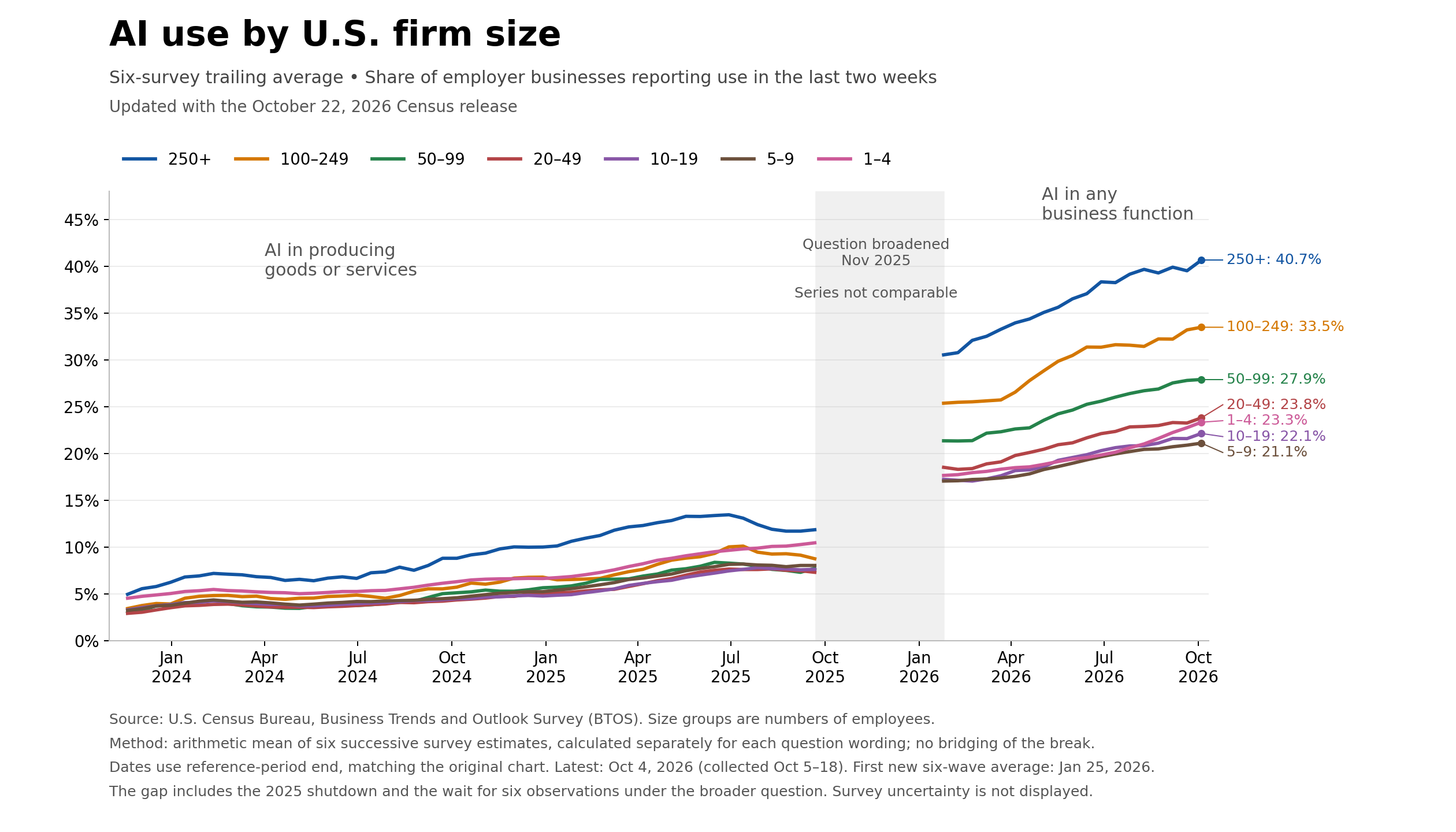
Here’s a link to the larger image.
For comparison, here’s that AI adoption chart from last year (my GPT-5 version):
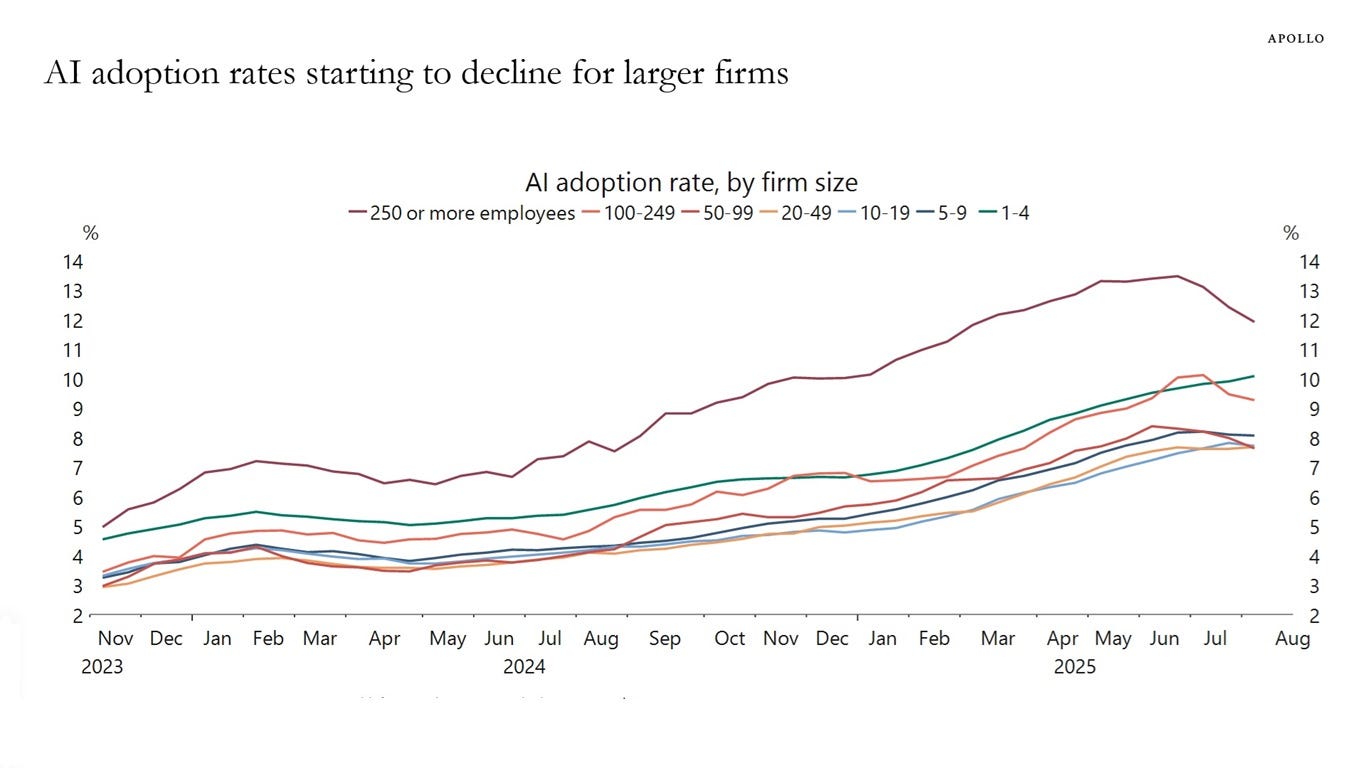
In September 2025 the largest (250+ employees) companies answered “yes” around 12% of the time to the question about whether they used AI in “producing goods or services”.
Under the new “any business function” wording, by February 2026, those same large companies answered “yes” around 30% of the time, and by October 2026 that had increased to around 40%.
The data in the above chart comes from the “Employment size class” XLSX file, available from here. Here’s a copy of the file I used.
You can view the survey document that is sent out to businesses - here’s my snapshot copy of that 346KB PDF.
The changing language of the questions
As the chart demonstrates, the question asked by the Bureau changed in a material way on November 17th, 2025. Prior to that date, the question they asked was this (emphasis mine):
In the last two weeks, did this business use Artificial Intelligence (AI) in producing goods or services? (Examples of AI: machine learning, natural language processing, virtual agents, voice recognition, etc.)
On December 3rd, 2025, the Bureau announced a significant change to that question. Here’s the replacement:
In the last two weeks, did this business use Artificial Intelligence (AI) in any of its business functions? (Examples of AI: machine learning, natural language processing, virtual agents, voice recognition, etc.)
No more “producing goods or services” - now it’s “in any of its business functions”! This means that the answers to the question before and after November 17th are not directly comparable.
From October 19, 2026, they ask about Super Intelligence
When I went looking for the updated question language in the latest XLSX file, I couldn’t find it. I found this instead:
In the last two weeks, did this business use Super Intelligence or SI (formerly referred to as Artificial Intelligence or AI) in any of its business functions? (Examples of SI use include: SI-powered data analysis; generative SI for marketing, product design, or coding; virtual SI agents for customer service; SI-powered forecasting or pricing; SI-driven computer vision for quality control, etc.)
The BTOS about page explains what happened:
Beginning with the October 19, 2026 collection, instrument wording was updated due to Executive Order 14434.
The current numbers reflect the old Artificial Intelligence survey wording - the first survey results reflecting the Super Intelligence wording are due for publication on Thursday.
Is this going to affect the survey?
The obvious open question here is whether this wording change is going to affect the survey results.
The businesses answering this survey will have last seen that question twelve weeks ago, when it was still called AI. Hopefully the new language isn’t going to confuse them, especially since the survey helpfully spells out “formerly referred to as Artificial Intelligence or AI”.
I can’t help but laugh at the absurdity of “SI-powered data analysis; generative SI for marketing, product design, or coding; virtual SI agents for customer service” though.
Link 2026-10-28 GitHub Octoverse 2026:
I’m at GitHub Universe (GitHub gave me a free ticket through their “GitHub Stars” program). EVP Jay Parikh just announced this year’s Octoverse report, and highlighted these numbers in particular:
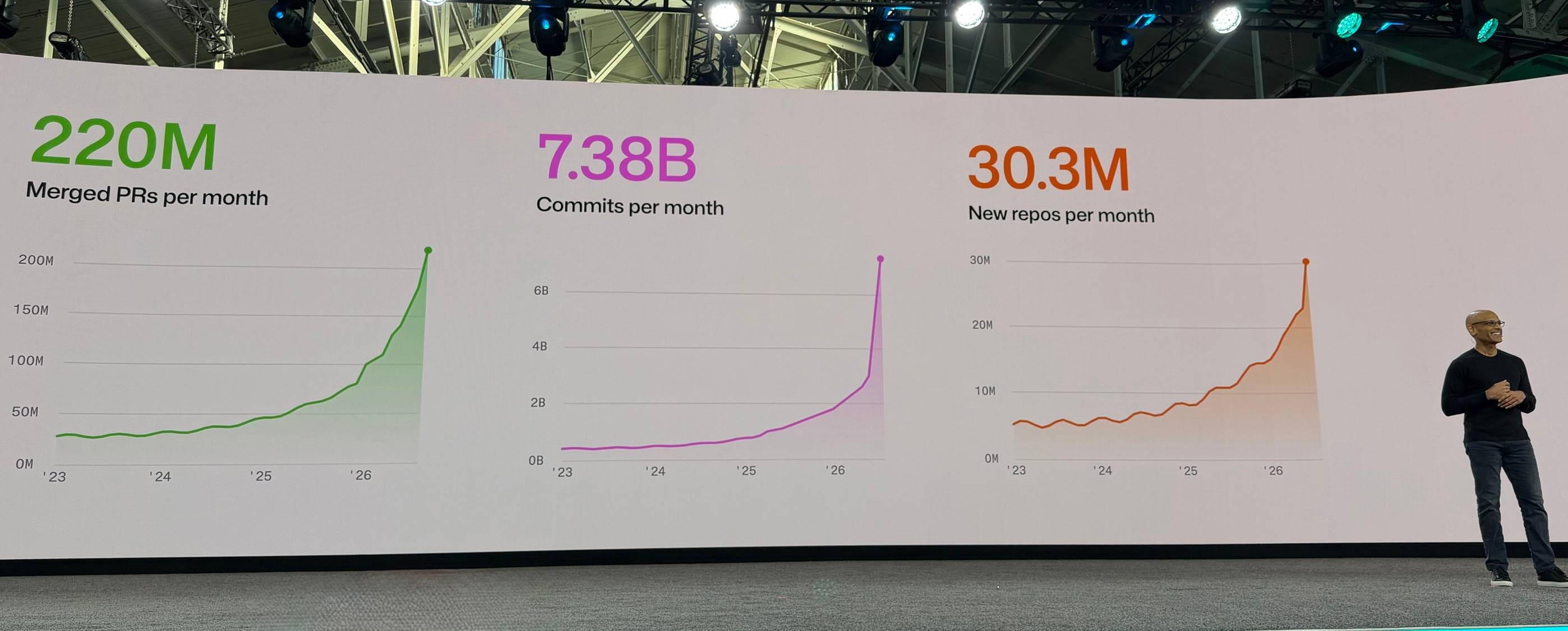
This is a pretty stark representation of the impact of agentic engineering on GitHub. In 2026, merged pull requests tripled in less than a year to 220 million per month. Commits more than tripled to 7.38 billion per month, with most of that increase in the second half of this year. New repository rate doubled this year, to 30.3 million per month.
The report includes new numbers by industry, and breaks out numbers for repositories that involve “interoperability or reverse engineering”. The methodology section includes notes about how they did this:
Top countries by pushes to public repositories, adjusted by profile location. Pushes from each country were summed across the Octoverse year. To adjust for biases caused by VPN usage, LLM classification was used to extract the ISO 3166-1 alpha-2 code from the profiles of GitHub users who contributed pushes during this period [...]
Industry. Public repositories created 2022 to 2026 were sorted into NAICS sectors by a fine-tuned multilingual embedding model using name, description, topics, and README, from random samples per year. [...]
Interoperability. Counts public repositories created each year whose name, description, topics, or README mention interoperability or reverse engineering, or related terms, such as clean room implementation, drop-in replacement, or protocol re-implementation.
Quote 2026-10-29
every product i use should just be a headless mcp, that feeds into an agent, where i never have to think about anything underneath.
except for our product, of course.
in our product, customers love the ui and love us very much.
we’re special that way.
Link 2026-10-29 How I Built the Most AI-Pilled Company in the World:
Don’t be put off by the clickbait headline, this piece by Jacob Sansbury describing how they are building Spawn is a fascinating exploration of the bleeding edge of what’s possible with agentic engineering against frontier models.
Spawn is a massively multiplayer gaming environment where players can use prompts (to the in-game agent, Savi) to modify the game world.
I fired it up on my phone for a few minutes and was able to prompt a castle into existence, then a dragon, then ride the dragon to fly around that castle.
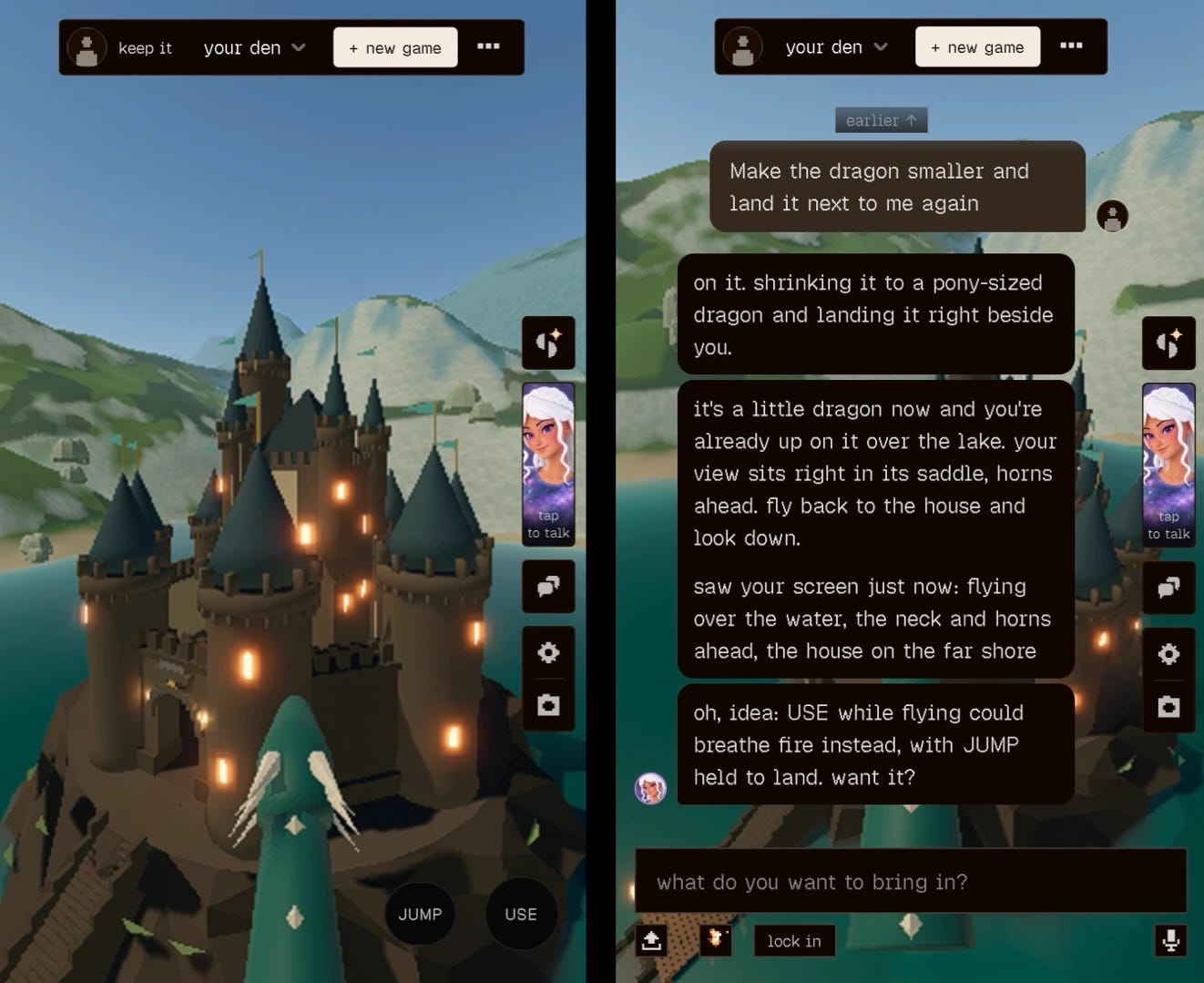
By Jacob’s telling, Spawn is now being developed autonomously by a swarm of Fable-powered agents costing over $3 million in tokens per month (”we spend 30x payroll on AI tokens”).
Our agents change the live code directly and ship to production hourly, so they read every error, bug report and metric themselves. About 60% of our work starts from a production error, a Savi bug report (Savi is the AI you build games with in Spawn), something odd in our logs, or a feature request.
Savi files bugs herself. When a user hits one, or Savi hits one in the product, she files it. It goes straight to an agent that decides whether it’s a real bug to fix, something we won’t fix, or intentional design that needs a decision. Usually it becomes a change, delivered to that user within an hour, with a message in the same chat.
This is continuous deployment turned up to 11:
A loop this tight only works if it never stops, so we treat an hour without a ship as a SEV-0, our most severe kind of incident. Unshipped changes pile up, and every problem already in production lasts longer. The feedback slows down too. An agent can only keep a few hours of work in its head, so shipping faster than that actually helps it stay coherent. [...]
We can roll back a broken change in 30 seconds, exactly where it’s broken and nowhere else. When a monitor or a log alert fires, it starts or wakes an agent that owns the incident, and we break things on purpose to test that those recovery paths work.
My eyebrows raised at least a dozen times reading this. I have trouble imagining this style of development working on software with higher stakes for when something goes wrong, but for a game this appears to be working surprisingly well.
Jacob says that Fable 5 (and then 5.1) was the model that made this level of autonomy possible. Opus 5.5 doesn’t quite hack it for them, and when they tried GPT-6 Astra to apply fixes from a security review everything stopped working:
Every feature had been disabled and marked to be turned on again once the security fixes were done. Astra had gone through our whole product and made the insecure things secure by turning them off.
These kinds of extreme experiments are why I’m excited about game development as a substrate for exploring the edges of what today’s coding agents can do.
Link 2026-10-29 API credits benefit for eligible ChatGPT subscriptions:
Earlier this month Anthropic announced a generous new benefit for their Max and Team subscriptions: $100, $200, and $500 per month subscribers would get the equivalent quantity of (expiring) credits to use with the Anthropic API.
OpenAI have now launched pretty much exactly the same deal: if you have a $100, $200, or $500 subscription plan with them you now get that same quantity of credits to apply to one of your API organizations.
I maintain subscriptions with both companies, so this is great news for me! I may even ship some public-facing demos now that the credits are already covered by my existing subscriptions.
Link 2026-10-30 dbreunig/nesformer:
Inspired by qwenputer by Divyansh Agrawal, Drew Breunig baked a working emulator for a Nintendo Entertainment System 6502 CPU into the weights of Qwen3.5-4B. You can now play NES ROMs such as Super Mario Bros (very slowly) running inside Qwen!
In a comment on Hacker News Drew reveals the Opus 5.5 prompts he used to build this system:
Read this article and any relevant source code: https://divagr.com/blog/qwenputer. Then explore if you could emulate the chip and ram in a Nintendo Entertainment System (as people do today with FPGAs in MISTRs) using this technique. If so, what size model would you have to build and if you could use smaller faster ones, could you get it to be at the standard clockspeed.
Followed by:
I think we should build it! Just for fun. It's okay if it's not fast. We want to be able to have the weights, and a cli to run them that we can point at a ROM.
Apparently Opus found and then used this collection of conformance tests for the NES CPU released 15 years ago by Christopher Pow.
Release: datasette-llm 0.1a9
I have some big upgrades to Datasette Agent in the pipeline, but in the meantime here’s a tiny user experience improvement to the underlying datasette-llm plugin.
It now picks up the default model used by LLM, which means you can start using Datasette Agent without needing to explicitly configure a default model:
uvx --with datasette-agent datasette content.db --internal internal.dbPreviously you would also need to specify a model with -s plugins.datasette-agent.default_model gpt-6-astra.
Link 2026-10-31 How We Took Over ChatGPT Accounts:
Parameter Labs describe an exploit they found against ChatGPT’s implementation of the artifacts pattern (OpenAI used to call this “Canvas” but it looks like the latest revision is called HTML previews), where interactive custom HTML apps are displayed in a sandboxed iframe.
It’s important that HTML in these stays tightly sandboxed to avoid untrusted code interacting with OpenAI APIs and accessing private data.
Parameter found quite a complex attack chain. OpenAI use the MathLive JavaScript library as part of their graph support, and that library includes its own virtual keyboard, which can be triggered in the parent page via postMessage() from the sandboxed iframe.
That message receiving code uses innerHTML, so anything that sends a message can add custom HTML to the parent - and there was no mechanism to prevent other sandboxed frames, including HTML preview frames, from calling that method.
This meant untrusted code in an iframe could insert HTML, and while innerHTML doesn’t directly execute script elements it could be used to inject a new iframe without sandbox restrictions.
OpenAI’s CSP rules blocked inline scripts entirely, and only allowed script loading from a handful of domains, but one of those was YouTube - and the YouTube oEmbed endpoint could be used to reflect JavaScript back in a way that executed it.
Once the attack had JavaScript execution on ChatGPT, it was trivial to fetch private user data from APIs and exfiltrate it via an image reference.
The end result: you could create a ChatGPT share URL which, when visited by another signed-in user, could exfiltrate their private data or take actions on their behalf.
OpenAI closed the hole and paid out a $5,000 bug bounty, which I think was a bit cheap for a vulnerability this serious.
Quote 2026-11-01
More broadly, the use of LLMs erodes trust in documentation, in software, and in the organizations which produce them. Perhaps engineers will begin to treat any new software project with suspicion—the signals we used to rely on as markers of a mature system are now easier to counterfeit. [...]
In the age of LLMs, what can maintainers do to ensure correct software and accurate documentation? Having done that work, how can they demonstrate its quality to users?
Kyle Kingsbury, Jepsen results for ParticleDB 1.1.4
Note 2026-11-01
I’ve been getting the occasional confusing Python dependency error since switching over to Python 3.15 and the rule I’m having to remember is:
If in doubt, delete the uv.lock file
Most of my projects are libraries which don’t include a uv.lock file, since it’s rude for a library dependency to lock versions for anything else that uses it.
Running uv run pytest etc tends to leave uv.lock files lying around, which are listed in .gitignore and so do not get committed to my repositories.
But... sometimes that uv.lock pins a version of a dependency that doesn’t yet have a Python 3.15 wheel. An example from earlier today:
error: Failed to build `watchfiles==1.1.1` cause: Call to `maturin.build_wheel` failed

error: the configured Python interpreter version (3.15) is newer
than PyO3's maximum supported version (3.14)
Deleting that file and running uv run pytest again usually fixes the problem.
Release: llm 0.37
There’s a lot of stuff in this new release of my LLM CLI tool and Python library, representing around two months of accumulated features and fixes.
I added gpt-6.1-sol and gpt-6.1-terra, plus a new llm openai endpoint add command to make it easier to configure additional models that use OpenAI-compatible endpoints.
I switched the default model (if you have not set your own default) to gpt-6-luna - half the price of the previous default, gpt-5.6-luna.
LLM’s support for embeddings now accepts that different binary content may have different content-type - necessary for models like Gemini Embedding 2, which can embed text, audio, images, and video.
A lot of open source maintainers complain about a flood of AI-assisted PRs. LLM is my project that has been most affected by this and, to be honest, I’m not finding it to be a problem. That’s mainly because I have Opus 5.5 or GPT-6 Astra help me with triage to spot the most useful fixes!
This release includes fixes from 12 authors - almost all AI-assisted - and the burden of reviewing them wasn’t nearly as great as I expected. I really see them as bug reports with attached examples - sometimes I land them, sometimes I implement my own fix.
So thanks to 0d00ciallo0721, ac1982, Allen Flux, Bian Yuhan, Bishop Kammeraad, Chen Yufeiyang, Christopher Krah, Ethan Stoner, Jiachen Xie, Olamide Faniyan, Sharat Chandra Sai Boddu, nosmile99 for helping out with (or spending tokens on) this release!
Note 2026-11-03
I sent out the October edition of my sponsors-only monthly newsletter. If you are a sponsor (or start a sponsorship now) you can access it here. This month:
The October inflection point for vibe game development
The vulnerability apocalypse gets hot
LLM releases
API credits for $100+/month subscriptions
What I’m using right now
My software releases
My September newsletter can now be seen here, as a preview of what you’ll get. Pay $10/month to stay a month ahead of the free copy!
Link 2026-11-03 I discovered a sound that leaks your exact location (and it’s everywhere) - YouTube:
Genius piece of OSINT by Colsto, who demonstrates how you can take almost imperceptible background noise of planes from a video soundtrack, figure out their Doppler curves, then cross reference them against ADS-B data to find the exact location of the video based on their speed, distance, and gaps between different flights.
If you find this newsletter useful, please consider sponsoring me via GitHub. $10/month and higher sponsors get a monthly newsletter with my summary of the most important trends of the past 30 days - here are previews from July and Augustand September.
Thanks for reading Simon Willison’s Newsletter! Subscribe for free to receive new posts and support my work.