AI is dramatically accelerating AI research
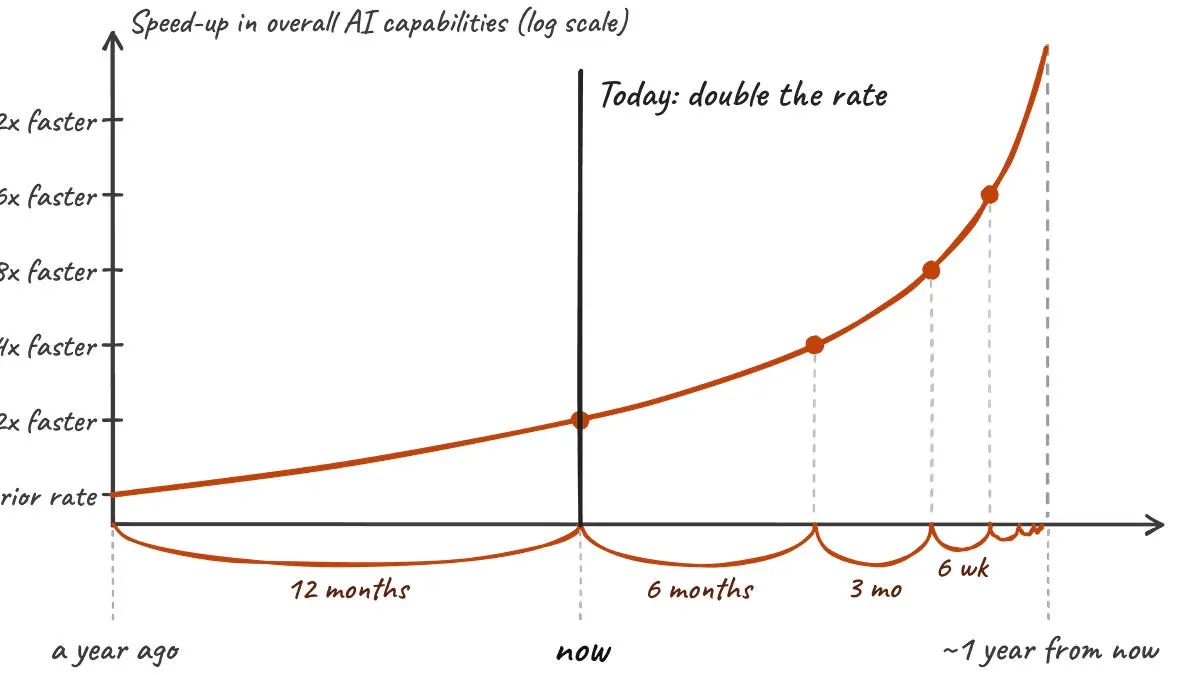
Ajeya Cotra, writing on Planned Obsolescence on November 6, 2026, argues that AI is already speeding up AI research at Anthropic. She points to a recent S-1 filing in which Anthropic said it may imminently meet the "dramatically accelerated progress due to AI" threshold in its Responsible Scaling Policy. Her case rests mainly on an independent review by METR, an AI evaluation nonprofit, whose report was released on November 5.
METR ran a high-access assessment of Anthropic from August 12 to October 29, 2026. It estimates that Anthropic is improving its models on well-specified tasks about twice as fast as it did from March 2024 to October 2025. On METR's AECI index, growth since October 2025 runs about 1.9 times the prior rate, with a 95% confidence interval of 1.5x to 2.8x. METR attributes roughly 80% of that speedup to AI use in Anthropic's research rather than to extra compute or headcount. Cotra translates this into roughly a 10x gain in researcher labor, close to Anthropic staff's informal estimates of a 12x uplift.
The evidence is contested. METR calls its quantitative estimate "only very loose evidence," and it says fully autonomous AI contributions to R&D show "signs of life" but are not yet large. Anthropic co-founder Sam McCandlish wrote that AI is speeding up the company's research but that it is hard to say how much. Anthropic plans to publish its own analysis in the coming weeks.
Why it matters
For founders, the report suggests that model gains may increasingly come from how labs use their own models, not only from larger training runs. That shifts where a lab's edge sits: internal agent tooling, experiment throughput and research workflow could matter as much as access to chips. Companies selling developer tools or research software to labs should expect fast adoption inside research teams, and should be ready for buyers to ask how productivity claims are measured.
For investors, the claim bears on timelines and risk. If progress compounds, capability could arrive sooner than plans and valuations assume, which affects the payback window for large compute commitments. Responsible scaling thresholds also move from distant policy questions to near-term constraints that could shape release timing and disclosure. Because the key evidence is partly redacted and built on lab-provided access, diligence should treat the figures as estimates rather than audited metrics.
Key points
- 1Ajeya Cotra published the essay on Planned Obsolescence on November 6, 2026.
- 2METR's assessment covered Anthropic from August 12 to October 29, 2026.
- 3METR estimates Anthropic's progress on well-specified tasks runs about twice its March 2024 to October 2025 pace.
- 4METR attributes roughly 80% of the speedup to AI use in Anthropic's research, not extra compute or headcount.
- 5