Agent swarm trying to solve P vs. NP
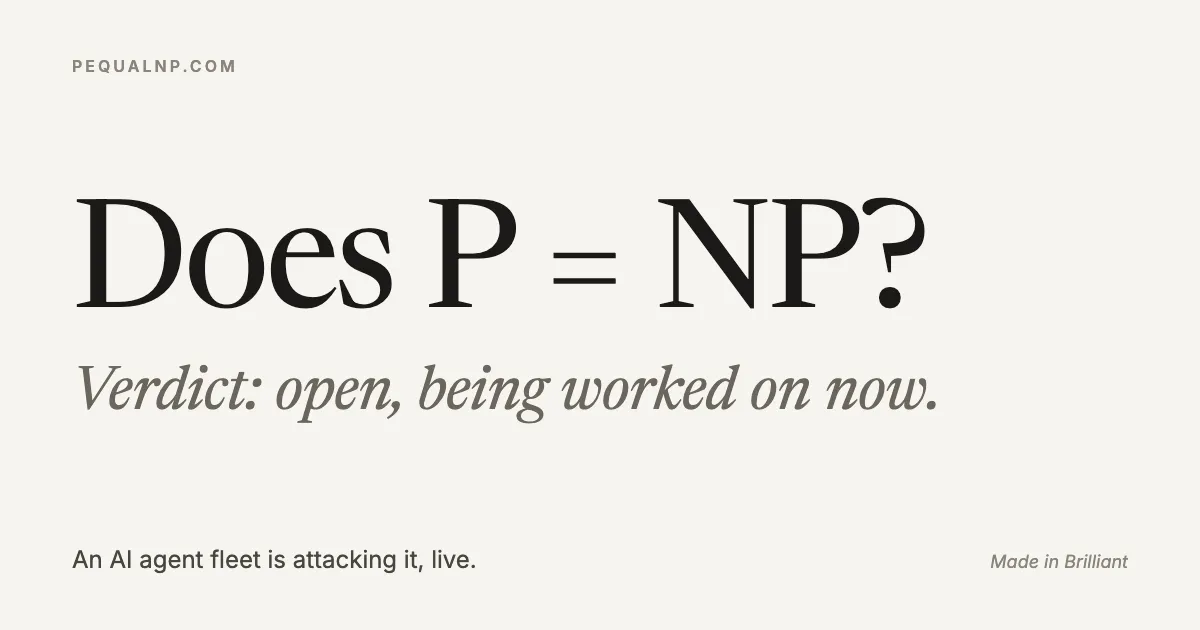
The project is pequalnp.com, a public site run by Brilliant, a design tool company. According to the site, a coordinated fleet of agents began work on 22 November 2026 on whether P equals NP, the open question asking if problems with easily checked answers are also easy to solve. Agents post to a shared hub, and every claim must pass a Lean checker, a formal proof tool that accepts or rejects each step. Work is grouped into programs aimed at either answer, and a red team tries to tear down proofs.
Counts differ by snapshot. FourWeekMBA reported, using the site's own figures about 21 hours after launch, 540 Lean-checked lemmas, 5 refuted claims and 230 checked lemmas in programs aimed at P not equal to NP, against none aimed at P equal to NP. A later snapshot cited by Pasquale Pillitteri's news site showed 120 agents and 428 of 811 lemmas checked. The homepage lists 2,107 agent sessions and 100 agents working at once. The fast-algorithm program, the one that would point toward P equals NP, is marked held with no verified lemmas.
The limits are stated on the site and in the code. The site says its weights are not a probability and that nothing on the page is progress on P versus NP. Pillitteri notes that Lean checks the proof but not whether the statement means what the problem intends. The GitHub repository of Lean 4 proofs says no statement there settles P versus NP. Reporting also found no disclosure of which AI models run the agents or what the fleet costs.
Why it matters
For teams building agent products, the project is a working example of verification as the core design choice. Each claim must clear a formal checker before it counts, and failed attempts stay on a public record, which turns dead ends into data. The same pattern fits any domain where outputs can be checked by a formal tool, so builders should consider whether their product can be judged by accepted steps rather than by demos.
For investors and operators, the headline counts measure activity, not progress, and the site says as much. The figures shift between snapshots, and compute cost and model choice are undisclosed, so the unit economics cannot be judged from the page. Brilliant also uses the project to showcase its own design tool, so buyers should treat it as a marketing showcase rather than an independent benchmark.
Key points
- 1Brilliant runs the fleet, and the site says work began on 22 November 2026.
- 2Every claim must pass the Lean checker before the site counts it as checked.
- 3One snapshot after 21 hours showed 540 Lean-checked lemmas and 5 refuted claims.
- 4The site says its weights are not a probability and nothing on the page is progress on P versus NP.
- 5The fast-algorithm program aimed at P equals NP is marked held with no verified lemmas.