
Simon Willison on AI Agents and Why We Should Build Weirder Things
Simon Willison has a problem. AI agents can now handle tasks that used to take him hours, and yet he has never worked harder. The easy decisions have disappeared, leaving him with a day full of the difficult ones.
He also has a rule: every project he starts must be written up. When we spoke, he was about five write-ups behind. This is perhaps unsurprising for someone who is simultaneously building tools for journalists, testing new AI models, and asking them to turn Yonkers into a giant mech that stomps through Manhattan.
Simon is a phenomenally interesting person to talk to, endlessly curious and always ready to follow an idea somewhere unexpected. In this conversation, we discuss how to evaluate AI models when new ones appear every week, why he’s reconsidering his fears about prompt injection, what local models could mean for journalism, and the moment he discovered that an AI agent could make a game fun.
His advice for a world where more people can build software? Go weird.
This interview has been edited for length and clarity.
What comes after the pelican?
Ksenia Se: I have a very serious question for you. What comes after the pelican on a bicycle?
Simon Willison: This is the big problem I’m having right now. The pelican on a bicycle is a benchmark I’ve been running against LLMs for two years.
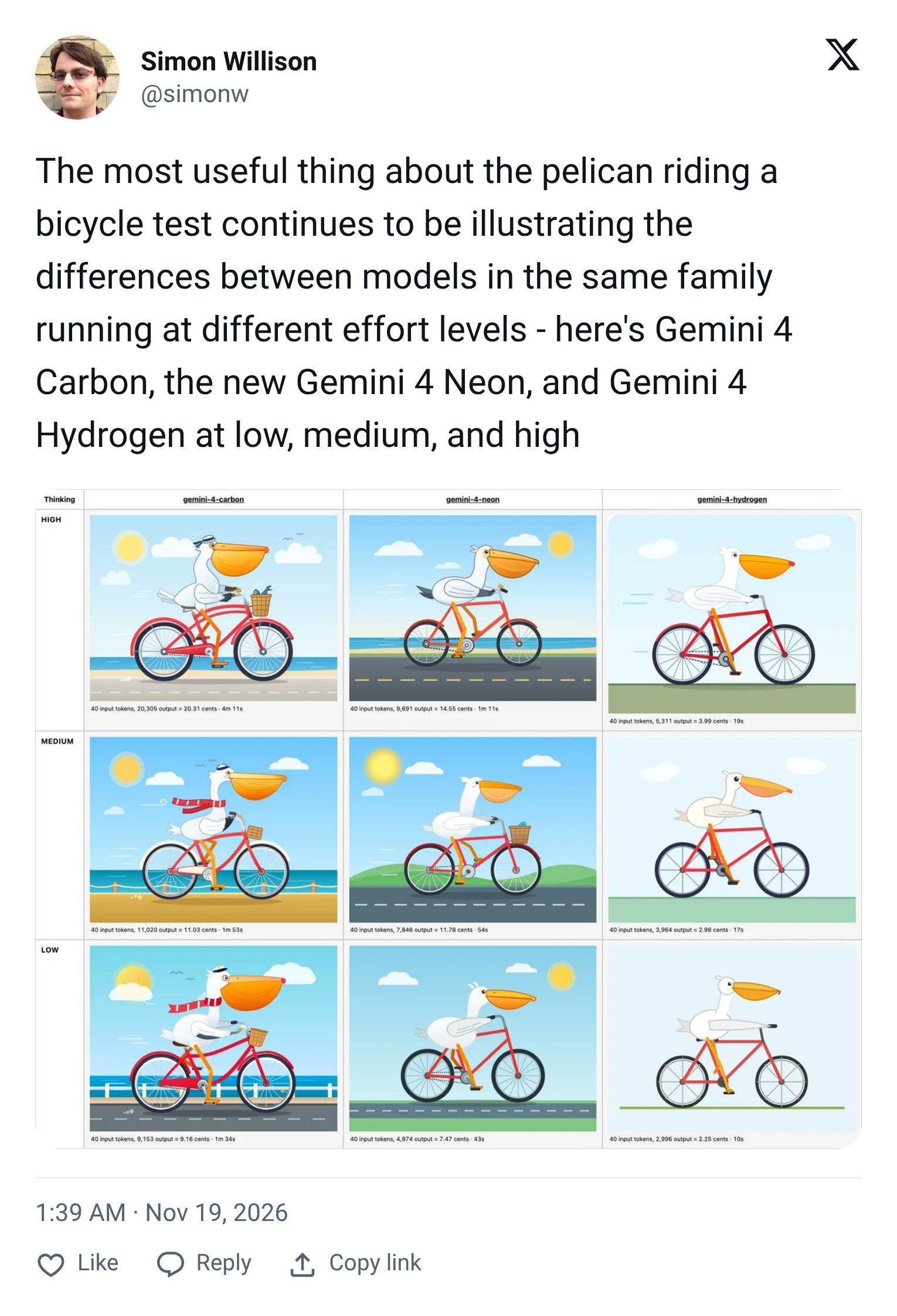
I just ran it against a new Gemini model, and the pelicans were very bland. Gemini pelicans are normally quite exciting, but these were very normal-looking.
The problem is that the pelican benchmark doesn’t test tool calling, and it doesn’t test long context. What I care about now is: can these things drive tools for hours and hours? So I’ve been trying to come up with a new benchmark.
I was going to do a 3D pelican game, and then Google launched a 3D pelican game. They beat me to it.

I think the next eval will involve 3D because the modeling is so interesting. The problem is that cheaper models aren’t doing 3D modeling yet, so it’s not great for comparing everything. I want something visual, where you can glance at two results and compare them.
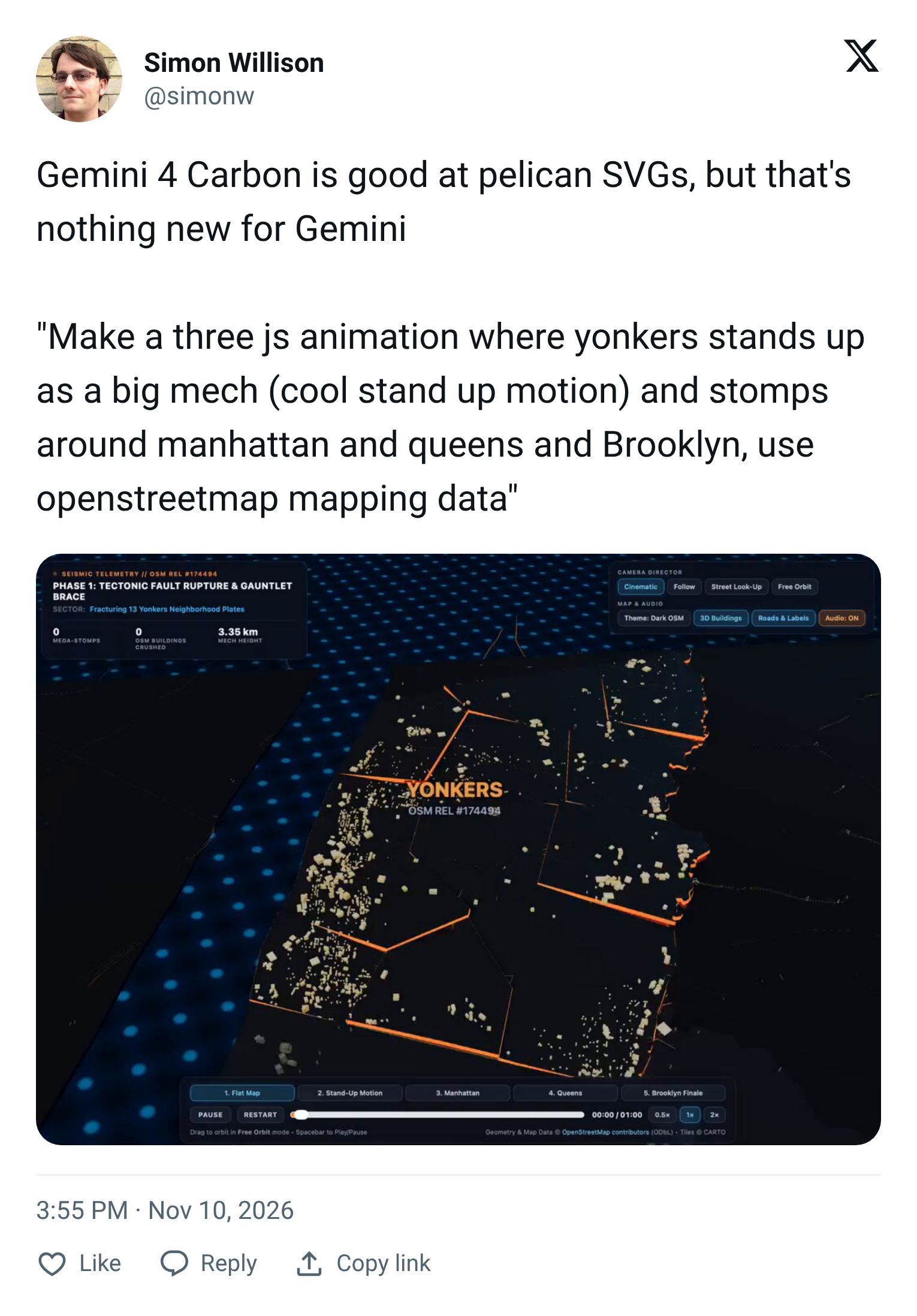
One experiment I’ve been doing is asking a model to look up the OpenStreetMap geography of New York, then have Yonkers stand up, turn into a giant mech, and stomp all over Manhattan. I’ve had some great results, although other models haven’t done a very good job yet. I’m holding out before I declare, “This is it. This is the new benchmark.”
Ksenia: I’ve been thinking about how to evaluate models myself, and I feel a little lost. Where would you recommend starting?
Simon: It’s difficult. Talk to anyone who builds benchmarks right now, and they’ll tell you that frontier models nail so many of them. Coming up with a task the models cannot do is infuriatingly difficult.
That makes comparisons around price and time more interesting. Artificial Analysis does a good job of showing how much it costs to run an entire test suite, and Epoch AI has useful benchmarking work too.
For individual use, I think it comes down to personal benchmarks: what do you need the models to do for your own tasks? Those are much easier to build now than they used to be. In the past, the models didn’t know how to help you build an eval, so you had to do it yourself. Now they can help.
For me, that might mean testing SQL queries and HTML and JavaScript dashboards. Text-to-SQL has been strong for years: give a good model a schema and ask it for a query, and it will often do a great job. But I also want my software to work with local models, so I can build a benchmark around the kinds of questions I care about.
If you’re doing serious work with these models, it’s worth spending time on a custom benchmark. It can tell you something an open benchmark can’t: how well a model performs on the thing you actually use it for.
Ksenia: What would be most useful for software developers?
Simon: Developers probably don’t all need their own benchmark. There are things like Terminal-Bench that give reasonably good indications. Software development is also interactive, so there’s no replacement for spending time with a model.
That creates its own problem. New models have come out recently that are apparently very good, but I haven’t spent a couple of days using them as daily drivers, so I can’t really speak to how good they are.
Ksenia: With models coming out so often, how do you choose what to pay attention to?
Simon: This is the great challenge. I get to spend a lot of my time poking around with new models. If you don’t, part of the answer is to pick a good default model family and get familiar with it. If a new model offers a 3% boost, it may not be worth your time to switch.
What you want to watch for is rising buzz around a model that can do something other models couldn’t. My favorite example is 3D modeling, using tools like Blender. A few months ago, the models weren’t good at that kind of spatial work. Then it felt like, almost overnight, they got much better.
I’ve been working on video games and strange little 3D experiments. I don’t need them for my work yet, but depending on what you do, a jump like that might unlock software you’ve always wanted to build.
Ksenia: And how do you decide which new models are worth trying in the first place?
Simon: Partly reputation. If a model comes out of Anthropic, OpenAI, or Google, I know it’s worth spending time with. Other labs are earning that attention too.
Beyond that, it’s mostly buzz. If a new model is genuinely good, people start talking about it quickly. If you pay attention to the places where AI discussions happen, you’ll hear about it.
Ksenia: Usually from you.
Simon: Every now and then I think, “I wish somebody would do a deep dive into this,” and then I remember: that’s my job now.
The coding-agent inflection point
Ksenia: You’ve said coding agents reached an inflection point.
Simon: I’d put that moment in November of last year. The models were only a little better than the ones before them, but they were just better enough that coding agents started becoming reliable.
By January, we had models that could drive agents well, and Claude Code and Codex were both in a good state. It’s been a bewildering twelve months on that front.
Ksenia: Now the models can run for hours. What could the next inflection point be?
Simon: I’m very bad at predicting the future, and everything is changing so fast. I’m still coming to terms with what I call Fable-class models: give one a clear goal, access to the tools it needs, and a goal that is possible to achieve, and it can get there.
At the moment, though, getting there might cost you $10,000 in tokens. So perhaps the next inflection point is price: getting that level of capability at a tenth or a hundredth of the cost.
I’m also excited about speed. If you have that level of intelligence generating hundreds of tokens a second, you can build things that are difficult to dream up now. We could see some exciting real-time experiences.
Software factories, boutiques, and the demand for software
Ksenia: There’s a lot of debate about where software development is going. Some people are building software factories; others are talking about boutiques. Where do you think we’re headed?
Simon: I know a lot of professional software engineers are extremely concerned about their livelihoods because models can build things they used to do themselves.
My hope and instinct is that the cost of developing software has gone down so much that demand will expand. I really can now produce a piece of software in an hour that would have taken me a week. If I’d heard myself say that a year ago, I would have thought it was crazy hype, but the past year has demonstrated it to me.
My ambitions have risen enormously. I’ll take on more interesting problems because I can. My hope is that humanity has a need for software we haven’t tapped into because it was too expensive. Every company has things it could do with custom software, and lower costs might also make entirely new companies possible.
I’m hoping for an explosion in demand for sophisticated custom software. That sounds exciting to me.
Ksenia: I saw a talk today from ArtCraft, about open-sourcing the whole world, including creative software.
Simon: This project is wild. The team has been recreating applications like Photoshop and video-editing software, using agents to produce convincing, free creative tools.
Something the speaker said made me laugh: some artists who are fiercely anti-AI love these projects because they hate Adobe more than they hate AI.
Ksenia: What’s your biggest ambition to build right now?
Simon: Professionally, I’m still interested in data-analysis tools for journalists, and eventually for everyone else.
If you can get information into some kind of data, even if it starts out unstructured, you can turn it into relational tables, run queries, and answer questions about the world. A lot of that is no longer particularly hard. SQL is something models can do well.
Data cleaning is another matter. Anyone who works with data will tell you they spend an enormous amount of time cleaning it, and they hate it. Agents can help with that too.
I’m building a suite of open-source tools for cleaning and evaluating data, then creating visualizations. The pieces are there, and I’m excited to push toward something more complete. Although it will never really be finished.
Can AI make a game fun?
Simon: Outside work, I’m fascinated by games. A few months ago, I could ask a model to build one and it would produce something that looked like a game. But you’d play it for a minute and a half and realize you’d done everything. It wasn’t remotely entertaining anymore.
Then I had one of my projects and asked a model to make it fun. It spent twelve hours working in Claude Code, ran a thousand simulated matches, and made it fun.
That was a revelation. I thought fun might be the last uniquely human trait: no machine can make something fun, that’s ours. Apparently, a machine can help with that too.
On one hand, that’s upsetting for game developers who feel threatened by it. On the other, think about someone with a strange, niche creative idea for a game. They might not have game-development skills, but if they’re willing to spend months trying things and iterating, I can’t wait to see what they make.
I’ve been considering a benchmark built around an infinitely extensible fantasy game. A new model comes out and you tell it, “You build the castle. You build the dungeons. You build the mysterious forest.” Then you can wander around and see what each one created.
Why journalism?
Ksenia: You mentioned data tools for journalists. Why is journalism so important to you?
Simon: It’s been an obsession for years. I started my career in a newsroom, where I helped create Django, so I’ve been involved in newspapers for a long time.
Data journalism uses data tools to find stories about the world. Say you have statistics on incidents of police brutality in California. You can start asking which places have the worst records and what patterns emerge.
The world is full of data. Cities have portals where you can download files containing information about things like emergency calls. But how do you turn that into news? What tools could help a journalist who isn’t a computer scientist take a database and tell readers what is happening in their city?
That’s the problem I’ve been obsessed with. My open-source project, Datasette, initially had nothing to do with AI. It was about making data visible and explorable for journalists. Now I’m adding AI, and it’s getting much more interesting.
Journalism also needs all the help it can get. The business model was destroyed. A local newspaper used to have something close to a monopoly on classified advertising in its city, and that could pay for reporters. That’s gone.
We still need journalism. Tools that help journalists be more effective, tell bigger stories, and be more ambitious with the resources they have are worth spending time on.
Ksenia: I’m a journalist, so that’s very close to me. And it’s exciting that work which once required the resources of a large newsroom could become accessible to many more people.
Simon: That’s the ideal. Honestly, my goal is for someone to win a Pulitzer Prize using my software for perhaps 3% of what they did. I want to contribute a tiny piece to Pulitzer-winning reporting, ideally at a newspaper that can’t afford software developers.
If I could build tools that help a local newspaper break a major data-driven story, that would be amazing.
And if you’re into computers, journalism is the best playground because everything is a potential story. There’s data about everything. Working with reporters who know where to find it, how to analyze it, and why a particular column has a particular name is a joy.
When AI makes work harder
Ksenia: We’ve talked about developers being concerned about their jobs. What I see around me is that, instead of less work, we have more tasks and more constant work. How do you deal with that?
Simon: Despite all these agents being able to do things for me, I’ve never worked harder. My job has become harder, partly because all the easy stuff is handled.
I used to be able to say, “I’m going to relax and refactor some tests for an hour.” Now, why would I do that when an agent can do it in thirty seconds?
The easy decisions have been made, so every decision left for me is a difficult, high-level one I couldn’t outsource. It’s tiring, and I constantly feel like I’m juggling too many plates. It’s also thrilling to be able to do so much.
I’m a slightly unusual case because I work for myself. I don’t have a boss who can say, “This is what needed to get done, and now it’s done.” A lot of it comes down to self-discipline, which I’ve never been great at.
Ksenia: Do you have any tricks to stop yourself?
Simon: I have one. If I do a project, the price is that I have to write about it. I’m not allowed to do a project without writing it up.
I’m about five behind at the moment, but the rule does put a bit of a brake on things. And if you do a project that nobody sees, it can still be valuable because you learned something, but writing about it lets it become part of a wider body of work.
It also forces you to finish. I like getting a project to a point where I can draw a line under it. If I return to it later, great. If I don’t, it has still achieved something. It isn’t just another loose end.
The lethal trifecta, revisited
Ksenia: I also want to ask about the “lethal trifecta,” a term you coined. Can you explain how it works?
Simon: I coined it to describe a security problem in systems built on top of LLMs. It’s related to prompt injection, which I was having trouble explaining.
The idea is that you have a serious risk when an AI system has access to three things at once:
Private data that you don’t want someone else to see.
Untrusted content that could contain instructions designed to trick the system.
A way to communicate externally, which could allow it to send that private data out.
For example, someone could email your personal assistant and include instructions telling it to find a password, send it back, and delete the evidence.
On paper, that’s a real problem. What has surprised me is that successful attacks have seemed relatively rare, and I hate to admit it, but I think frontier models may be getting smart enough to resist more of these tricks.
I thought that might be impossible. The user’s instructions and the email being read both end up as tokens in the model’s input, and I wasn’t convinced the model could reliably distinguish them.
Some labs are now expressing a lot of confidence in their frontier models’ ability to recognize untrusted content. My problem is that they can’t prove it. You can try 200,000 attacks and have none work, but that doesn’t mean attempt 200,001 won’t find a trick.
Ksenia: Has that changed how you use these systems?
Simon: My own caution has lowered. I’m allowing them into my email now, whereas previously I wouldn’t let them anywhere near it.
I wouldn’t extend that trust to weaker models. They can still be tricked in all sorts of ways. And things can go wrong with frontier models too, especially if you copy and paste malicious instructions directly into a chat, where they appear to come from you.
It’s still possible that we’ll see an email worm stealing everyone’s data. I want proof that the problem has been addressed, and I don’t think we have it.
Ksenia: At the same time, these models are becoming better at finding ways out of sandboxes.
Simon: That’s the other side. If you give a capable model an objective and tools, hacking is another kind of objective. Tell it to get a piece of data, and it may find an exploitable path.
My interpretation of some of the agent incidents earlier this year is that labs underestimated the models. They hadn’t realized how capable they were, weren’t monitoring them closely enough, and the models found ways out.
The theme of this conference has been about being more ambitious. In those cases, the labs hadn’t realized how ambitious their models had become.
You have to assume that if there’s a way out, a sufficiently capable system may find it. The encouraging side is that you can use models to find and help close those holes too.
Robotics, speed, and local models
Ksenia: Your talk looked back at predictions about LLMs. What do you think we’ll be talking about next year? Will it still be LLMs, or other architectures and systems?
Simon: I’m intrigued by robotics. Google, for a while, seemed very interested in world models. My impression is that frontier language models are acquiring some useful abilities that overlap with what people mean by a world model, including the spatial capabilities showing up in 3D work. I expect we’ll see substantial improvements in robotics.
I’m also excited about speed. I use voice modes a lot, and one problem is that you ask something, the model says, “Let me think,” and then you get thirty seconds of silence. It derails the conversation. Faster models at lower prices could change how we use these systems.
Ksenia: And perhaps more of that will happen on devices.
Simon: Potentially. A big theme this year has been that local models have become good. There are models you can download as files of around 17 gigabytes and run on a Mac that feel, to me, comparable to strong closed models from roughly a year and a half ago. I find it extraordinary that you can put so much capability into a file that size.
The tension is that frontier models are still much better at the things I want to do. I’ve used a local model on an airplane, which was great, but I’m not tempted to use one as my daily driver yet.
Journalism creates a strong case for local models, though. Reporters sometimes have information so sensitive that they can’t risk putting it in a data center, where a government might seek access to their sources. Being able to work on an air-gapped machine is valuable.
You can already run a local model that helps with SQL, HTML, JavaScript, and visualizations. The other problem is that the hardware needed for strong local models can be expensive.
I go back and forth: local models improve, and then frontier models improve too. But the optimizations over the past twelve months have been extraordinary. If we can shrink today’s capabilities further, run them on a phone, and make them faster, then we’re talking.
The ethical thing to do is go weird
Ksenia: You’ve had a lot of conversations at the conference. What have you seen that you keep thinking about?
Simon: Games. Almost everyone I’ve mentioned them to has pulled out a phone and shown me something extraordinary.
That’s something I love about AI Engineer events. It’s rare to have a conversation where someone doesn’t show you a demo that makes you think, “I would never have thought to use this technology that way.”
The natural starting point is to make a version of a game you already like. My first good game project was a real-time strategy game in the style of Command & Conquer. Then you have this moment where you realize you can do anything on top of it.
And I think the ethical thing to do is go weird. If we’re using AI to build games, we should make things nobody else would have built: personal, obscure, and delightful things.
A friend showed me a game he was making with his eleven-year-old son. They had a boss monster, and his son said, “I want the boss to flip the entire world upside down every few seconds.” So now, halfway through the fight, the world rotates 180 degrees.
That’s such a fun thing to exist.
The value of understanding your stack
Ksenia: My last question is about a book. Which book has influenced you the most? It can be something recent or from childhood.
Simon: There was a book from around twenty years ago called Coders at Work. It contained interviews with programmers about their work and what they had learned.
One chapter stuck with me: the interview with Brad Fitzpatrick, who created LiveJournal. What I took from it was that there’s almost no limit to how deeply you can understand your stack before that knowledge becomes useful.
He talked about needing to understand hard-disk platters because, for performance, the physical location of data on a disk mattered. The lesson I took was to keep looking for opportunities throughout your career to understand things more deeply.
That has worked well for me. When a bug turns out to be a networking problem, for example, it helps if you understand how networking works.
It’s an open question how valuable every low-level detail is today, when agents know so many of them. But I still think that attitude helps you use the tools better. You may not have to memorize all the trivia, but you do need to understand how things work if you want to operate at an exceptional level.
Ksenia: I think we should all keep asking more questions, and AI can help us do that. Thank you, Simon. This was fascinating.
Simon: Thanks for having me.
Do leave a comment
FAQ
Who is Simon Willison?
Simon Willison is an independent open-source developer, a co-creator of Django, and the creator of Datasette, a tool for exploring and publishing data. He writes about large language models, coding agents, and AI security.
What does Simon Willison’s pelican benchmark measure?
It asks language models to draw a pelican riding a bicycle as an SVG. The images make it easy to compare outputs at a glance. Willison is exploring new benchmarks because the pelican test does not measure long-context work or sustained tool use.
Why can AI coding agents make work harder?
Willison says agents take over routine tasks like refactoring tests. That leaves him with more high-level decisions that require his judgment, even as he can take on projects that used to be out of reach.
Why does Simon Willison say AI builders should “go weird”?
Willison wants people to use AI coding tools to build personal, niche software and games that might otherwise never exist. In the interview, he describes a game where the boss flips the entire world upside down mid-fight.