GGUF LLM Models with Hidden Malware on Hugging Face Reached 2400 Victims
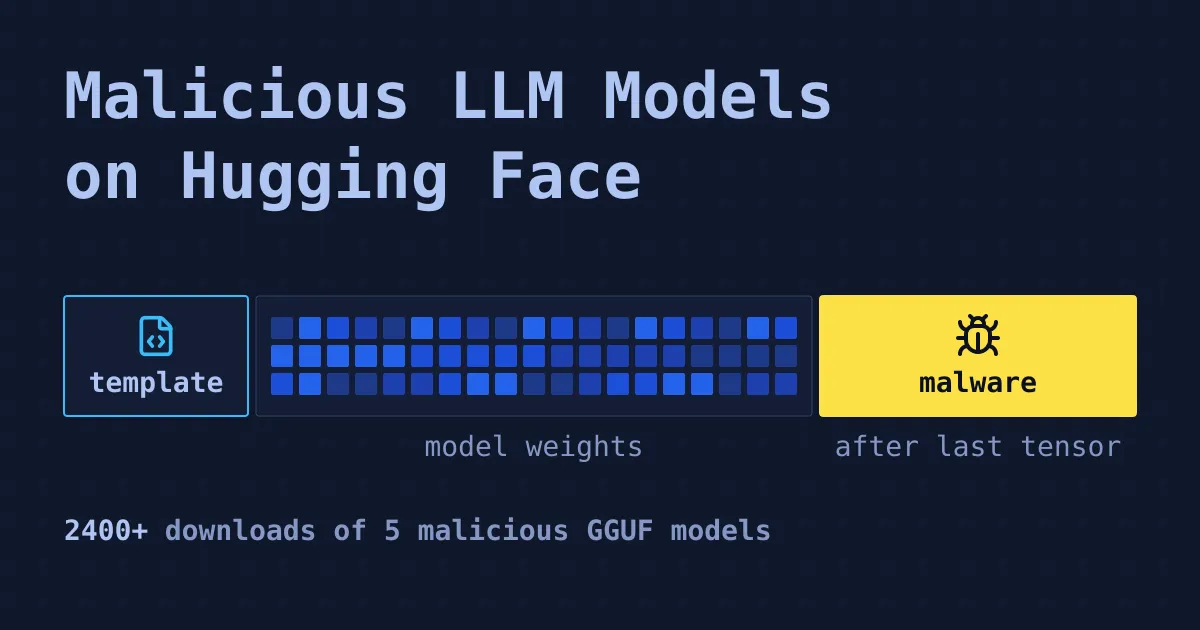
Malspark, a security firm, published its findings on November 27, 2026. Its scan covered 3,273,389 public Hugging Face model repositories on November 26 and found five malicious GGUF models from two uploaders, Mir2k and timdedid. The five repositories had 2,428 downloads as of November 27, up from 1,502 a day earlier, and almost all of that growth came from the two Mir2k models. Because Hugging Face counts downloads rather than people, the number of affected users is lower or equal.
The files used two delivery methods. In the first, a Windows remote access trojan sits in the bytes after the last tensor, a region that loaders never read, so the model still loads and runs normally. In the second, the chat template is altered so the model prints a PowerShell command at the start of each reply. That command hunts down the largest GGUF file in your user folder, copies the hidden program into your temp folder as d.exe and starts it. Malspark says the payload, called ollie, was built to steal saved browser passwords, target Phantom and MetaMask wallets and mine Monero.
Hugging Face has since disabled all five affected repositories, but an Ollama mirror from the second account was still listed on November 29. Malspark released gguf-radar, an open-source tool that flags poisoned templates and hidden trailing bytes. Malspark also urges model hubs and runtimes to reject GGUF files with data after the last tensor or with non-zero padding.
Why it matters
For companies that ship products on open-weight models, this shows a model file is not only data. A chat template can steer an assistant, and an agent with shell access can act on that output without a person reading it. Any pipeline that pulls GGUF files automatically, or lets an agent run commands the model suggests, now needs a scan step before a file is loaded.
Investors and acquirers are likely to ask how portfolio companies vet third-party weights, mirror them internally and track provenance. The main exposure sits on developer laptops and end-user machines rather than inside a hosted API, which makes incident response and liability harder to scope. Five files are a small share of the 3.27 million repositories scanned, but a single download is enough to infect an unprotected Windows machine.
Key points
- 1Malspark scanned 3,273,389 public Hugging Face model repositories on November 26, 2026.
- 2Five malicious GGUF models from two uploaders, Mir2k and timdedid, were identified in the scan.
- 3The five repositories had 2,428 downloads as of November 27, 2026, up from 1,502 a day earlier.
- 4One method hides a Windows trojan after the last tensor, where standard loaders do not read.
- 5Hugging Face has disabled all five repositories, though an Ollama mirror was still listed on November 29.